Embedding Deep Dive: Why Your Introduction is Crucial to AI-search
This boring introduction exists for a reason, and by the end of the article you’ll understand why.
Research consistently shows that AI-search systems give a lot of weight to the first 30% of text from an article. In this article I argue that this is at least partly caused by embedding models assigning more weight to the first part of a text in the eventual vector. I show this by inserting a disruptive piece of text (text about purple clowns) at multiple points in a normal article (about the pyramids of Egypt). The results show that placing the disruptive text at the beginning of the article has a bigger effect on the eventual vector than it has placing it later in the text.
Why this is important
So why is this important, why should we account for what part of your text embedding models like? Well, in AI-search you basically can’t get around appealing to these embedding models. AIs make use of them on both page and chunk level. Having a low page-level similarity to the query you are after can mean you are not getting considered at all for eventual citations. Since you are competing with lots of other pages, it can be worth it to squeeze out every percentage point of similarity you can get.
What is an embedding
I won’t go too much in-depth in this article, but for people still unfamiliar, embedding is a technique used to represent meaning of a piece of text (can be a word, a sentence or whole texts) in a string of numbers. These numbers stand for coordinates in an n-dimensional so-called embedding space. This means that you can calculate the distances of pieces of texts in this embedding space. Points that are closer together generally have a similar meaning.
The Purple Clown Experiment
In order to show that the first part of your text truly has a significant effect on the eventual vector, I’ll be doing a simple experiment. I’ll be inserting a disruptive paragraph at multiple positions in an article, and I’ll measure the differences in similarity to the untampered article.
I’ve had Claude write me a general, 6-paragraph article on the Egyptian Pyramids. I’ve also asked Claude to write me a single paragraph on purple clowns. This might seem completely unrelated to the Egyptian pyramids, but that is exactly the point! I want the expected effect to be clear to see.
I then inserted the purple clown paragraph at multiple points in the article and then embedded all these versions of the article.
Now the only thing that is left is to compare the distances between the tampered versions and the original article. Tampered versions that were farther away from the original article would have clearly experienced more disruption from the purple clown than the versions that were close to the original article.
Results: Is the introduction important to page-level similarity?
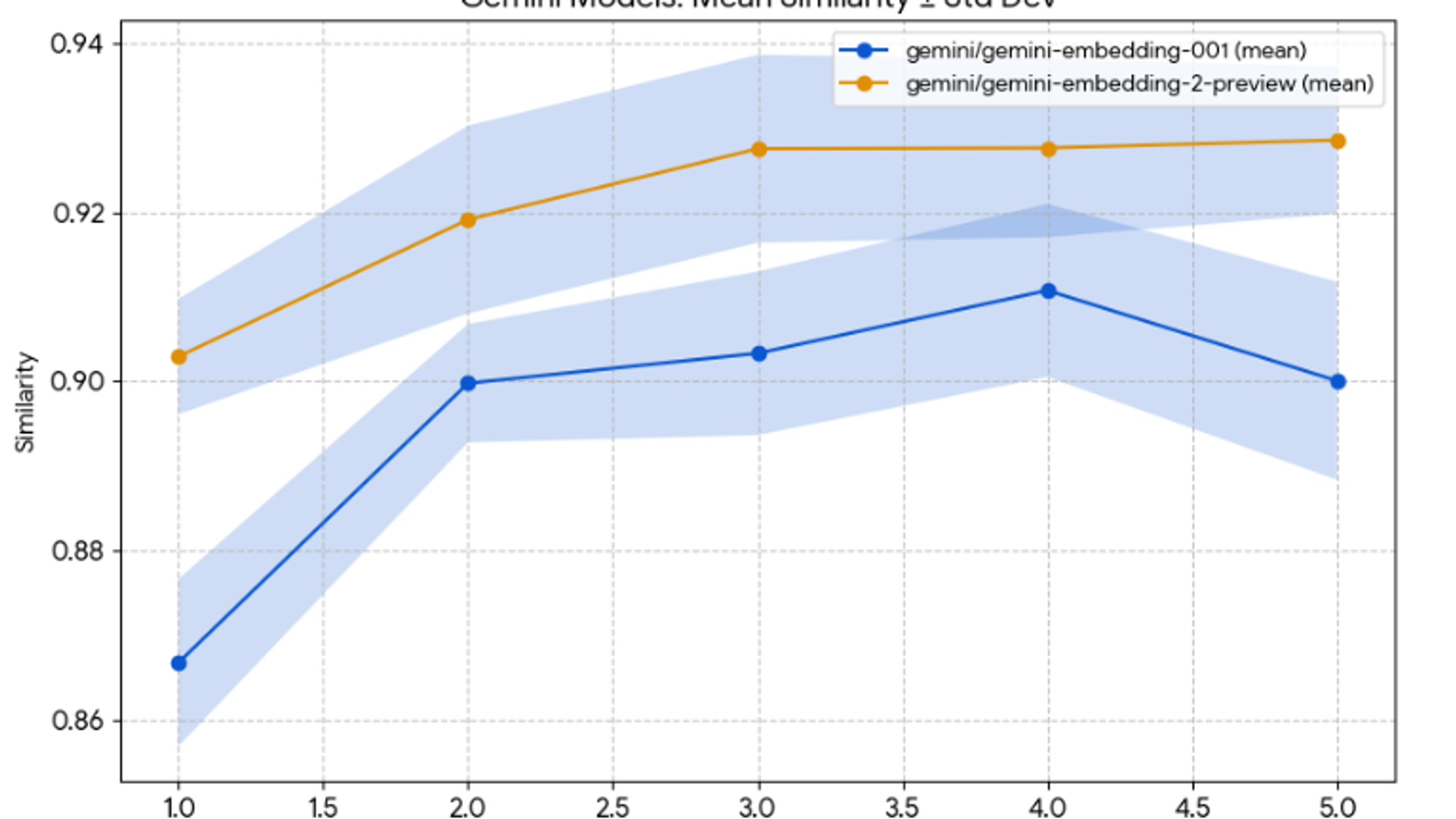
For Google / Gemini the first part of a text is most important
The results are clear as day! If the first paragraph in an article is unrelated to the rest of the article, this has a disruptive effect in the embedding model that can’t easily be solved. The first chunk pulls in the other direction so hard that the rest of the article has a lot of trouble pulling it back.
The result is most present in ‘gemini-embedding-2-preview’, Google’s more recent embedding model. You see there is a difference of 0.14 in similarity, in terms of embeddings this is a big gap.
Action Point: Make sure your introduction aligns with the rest of the text and the queries you are optimizing for. An irrelevant introduction like an anecdote might seem more enjoyable to read, but it leads to a disruption in the final embedding that is hard to fix.

For OpenAI / ChatGPT the last part of a text is actually more important
Surprisingly enough, OpenAI’s embedding models actually seem to assign more weight to the end of a text. Showing disruption in similarity of up to 0.40 when given an irrelevant conclusion, this is an insanely huge disruption showing that the conclusion of your text is crucial for proper page-level similarity in ChatGPT.
Action Point: Make sure the conclusion of your text aligns with the rest of your text and the query you are optimizing for. OpenAI seems to give the last part of a text disproportionate weight in giving the page-level embedding, so an off-topic or generic closing could be hurting your similarity more than you’d expect.

Sentences
In order to see if these embedding effects are persistent on paragraph level as well, I’ve performed the same experiment on all pyramid paragraphs! I’ve let Claude generate a single sentence about purple clowns, and I inserted that into every position between sentences, into every paragraph. For this experiment, both OpenAI’s and Google’s models seemed to align.
The first sentence of a paragraph has a lot of weight in the final embedding of that paragraph in all tested embedding models (gemini/gemini-embedding-001, gemini/gemini-embedding-2-preview, openai/text-embedding-3-small, openai/text-embedding-3-large). The mean disruption is especially big in the OpenAI embedding models, with a mean disruption of 0.14 in similarity. This effect is less present in Google’s embedding models where the difference was only 0.02 in similarity.
Action point: This suggests that the first sentence of each paragraph carries significant weight in how embedding models represent that paragraph. Since AI search systems typically chunk your content before embedding, this effect could directly influence which chunks get retrieved. It’s worth front-loading each paragraph with a sentence that clearly reflects its topic and the queries you’re targeting, rather than easing in with transitional or contextual filler.


Possible Causes
There are a few possible explanations for why embedding models assign more weight to certain positions in a text.
First, it could simply be a reflection of training data. Academic texts tend to front-load their key information in abstracts, and internet content generally follows a similar pattern; the most important information comes first. Models trained on this data may have learned to treat early text as more semantically important because, statistically, it usually is.
Second, there’s a technical angle. Most embedding models are transformer-based and use positional encodings that give the model awareness of where tokens sit in a sequence. Early tokens set the topical context and influence how all subsequent tokens are represented through the attention layers. By the time the model collapses everything into a single vector, those early tokens have already shaped the entire representation. This is related to the well-documented “lost in the middle” phenomenon in language models, where information in the middle of a context window receives less attention than content at the beginning or end.
Takeaways / action points
Here’s a summary of the key takeaways from this experiment:
- Front-load your introduction with topic-relevant content. Google’s embedding models give disproportionate weight to the beginning of a text. An irrelevant introduction can pull the entire page-level embedding away from the queries you’re targeting. Save the anecdotes for later.
- Don’t neglect your conclusion. OpenAI’s models showed the opposite pattern, assigning heavy weight to the end of a text. A generic or off-topic closing paragraph could be quietly hurting your visibility in ChatGPT. Make sure your conclusion aligns with your core topic.
- Start each paragraph with a clear, on-topic sentence. At the paragraph level, all four tested models agreed: the first sentence carries a lot of weight in the chunk-level embedding. This is especially relevant since most AI search systems chunk your content before embedding it.
- Different providers, different biases. Google and OpenAI handle positional weighting differently. If you’re optimizing for both, the safest strategy is to make sure both the beginning and end of your content clearly reflect your target topic.
Conclusion
So, embedding models don’t treat all parts of your text equally. Where you place content within an article, and even within a paragraph, has a measurable effect on the eventual embedding. For Google’s models, the introduction matters most. For OpenAI’s, it’s the conclusion. And at the paragraph level, all tested models agree: the first sentence carries the most weight.
This doesn’t mean you should stuff your introduction with keywords or write like a robot. But it does mean that the structure of your content directly affects how AI search systems see it. As the experiment shows, the differences are far from small.
You might have noticed that this article’s own introduction is unusually direct and summary-like. Now you know why.