PromptMarketing AI Influence Funnel: a better way to measure AI Search
By Arjan ter Huurne, March 31, 2026
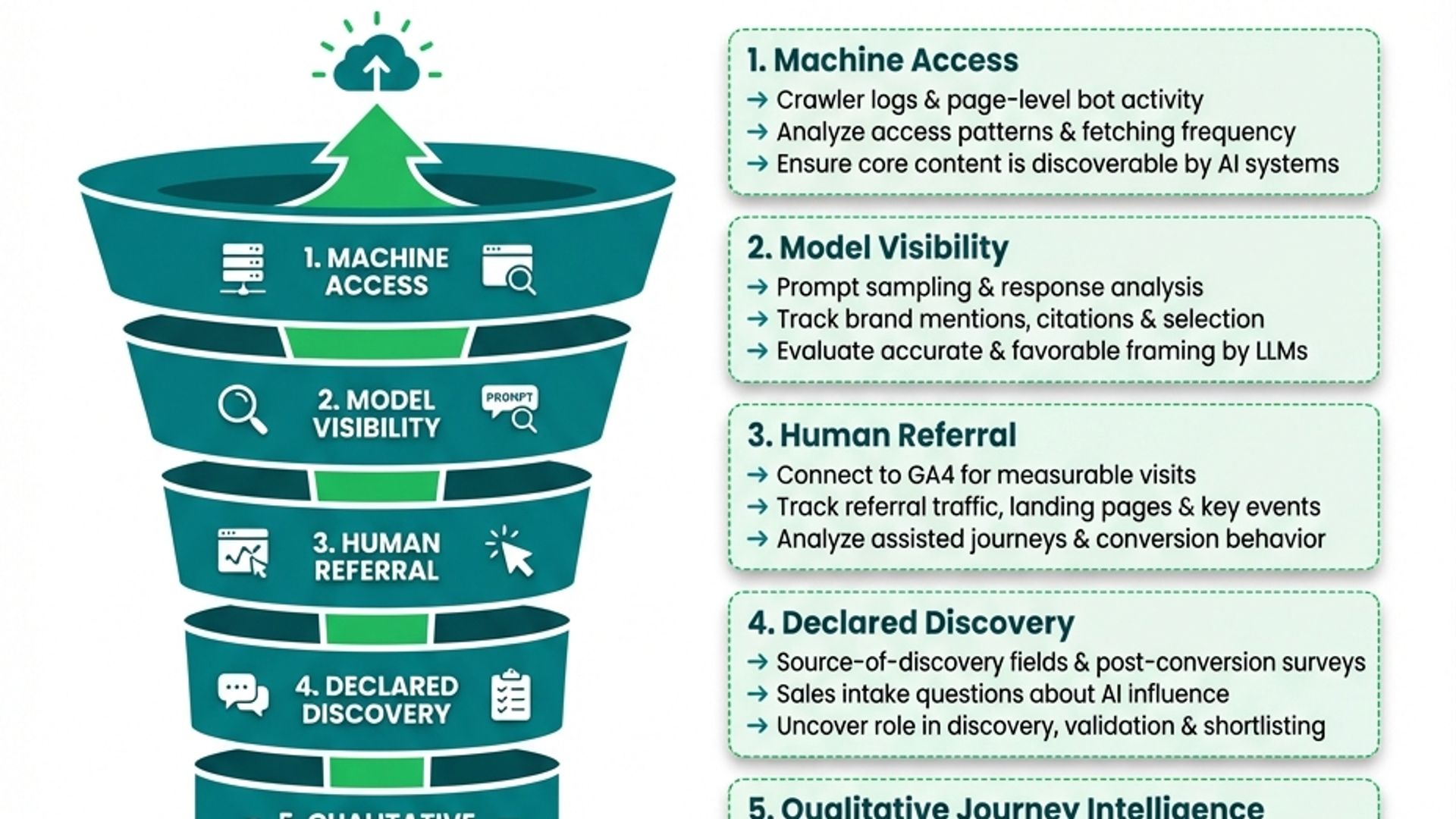
The PromptMarketing AI Influence Funnel: a better way to measure AI Search
For years, marketers have measured search with a familiar chain: rankings, clicks, sessions, conversions.
That no longer captures the full picture.
In AI Search, influence often happens before the click, without the click, or well before analytics can recognise it. A buyer might discover your brand in ChatGPT, shortlist you in Gemini, and only visit later via direct traffic or branded search. By then, the real source of influence is hard to see.
That is the problem the PromptMarketing AI Influence Funnel is designed to solve.
From machine readability to commercial outcomes
The framework has five layers:
- Machine Access - AI systems reach and read your content
- Model Visibility - LLMs mention, cite, select, and frame your brand
- Human Referral - AI platforms generate measurable visits and conversions
- Declared Discovery - Buyers report AI’s role in discovery and shortlist formation
- Qualitative Journey Intelligence - Research reveals how AI shapes the real customer journey
Together, these layers create a fuller view of AI influence than traffic data alone ever could.
Why old measurement falls short
Traditional search analytics starts when someone lands on your site. But in generative experiences, that is often the middle of the story.
Models now do more than retrieve links. They compare, summarise, recommend, and shape perception. Your brand can gain influence even when no visit happens immediately. Your content can inform an answer even when the user arrives later through another channel.
So AI Search needs a broader measurement model: not one metric, but a sequence of evidence.
1. Machine Access
The first question is simple: are AI systems actually reading your site?
This layer looks at crawler logs, page-level bot activity, and access patterns. It shows whether important pages are being reached and whether your content is even entering the machine-readable opportunity set.
It is an important starting point, but it is not proof of success. A crawler hit does not mean a mention, a citation, or a conversion. It only tells you that access exists.
2. Model Visibility
This is the strategic centre of the framework.
Once AI systems can access your content, the key question becomes: do they bring your brand into the answer?
Model Visibility measures four things:
- Mentions - are you named?
- Citations - are you cited?
- Selection - are you recommended?
- Representation - are you framed accurately and favourably?
These signals should be tracked across prompt buckets such as brand, comparison, informational, and commercial queries.
This is where brands often discover that AI does not see them the way they see themselves.
3. Human Referral
The third layer measures what happens after the answer: does AI visibility generate visits and conversions?
Here we look at GA4 referrals, landing pages, key events, assisted paths, and conversion outcomes from identifiable AI sources.
This matters because it links AI visibility to commercial behaviour. But it only shows the observable part of the picture. Many AI-influenced journeys will never appear neatly in analytics.
So referral data is valuable, but incomplete.
4. Declared Discovery
Analytics misses a lot. That is why the fourth layer asks buyers directly.
Declared Discovery captures what leads and customers say influenced their research through source-of-discovery fields, surveys, onboarding questions, and sales intake.
This helps recover hidden attribution. A buyer may first find you through an LLM, but convert later through another route. Standard analytics may miss that. A good survey can surface it.
It is not perfect, but it adds an essential human layer.
5. Qualitative Journey Intelligence
The final layer explains the behaviour behind the signals.
Through interviews, win/loss analysis, sales notes, and customer research, this layer reveals how buyers are actually using AI: where it enters the journey, which prompts matter, which proof points shape trust, and where your brand representation diverges from your intended positioning.
This is where measurement turns into strategy.
The real value: the insight loop
The funnel is not just a reporting model. It is a learning system.
What you learn from later layers should feed back into:
- prompt buckets,
- content priorities,
- technical optimisation,
- authority building,
- and measurement design itself.
That loop is what makes the framework useful. It does not just describe performance. It helps improve it.
No single metric is enough
One of the biggest mistakes in AI Search is looking for one new master KPI to replace rankings.
There is no single answer.
- Logs show access, not influence
- Prompt tracking shows visibility, not revenue
- GA4 shows measurable traffic, not total impact
- Surveys recover hidden influence, but imperfectly
- Qualitative research explains behaviour, but is not a KPI on its own
The right approach is to combine these layers into one coherent view.
A better way to measure AI Search
The PromptMarketing AI Influence Funnel is our answer to the measurement gap in the generative era.
It tracks whether AI systems can access your content, whether models use it, whether that generates measurable visits, whether buyers report AI influence, and how real customer journeys are changing.
That is a more honest way to measure AI Search.
And it is how we move from machine readability to commercial outcomes.
Launch your next big idea today
Join creators, teams, and startups already turning their ideas into reality. Get started in minutes and see how simple launching can be when everything works together seamlessly.
Try it for free!