This week in AI Search News: ChatGPT picks its shortlist before it opens a page, its fetch bot ignores robots.txt, French publishers go to the regulator, Anthropic marks everything Claude writes, Shopify counts AI referrals, and new citation data shows where visibility gets built.
ChatGPT picks its shortlist before it searches
Suganthan Mohanadasan analysed 57 ChatGPT conversations and 3,554 labelled pages, published on 14 August. He measured one moment: which brands ChatGPT types into its own search queries, before it fetches anything.
Brands in those self-written queries were named in the final answer 68.9% of the time. Brands that only turned up in the pages ChatGPT fetched were cited 2.1% of the time. Being in the query is worth roughly 33 times more than being findable.
The model arrives with a shortlist already set. The fetch mostly confirms what it was going to say. Your pages compete for second place, and first place was decided before the prompt was typed.
What our own fanout data shows
We track query fanout, the sub-queries a model writes for itself. In the 30 days to 17 August, four client accounts logged 12,326 sub-queries against 235 tracked prompts.
ChatGPT expands almost every prompt, at 1.4 to 1.7 sub-queries per response. Perplexity sat at 1.0 in all four accounts. Perplexity searches the question it was given. ChatGPT rewrites it first. The shortlist effect is a rewriting effect, so today it is mostly a ChatGPT problem.
What ChatGPT writes into those rewrites differs sharply by category. In a B2B manufacturing software account, unbranded prompts came back carrying vendor names the user never typed. "Top supply chain planning tools for multi-plant manufacturers 2026" produced sub-queries naming Kinaxis, o9, Blue Yonder, SAP IBP, Anaplan, Oracle and PlanetTogether, several with Gartner attached as an authority cue. Two pointed site: operators straight at vendor domains.
In three other accounts, a marketplace software vendor, a Dutch window supplier and a Dutch clinic, that did not happen. Unbranded prompts produced generic reformulations about cost, subsidy, materials and procedure. No supplier was named. Brand names entered the fanout only when the user's prompt already contained them.
So the 33 times premium applies only where the model already holds a shortlist. Where it does not, the fetched pages still decide the answer. That is the lane a challenger can win.
Comparison prompts blow the fanout wide open. In the Dutch supplier account, prompts naming four suppliers at once produced up to 4.6 sub-queries per response and 141 distinct sub-queries from one prompt, against roughly 1.2 for a single-topic question.
Our view: AI visibility is built off your own website. What the model associates with your category comes from how other people describe you across the open web. Your own pages still decide whether you survive the confirmation step. Once ChatGPT has pre-named a brand, it goes hunting for that brand's official pages, sometimes with a site: query. The shortlist gets you searched. Your pages decide what it finds.
Your robots.txt does not stop ChatGPT's fetch bot
TollBit's State of the Bots report for the first half of 2026 was covered on 14 August. ChatGPT-User reached disallowed pages on more sites than any other bot. On European sites that named it in robots.txt, it reached blocked URLs on almost half of them. Around 15% of identified AI page fetchers reached disallowed URLs on European sites.
OpenAI's documentation explains why. ChatGPT-User fetches a page because a user asked a question in that moment, so OpenAI treats it as an action by a person and says robots.txt may not apply. Fewer sites disallow Claude-User and Perplexity-User, so the pattern is sharpest around OpenAI.
Digiday reported the same day that European publishers are hit harder than North American ones: more scraping, fewer referrals, more ignored robots.txt rules.
Your robots.txt records what you asked for. Your server logs and CDN records show what happened. To keep ChatGPT out you have to block ChatGPT-User and OAI-SearchBot, then verify it in the logs. Most brands we audit have the opposite problem. They block AI crawlers by accident, never check, and then ask why they are missing from AI answers.
Three hundred French newspapers take AI Overviews to the regulator
APIG, the alliance representing nearly 300 French newspapers, filed a complaint with France's competition authority on 11 August. The publishers say Google switched on AI Overviews in France without their consent and broke a 2022 compensation agreement. The AI summaries answer the question inside Search and cut traffic to the original articles. APIG president Marc Feuillee said the publishers want the value shared and the use of their content compensated.
France fined Google 250 million euros in 2024 over the same neighbouring rights file, and an EU investigation into Google's use of publisher content for AI is still open. Google says AI Overviews help people ask harder questions and still send them to new content.
Our own sweep of business communities on 2 August found France is the only European market with live, findable demand for AI visibility help. Dutch and German demand was effectively zero across roughly 100 sub-restricted searches. Every fresh French complaint thread postdates the AI Overviews launch there on 22 July. The publisher complaint and the business owner reaction are two symptoms of one event, three weeks apart.
Anthropic marks everything Claude writes, and the mark is weakest where it earns most
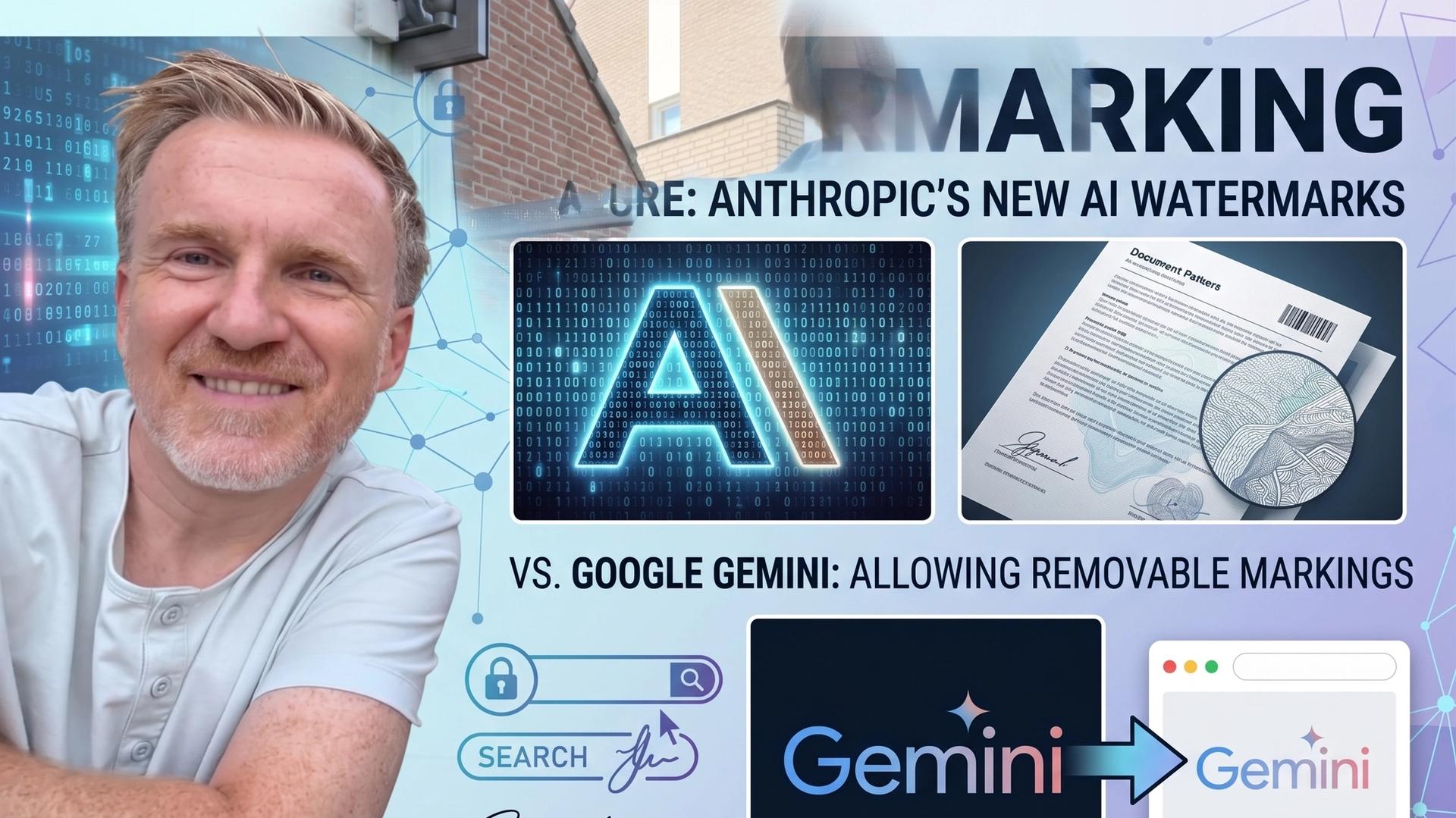
On 11 August Anthropic started embedding machine-readable watermarks in Claude's text. It covers Claude, the Claude API, Claude Code, Claude Cowork and Claude Tag. Models released on or after 2 August carry it, and Anthropic is retrofitting older ones. Generated PNG, JPG and SVG files also get signed C2PA provenance metadata. The commitment comes from the EU AI Act code of practice, but Anthropic switched it on everywhere Claude operates, not only in Europe.
Anthropic revealed the mechanism on 15 August. There are no hidden characters and no metadata in the text. The model changes the source of the randomness it uses to pick the next word. A secret key and the preceding words decide which candidates get a small lift, so the text carries a statistical pattern that only a key holder can read. It is a version of Google DeepMind's SynthID-Text, published in Nature in 2024. It costs no extra tokens and almost no speed.
Our colleague Felix Koole wrote the clearest explanation we have read on 15 August. He describes a loaded coin toss across the model's roughly 100,000 possible tokens, with the previous three tokens deciding which ones get lifted. Detection then asks whether those lifted tokens keep reappearing across a document. You can rewrite 40% to 50% of the text by hand, or move to a model that does not watermark, but both cost more than they return. "The best option seems to me to just accept it." He adds that the taboo has come off AI writing, and that text written by people tends to do better anyway.
Anthropic's caveats are blunt. A watermark does not prove Claude wrote the ideas or the original text, and a missing watermark does not make text human. Search Engine Journal listed five ordinary ways marked text comes back clean on 14 August: an older model, heavy editing or paraphrasing, a passage under 200 tokens, metadata stripped by a format conversion, and unsupported mark types. A hit only means Claude touched the text at some point. That could be a translation or a proofread.
Henning Steier made the sharpest point on 11 August. A watermark needs choice to hide in. In low-entropy output such as code, tables, JSON and short factual answers, the model has few valid alternatives, so there is little room to encode a pattern. That is also the densest part of Anthropic's business, with Claude Code at a $2.5 billion annualised run rate by February. Agentic workflows make it worse, because every formatter, compiler and refactor pass is another rewrite. The mark is weakest where the product earns most.
Our view: treat this as a labelling standard, not a detector. Nobody outside Anthropic can calibrate it yet, because the detection tools and documentation are still to come. Felix puts the removal threshold at a 40% to 50% rewrite, Anthropic says only a full rewrite clears it, and that gap is unverifiable today. It is also the number every AI-detection vendor will soon claim to know. Your exposure is not your own blog. It is a client, a journalist or a marketplace running a detector on your content and reading a hit as proof of authorship, or a miss as proof of a human. Both readings are wrong. Keep your own record of how a piece was made. That is evidence. A watermark is not.
AI referrals convert well, and they are still small
Shopify released second quarter commerce data, reported on 13 August. AI-referred sessions to merchant storefronts grew 197% year over year. Organic search grew 12%. Organic search still sent more traffic to Shopify merchants than every tracked AI platform combined.
In specification-heavy categories, AI-referred shoppers converted at about twice the rate of organic visitors. That doubling showed up when AI systems used structured Shopify Catalog data. In broader categories, AI brought in about 1.3 times more first-time customers.
Digiday published the matching problem the same day: CMOs cannot link AI visibility to sales. 73% of marketers have already bought monitoring tools such as Scrunch and Profound. Those tools estimate how models describe a brand. They do not measure revenue. Teams triangulate instead, mixing visibility scores, paid ChatGPT conversion data and media mix models. The same piece notes B2B brands saw ChatGPT-referred visits rise 303% year over year, from 645,000 to 2.6 million between June 2025 and June 2026.
Our view: take both halves to your board. The volume is still a small share of your traffic, and the visitors are worth more per session than your average organic visitor. The one lever you can pull this quarter is structured product data, because Shopify just showed it doubles the conversion rate of the traffic you already get.
The two places AI visibility gets built
Kevin Indig published an analysis of roughly 35,000 ChatGPT citations on 12 August. He measured the share of unique cited domains, with vendor domains excluded. User-generated content platforms hold 17.1% of cited domains. Publishers hold 4.0%. Wikipedia is the largest single third-party source at 10.1 to 14.0 points. Reddit is significant but volatile, and LinkedIn is growing for named individuals.
Review platforms swing from 7.4% at discovery to 13.2% at evaluation. UGC stays between 15.1% and 18.2% across all four stages. Indig's summary: review platforms are a reliable bottom-of-funnel lever, and UGC is a floor.
Stanley 1913 did the other half of the work. Digiday reported on 12 August that the brand rewrote its product pages for AI answers. It added product-level FAQs, care instructions and occasion-based copy where it used to rely on images. It added structured data to keep product facts consistent across search and chat. It is testing Shopify and Google's Universal Commerce Protocol to get its catalogue into conversations. It tracks which third-party sources AI tools treat as authoritative. Chief Brand Officer Kate Ridley said the aim is to keep the brand's voice intact inside natural-language answers.
Our view: read this next to the shortlist research at the top. Your own pages decide whether you survive the confirmation step. Other people's communities decide whether you reach the shortlist at all. Stanley is doing both halves, and the second half is the one most brands skip.
In the GEO and marketing communities we work in daily, the question is not how to get cited. It is how to prove a fix worked when four things ship every week. Group the work by claim instead of by calendar, so no two changes touch the same fact in the same window. And check your AI answers from a clean logged-out session, because a check from your own account trends on your own chat history.
Also noted
• OpenAI is moving the sources button out of the response footer and into the three-dot "More actions" menu. Fewer people will click through to you from the same citation.
• Scrunch tracked an opt-in panel from February to June and found only 1.1% of news publisher visits carried an AI referrer. Around 75% of visits after an AI chat were direct, and large publishers took 97% of the follow-through.
• SE Ranking studied 50,006 prompts and found ChatGPT shows ads on 25.94% of commercial queries, while more than 14% of those ads appear for the wrong topic.
• Microsoft Clarity now splits AI citation queries into branded and non-branded. Only the non-branded half counts as discovery.
That is the week. If you want to know what any of this means for your own AI visibility, our door is open.