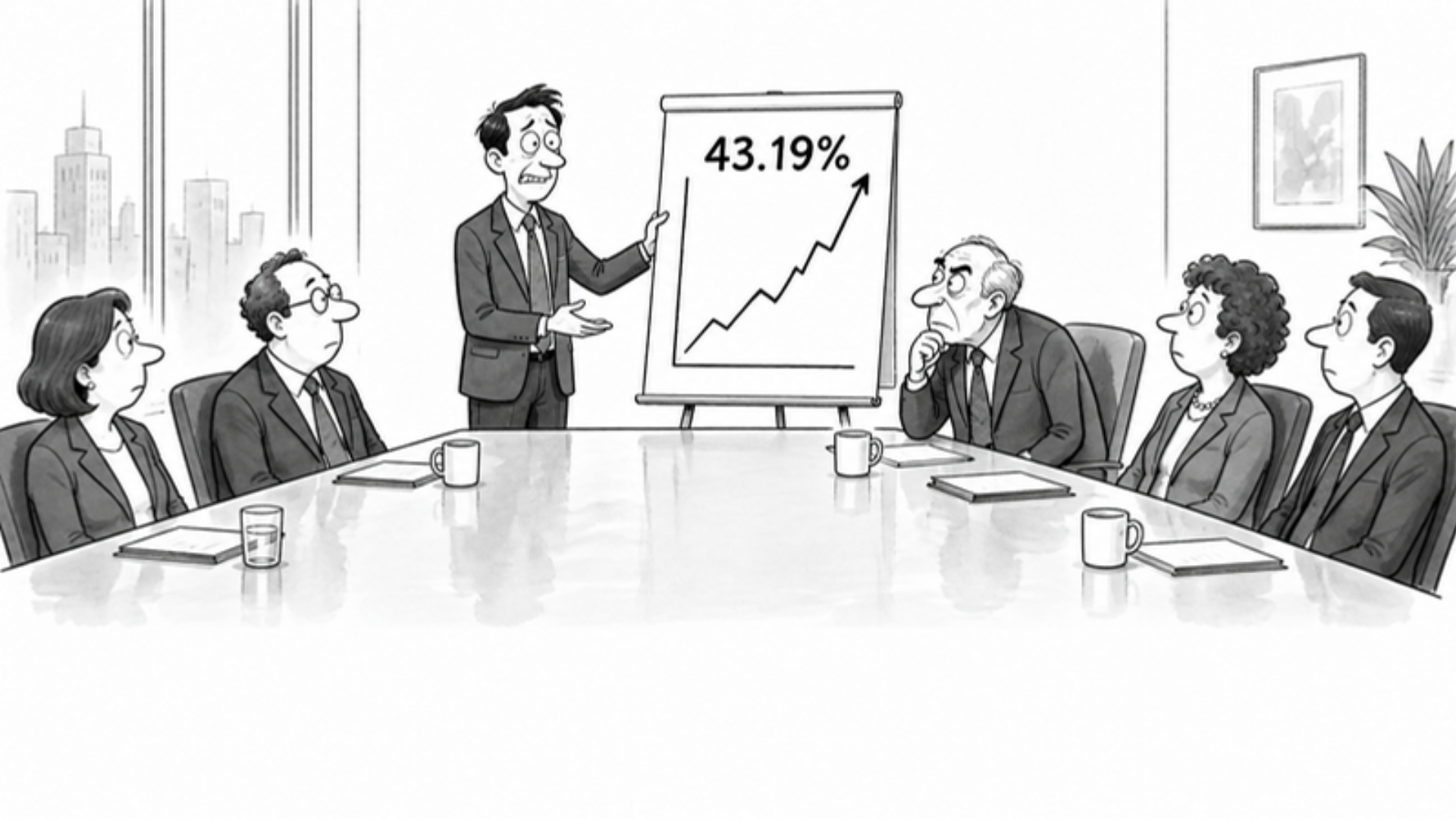
Every tool in the market says it does "AI search visibility tracking". Then it hands you a number, say 43.19%, and tells you to take it to the board. Yesterday, in the first session of our webinar series, I tried to explain what is actually behind that number, and why the honest word for it is sampling, not tracking. This post is the short version. The replay and the slides are below.
Two things nobody knows
In Google we had two things: the query and the volume. In AI search we have neither.
We do not know what people prompt. There is no query report, no Search Console for ChatGPT. The question is formed in the buyer's words, in a chat window we cannot see.
And we do not know how often. No prompt volume exists. Nobody publishes how many times a question is asked to ChatGPT, Gemini or Copilot. Vendors that show "prompt volumes" buy panel data from browser extensions, which never see the apps. It is a useful signal. It is not a count.
Everything we build works around these two blanks.
Where the clicks went
AI influence hides from your analytics in two ways. First, there is often no click at all: the shortlist is formed inside the answer, and the interface does not invite you to leave. People read, decide, and then search the brand on Google or type the URL. That shows up as organic brand or Direct, never as AI.
Second, when there is a click, the label often does not survive. The iOS ChatGPT app hands the link to the browser and the referrer and UTM get dropped on the way. And sometimes the vendor breaks it: for about a week in October, ChatGPT stopped adding its UTM parameter to outbound links, and sites saw their ChatGPT sessions in GA4 drop by roughly half while Direct rose. The visits did not go away. The label did.
So the standard we hold ourselves to is the one Simone De Palma put on a slide at BrightonSEO: tracking AI visibility is not about perfect attribution but about directional clarity.
What a sample is
Here is what the tools actually do. You give them a panel of prompts. A headless browser, logged out, with no history and no subscription, types each prompt into the engine from a chosen location, and repeats that every day. The tool reads the answer and records whether you were named, cited, recommended or caveated.
That is a sample. It is not what a logged-in user sees. It is the engine's default answer, which is the closest thing to a public baseline that exists, and nothing more.
Two consequences. One answer proves nothing: on one of our client prompts, one engine named the brand in 2 of 14 daily runs, and the shortlist of competitors changed almost every day. A 14% mention rate is information; one screenshot is an anecdote. And sampling tells you who gets named and how you are described, but not how many people asked, what they did next, or what a personalised answer said.
The AI Influence Funnel: four layers
Sampling is one layer of four.
- Machine Access. Can the engines reach and read you? Read the raw server logs, not the analytics. Separate the three kinds of crawler: training bots (GPTBot, ClaudeBot), index builders (OAI-SearchBot, Bingbot, Applebot) and the live-search fetchers that decide whether you are cited today (ChatGPT-User, Perplexity-User). Verify every request against the published IP lists; on one client site, counting by user agent alone overstated OpenAI's crawl by three times.
- Model Visibility. The sampled panel, read through six metrics: mention rate, citation rate and share of voice for the Visibility axis; position, sentiment and accuracy for the Representation axis. Plot the two and you get four quadrants: Invisible Brand, Hidden Expert, Misrepresented Brand, Category Leader.
- Traffic. AI assistants as a channel group in GA4. Build it, read it weekly next to Direct, and never present it as the full picture. This is the layer that broke in October.
- Surveys and Conversations. One survey field ("Where did you first hear about us?" with AI assistants as an option), one CRM field filled by sales, and ten customer interviews a quarter. This is the layer that survives a tagging bug.
The arrows between the layers are the correlation analyses: do the pages the crawlers fetch become the pages the engines cite? Does a move in share of voice show up in AI referrals a few weeks later? Do the GA4 sessions match what buyers report?
Expected Prompt Behaviour
If there is no prompt volume, how do you pick the prompts to sample? Not by brainstorming. We derive what we call Expected Prompt Behaviour from seven real demand signals: keyword research across organic and paid, Google Search Console queries, People Also Ask, Bing's grounding queries (ChatGPT retrieves through Bing), Reddit and forum threads, review platforms, and sales call transcripts. Mine, translate into conversational form, tag by funnel stage and persona, dedupe, score with the demand proxy named next to the score, select by coverage rules rather than top-N, and freeze the panel as a version so month three compares with month one.
We run four panels per client. Informational prompts, monthly, to learn which sources the engines trust in the category. Commercial prompts, daily, the money stage and the one panel we fight to win. Brand prompts, weekly, to check accuracy and sentiment. Competitive prompts, weekly, to see who wins head-to-head and why. One panel to win, three to learn.
Replay, slides and what is next
The full session is on YouTube: watch the replay of webinar 1. The slides are here: download the PDF. The one-page scorecard, four layers and what to measure in each, is in the replay mail to everyone who registered.
Session 2, Engineer: content, technical signals and authority, is Tuesday 27 October at 11:00 Amsterdam time on LinkedIn Live. Session 3, ChatGPT Ads, a masterclass, follows on 3 November. Registration for both: promptmarketing.com/webinars.
If you want to know where your own brand sits today, the free GEO Audit is the first read. For a proper sampled panel and the six metrics across nine engines, that is our Understand service, from EUR 2,000 per month.