This week in AI Search News: Anthropic and Google write the GEO shortcuts into policy while a 50 dollar site of fake statistics still feeds ChatGPT, two studies put three in four of your citations on pages you do not own, Google builds Reddit a fast lane into Search, and ChatGPT Ads get pictures and attribution partners.
Anthropic and Google write the GEO shortcuts into policy, and 50,000 fake statistics still feed ChatGPT
Anthropic published its 2026 usage policy on 8 October, in force from 12 November. A new section, "Do Not Engage in Deceptive Campaigns or Artificial Activity," bans using Claude to "manipulate the sources from which search engines or AI systems draw answers by seeding them with content that misrepresents its origin, authorship, or independence." The example is "networks of sites posing as unaffiliated sources corroborating the same claims." Selling that work as a service is banned too. The 2025 version did not mention search engines or AI answers, Anthropic, the policy and Search Engine Journal on 9 October. Google's spam policies have covered manipulation of generative AI responses in Search since May. Google enforces against sites, Anthropic against the account that produced the content.
Google added its own line the same week. Its helpful-content guidance now says: "avoid using deceptive authorship information. Fabricating creator profiles (such as by using AI-generated headshots, made-up names, or false credentials to make content appear as if it was written by human experts) is a form of deception," and calls it "a signal of a low-quality page," Google and Search Engine Roundtable on 6 October. Marie Haynes reports manual-action requests going "from essentially no requests to several per week," for thin content, pure spam and scaled content, mostly at "legitimate long standing businesses," Search Engine Roundtable on 8 October. At Search Central Live in Barcelona Google said it runs more spam updates because there is far more new content, and that it uses AI to find it, Search Engine Roundtable on 5 October. The September spam update completed on 8 October after 13 days and 16 hours. The three earlier spam updates this year took under three days each, Search Engine Roundtable.
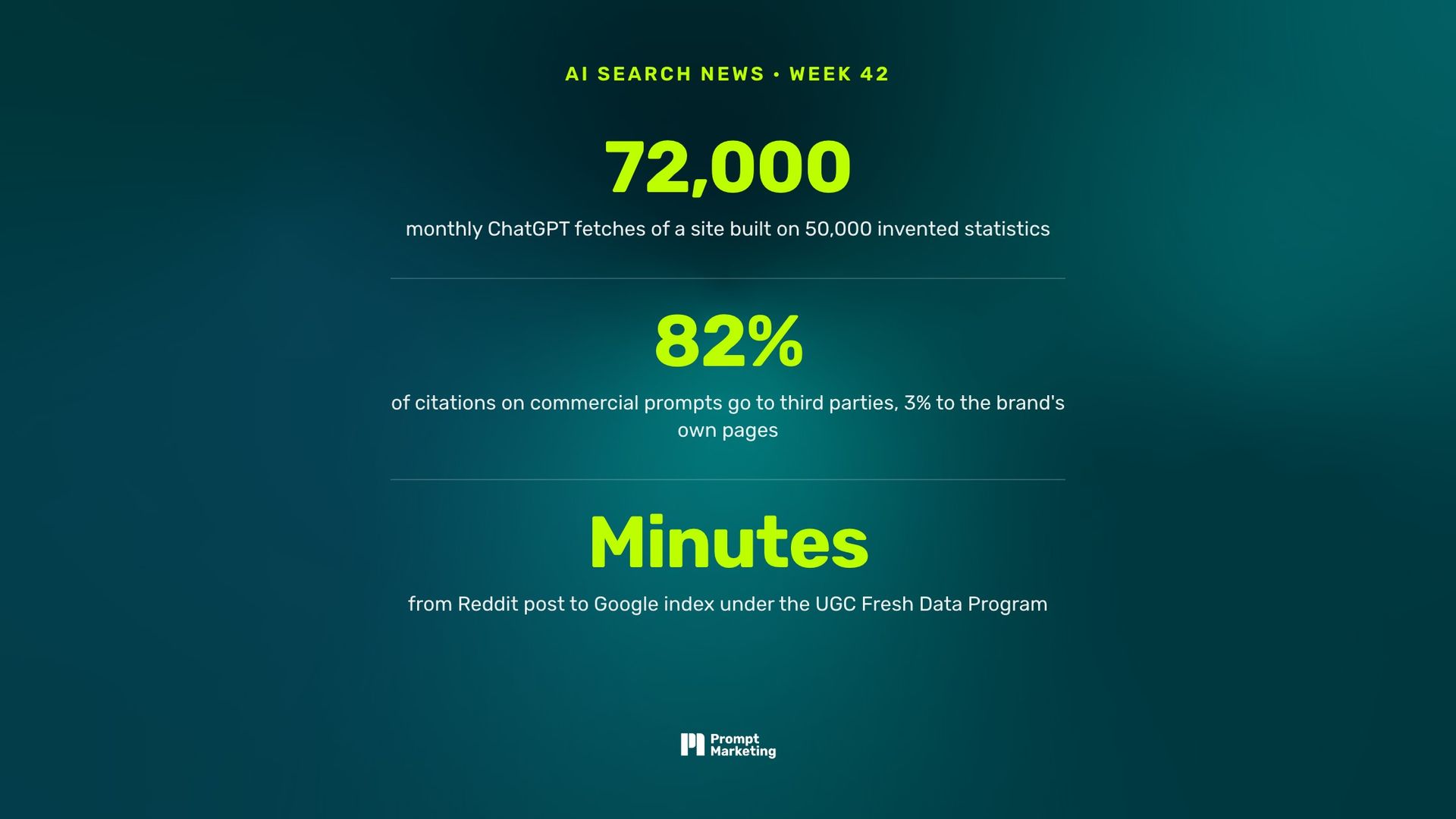
The experiment that shows why the policies exist: Metehan Yeşilyurt of Peec AI bought a new domain in March, generated 50,000 statistics pages in one day with GPT-4.1, every number invented, added 15,000 listicles, and spent about 50 dollars. Two Google updates later the site gets 5 to 20 impressions a day. ChatGPT never left. In the last 30 days the site took 600,000 bot requests, about 72,000 from ChatGPT-User, the agent that opens a page while answering a real question. Since March it has sent more than 10,000 ChatGPT sessions, earned links from more than 330 domains including Shopify, DHL and Bluehost, and its numbers appear in an academic paper and in the investment research of Qatar's largest financial group. On 7 October the site ranked second on its tracked prompts, behind Statista, metehan.ai on 7 October. His explanation: an LLM writing an article runs fan-out queries for "[topic] statistics 2026," takes the first specific number that matches, and nothing in the pipeline checks whether it is true. Rerankers score relevance, not truth.

Our view: statistics pages, networks of "independent" sites and expert bylines are the GEO playbook in half the vendor decks we see. Two policies now name it, and Google enforces with manual actions. The tactic still works on ChatGPT, which is why both companies wrote it down. Publish statistics with real data, one claim per sentence, source and year next to each number. Put a real name only where a real person did the work. And ask the agency that reports your citations whether any of the "independent" sites in that report belong to them.
Three in four of the pages that cite you are written by someone else
Searchable analysed 1.8 million AI answers from 24 August to 20 September across ChatGPT, Perplexity, AI Overviews, AI Mode, Gemini and Copilot. On comparison prompts, "X vs Y," "alternatives to," "better than," Perplexity used comparison pages 10.9 times as often as on the same brand's other prompts, AI Overviews 9.7 times, ChatGPT 3.2 times. On every other prompt comparison pages were 1% to 2% of the sources. 75% of the comparison pages the engines used came from third parties, the same share as for guides, how-tos and ranked lists, 77%. Then the test that matters: 117 brands whose own site started being cited between July and August. The 47 with a new comparison page went from 13.5% to 15.6% of non-branded answers naming them. The 70 with a new guide went from 13.1% to 15.0%. The difference is 0.2 points, with a range from minus 1.3 to plus 1.9, Searchable on 8 October.
NP Digital's Nikki Lam found the same in a larger set: 9 million AI answers across nine platforms and more than 400 enterprise brands, published on 30 September and shared again by Writesonic this week. On commercial-intent prompts 82% of citations went to third parties and 3% to the brand's own pages, against up to 13% owned on informational prompts. 64% of citations came from ordinary pages, not listicles, comparisons or how-tos. YouTube gave the strongest third-party lift at 2.8 times, ahead of LinkedIn at 2.7 and Reddit at 2.4. An owned citation lifted visibility 5 times. Up to 58% of citations never reappeared, owned pages lasted 3 to 9 times longer than third-party ones, and up to 75% of answers that cited a brand's page did not name the brand, NP Digital and Search Engine Land.

What we see ourselves
Our own-brand tracker runs 31 Dutch prompts about choosing an agency, since 24 August. The engines answer "best GEO agency in the Netherlands" and "what to look for in a GEO agency" from five pages written by competitors and trade media, cited 140 to 414 times each in the last 30 days. PromptMarketing's GEO pages are not cited on those prompts. The one page of ours that is cited, 162 times at an average rank of five, is the ChatGPT Ads agency page, because it says what the service costs and what to expect. Searchable's three in four is our five out of five.
Our view: build the comparison page for the comparison prompts you track, and judge it on those prompts after more than a month, not on your overall mention rate. The page that names you in a category is written by someone else three times out of four. The PR work on those pages, inclusion, corrections and a quote, deserves the same budget as the page on your own site.
Google builds Reddit a fast lane, and translated Reddit answers Europe's shopping questions
Google documented its UGC Fresh Data Program on 8 October. Approved platforms get "a dedicated data ingestion pipeline to send content and interaction signals to Google," separate from the Indexing API and from crawling. The platform must host user-generated content on stable URLs, be large, keep content public and attributable to a creator with a public profile, carry DiscussionForumPosting or SocialMediaPosting markup with interaction counts, send new content "ideally within minutes," and update engagement counters within 72 hours. Google answers applications in six to eight weeks and promises nothing about appearing in Search, Google and Search Engine Roundtable. Google names no platform. The criteria describe Reddit.
The same week the RSS feeds resurfaced a Peec AI study from June on what Google does with Reddit abroad. Across 64.77 million Reddit citations in 20 countries from 1 March to 10 June, 3.7 million pointed to Reddit's own machine-translated pages, the ones with the ?tl= parameter. Google AI Overviews served translated threads in 8% to 11% of its Reddit citations and AI Mode in 10% to 14%. In Germany 52% of the Reddit threads AI Overviews cited were translated English threads, in Sweden and Norway more than 70%, in Spain AI Mode reached 72% in June. ChatGPT went the other way, from 6.14% translated in April to 0.66% in May. Gemini stays under 1% and Perplexity never cited a translated page. In Germany the translated citations sit on buying questions: bags, hardware, soundbars, cars, business software, and a German asking for the cheapest supermarket gets an English r/AskGermany thread in translation, Peec AI, 22 June. The Netherlands is not named in the published breakdown.

What we see ourselves
Our daily Reddit run has read the Dutch subs, r/ondernemen, r/FreelanceNL and r/ZZPNederland, fourteen days in a row without one thread about AI visibility, GEO or ChatGPT Ads. The one Dutch "best GEO agencies" listicle on Reddit sat at 3 points and one comment after a week. The English threads on the same questions get answers within the hour and, with a fast lane into Google, soon within minutes. Dutch buyers who ask Google a shopping question will read those English threads in Dutch, translated by Reddit and cited by Google. A French freelancer created r/ChatGPTAdsFrance this week after his first campaign question in r/OpenAIAdvertising, so the French side is building its own supply.
Our view: Google is making Reddit a primary source with a service level, minutes to ingest and 72 hours for the vote counts. For a Dutch brand the English thread about your category is now a Dutch-market source. Filter your citation tracker to reddit.com and look for ?tl=nl. Then answer in English, in the subs where your category is discussed, under your own name, with the disclosure. Nobody is writing the Dutch thread, and Google will not wait for it.
ChatGPT Ads get pictures, attribution partners and the first incrementality numbers
OpenAI announced a visual ad format on 5 October. It appears while ChatGPT generates an image for users on the Free and Go plans, labelled and kept apart from the image. OpenAI repeats that "advertising does not influence the answers ChatGPT provides." The test starts later this month in the US with a first group of advertisers, with no targeting, pricing or creative specs published, OpenAI, TechCrunch and Search Engine Journal.
The measurement part is larger. Hightouch, Tealium and LiveRamp can push conversion data from your own systems into ChatGPT Ads. Ten attribution partners handle Conversions API, reporting and click attribution: AppsFlyer, Triple Whale, Adjust, DV Rockerbox, Northbeam, Branch, Singular, Kochava, Airbridge and Tenjin, plus Fospha, Measured and INCRMNTAL for full-funnel work. Haus, Measured and WorkMagic run geo-based incrementality experiments, which OpenAI calls "early stages." Kantar and Cint test brand resonance. Qualifying advertisers get Negative Phrases to keep ads out of named contexts, and DoubleVerify and IAS run brand suitability pilots without reading real conversations. OpenAI's numbers: 52.7% of eligible one-day view-through conversions happened within an hour of the impression, with no click. WorkMagic's geo-lift study for Dose counted 2.3 times more incremental orders than last-click captured. WeightWatchers' attributed CPA came in 15.3% under its paid-search benchmark, and 93% of Portland Leather's visitors from ChatGPT Ads were new, OpenAI Ads blog.
Digiday heard the other complaint at Advertising Week New York: inventory. Zeno Group's Shamsul Chowdhury put it at about 2.5 billion prompts a day against 15 billion Google searches, with one ad placement per conversation, Digiday on 5 October. OpenAI's Samantha Jacobson said at the same event that "knowing who the person is, I think matters less" than what the person is trying to do in the conversation. The ads business reached a one billion dollar run rate at the end of August, with tens of thousands of advertisers in more than 40 countries, and reportedly targets 2.5 billion dollars this year, Digiday on 8 October.
What we see ourselves
The measurement gap went viral. A small webshop owner posted "ChatGPT Ads = TOTAL SCAM" in r/OpenAI on 8 October: 50 dollars a day, 7,652 impressions and 64 clicks within two hours, while Google Analytics, Hotjar and Shopify showed 24 visitors that all predated the launch. Two days later the thread stood at 261 points and 60 comments, r/OpenAI. Arjan answered in the thread: nearly every ChatGPT Ads click comes from the phone app, which opens the page in an in-app browser, and a consent banner that holds analytics until someone accepts means the visit never reaches GA. The server access log with chatgpt.com as referrer settles 64 against 24 in an evening. In our own three-webshop case across NL, DE, AT and FR, the dashboard reports 3.0 times the spend back on its own attribution and 0.7 on click-through orders, at 2.4% CTR and 0.44 euro per click. A French freelancer in r/OpenAIAdvertising showed the other side of conversation targeting: a B2B solar installer, 60 clicks at 1.67 euro, and seven calls from private homeowners, because the context hint said "solar panels" and ChatGPT placed the ad under consumer questions.
Our view: the measurement stack now exists, in the US and through US vendors. The three partner numbers are three claims, not a benchmark. The geo test is the one that counts, because it is the only method that answers whether the orders would have come anyway. Until your own order export matches the dashboard, read the ROAS as the platform's claim. Write the context hint as a buyer situation, not a product name, or conversation targeting finds the wrong buyer. And check the pixel: OpenAI's documentation says it "initializes consent to true by default" unless your code sets it to false before init, so on a Dutch site it measures before the banner unless a developer wrote that line, OpenAI developer docs.
Also noted
• Digital Content Next collected the year's publisher evidence on 5 October. Chartbeat data from 2,576 sites: Google Search referrals down 33% worldwide between November 2024 and November 2025, 38% in the US. Google Search was 7.3% of publisher referrals, Discover 13%, ChatGPT 0.02% and Perplexity 0.002%, so Google Search sent about 500 times the traffic of ChatGPT, Digital Content Next. The Verge puts a hard registration wall in front of a cohort of readers later this month, and one publisher told Digiday registered readers earn up to eight times the programmatic rate, Digiday on 8 October.
• The same 0.02% looks different from the brand side. Ahrefs says more than one in five people who sign up for its product name ChatGPT or Claude as where they found it, ahead of YouTube and second only to Google, and 6% of its AI visitors sign up, four times its organic search rate, Ahrefs on 6 October. Put "how did you hear about us" in every form and sales call.
• Poland's competition authority UOKiK raised objections against four Google companies on 5 October: under the copyright law that implements the EU's DSM directive, Google has to give publishers the data to assess a remuneration offer for their articles in Search, News and Discover, and UOKiK says it did not. The authority calls the talks "negotiations in name only," UOKiK. Google's Reader Revenue Manager now lists AI Mode, AI Overviews and Gemini as places where a reader's subscriptions surface, Search Engine Roundtable on 9 October.
• Rank trackers showed drops from 26 September that searchers did not see, which SEOmonitor attributes to bad data Google returned to automated tools, and the Search Console performance report ran more than 64 hours behind on 11 October, Search Engine Journal on 10 October and Search Engine Roundtable. Read the spam update from Search Console, 24 September to 8 October, not from the tracker.
• GPT-6 reached ChatGPT on 7 October with Intelligent UI: answers laid out as charts, forms, buttons and small tools built in the chat, such as a savings calculator. OpenAI has not said how sources appear in those layouts, Search Engine Journal. Calculator and converter pages lose the visit first.
• ChatGPT is testing labels on its product results, a green "best all-rounder" and grey "best for beginners" or "best cushioning," spotted by Brodie Clark, Search Engine Roundtable on 6 October. The model writes the label from the sources it read, so the review that calls you "best for beginners" is the one to earn.
• OpenAI adds an invisible watermark to ChatGPT and Codex text in the EU under Article 50 of the AI Act, with API opt-in worldwide. Replacing 25% of the words with synonyms dropped detection from 92% to 17% in its own test, and the detector is open to researchers only, OpenAI and Search Engine Journal.
• Google Merchant Center is rolling out a UCP integration hub in the US: onboarding to the Universal Commerce Protocol, cart transfer to your own site, native checkout on Google, identity linking and a sandbox for the checkout APIs. Australia and Canada follow next year, Search Engine Roundtable on 7 October. Checkout in AI Mode and Gemini becomes a Merchant Center setting, like Shopify's switch last week.
• John Mueller sees AI crawlers fetch his sitemap.xml and RSS feed in his server logs, so keep the default file name if you want them to find your pages, and on llms.txt: "the hope is bigger than the reality," Search Engine Journal on 6 October.
That is the week. If you want to know what any of this means for your own AI visibility, our door is open.