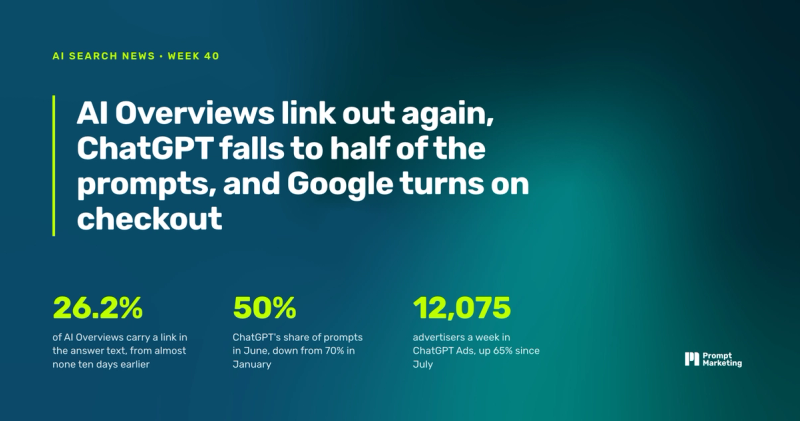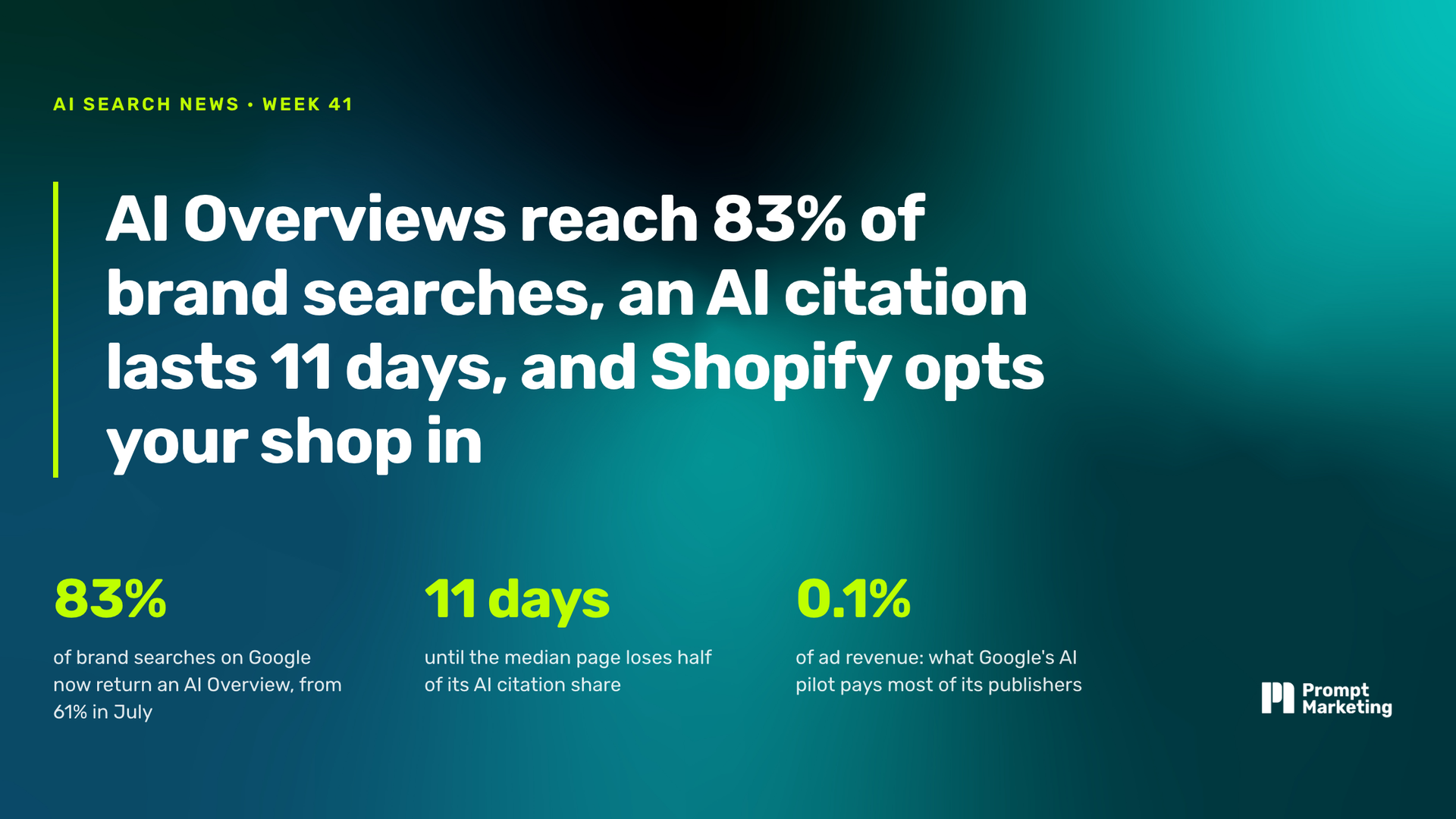
This week in AI Search News: AI Overviews reach 83% of brand searches, the median AI citation loses half its share in 11 days while Gemini starts tagging its links, Shopify opts shops into every AI channel, Google pays its sources 0.1%, and German regulators warn about ChatGPT ad profiling.
AI Overviews reach 83% of brand searches, and quote Wikipedia instead of you
Ahrefs crawled 232.8 million US desktop results from July to September, 92.5 million of them for brand keywords. In July 61.3% of brand searches carried an AI Overview. In September it was 73.3%. In a separate panel of 100 large brands, checked weekly, the share stood at 83% on 29 September. The gap with non-brand searches shrank from 12.2 points to 5. 76.2% of these AI Overviews sit in position one. The cited sources are mostly not the brand's own pages: Wikipedia appears in 71.9% of the external citations, YouTube in 38.6% and LinkedIn in 22.8%, Ahrefs on 2 October.

Barry Schwartz saw the same on 30 September for Adobe, Reddit, Amazon, Samsung and Apple, mostly mid-page under the official site, and not for Google's own name or for news publishers, Search Engine Roundtable. Chris Long of Nectiv tested 100 enterprise brands and found an AI Overview for 93 of them, on X. DemandSphere's daily tracking across all its markets and devices went from 26.12% of brand keywords with an AI Overview on 1 September to 82.06% on 29 September, DemandSphere on 1 October and Search Engine Land.
Lily Ray reran her June study of self-promotional "best of" listicles. Google now cites 38% fewer of them than in June, and when it does cite one, the brand that wrote it is left out of the recommendation 83% of the time, up from 69%, via Ethan Lazuk's weekly recap and the June study. Google is also testing the citation cards at the bottom of the AI Overview instead of the right side again, after tests in September 2025 and March 2026, Search Engine Roundtable on 29 September.
What we see ourselves
On the client sites we read, informational and comparison queries have shown the same shape since 2023: impressions level, clicks down. Brand queries kept both. Ahrefs' numbers say the brand queries join the first group this month. In our own Dutch tracker of 31 agency-choice prompts, running since 24 August, the engines answer "best GEO agency" and "how do I choose a GEO agency" from five listicle and criteria pages, cited 140 to 414 times in the last 30 days, and almost never from an agency's own service pages. The page that names you decides the answer, and in most categories you did not write it.
Our view: the brand search was the one query you controlled. Now Google writes an answer above or under your homepage from Wikipedia, YouTube and LinkedIn. Open your Wikipedia article, your YouTube channel and your LinkedIn page and read them as a product page, because that is how Google uses them. Then run the brand audit in Dutch and English: brand name and misspellings, brand plus reviews, pricing and complaints, your executives, and comparisons with competitors. Record the answer, the errors and the cited sources. And a "best X" listicle on your own site now helps your competitors more than you.
An AI citation lasts 11 days, and Gemini starts tagging its links
Profound followed 883,000 pages across ChatGPT, Perplexity, Claude, AI Overviews, AI Mode, Gemini and Copilot for twelve months, 1.19 million page-engine lifecycles in total. The median page loses half of its citation share within 11 days of its peak. 78% of cited pages do so within two weeks. The 22% that hold on have half-lives of 27 to 29 days. A page cited by five or more engines is 5.5 times more likely to still be cited after eight weeks, and a Claude citation is 2.8 times more likely than a ChatGPT citation to last that long. Explanatory and comparison pages outlast news, Profound on 30 September.

Gemini now adds UTM parameters to its outgoing links. John Mueller confirmed it on 1 October, Google has not documented when they fire, and referrer pass-through from the Gemini app ran at about 9%, so most Gemini visits sat in Direct until now, Search Engine Journal. The st_source=ai_overview parameter spotted on AI Overview links on 2 October was a Chrome extension rewriting URLs, not Google, Search Engine Roundtable. AI Mode's monitoring went live for everyone on 28 September. A user tells AI Mode what to watch, and Google rechecks sites, forums, social posts and the Shopping Graph of more than 60 billion products, Search Engine Roundtable. Google Maps now asks for a sign-in to read all reviews of a Business Profile, which Barry Schwartz reads as a block on scraping by AI and third parties, Search Engine Roundtable on 30 September.
Our view: a citation is a weekly event, not an asset. One placement buys about two weeks. The pages that keep their place explain or compare something and are cited by several engines at once, so read your tracker per engine on a fixed prompt set, every week, and treat a single reading as noise. Add utm_source=gemini to your AI referral report and compare it with the referrer-based Gemini traffic. A price or stock change in your feed can now trigger an alert to a shopper, so the feed is a publishing channel too.
Shopify opts your shop into every AI channel, and the agents favour the chains
Shopify's "Allow Shopify to manage for me" setting is on by default and enrols eligible stores in every new AI shopping channel: Meta's Muse, Google AI Mode and Gemini, Microsoft Copilot, ChatGPT, and experimental partners. On 8 September it shared eligible catalogues with Muse without a merchant action. Direct checkout is on by default on Meta, Google and Copilot where available, and those orders do not fire your analytics pixels, so Slobodan Manic, who documented the setting, advises filtering the order list by channel. Meta has said commissions may follow. For now Meta covers US, Canadian and Mexican stores and Google US stores, Search Engine Journal on 2 October.

Shopify also extended WebMCP into checkout on 29 September. A browser agent can now read, update and complete a Shop Pay checkout after it shows the buyer the order and the total. No merchant setting is needed, and the documentation does not say whether a merchant can switch the tools off or separate agent orders, Search Engine Journal. Google will adopt the Universal Commerce Protocol's hotel booking draft of 25 September for hotel bookings in AI Mode, with the hotel as merchant of record, Search Engine Journal on 28 September.
Google's Loyalty Customer Match now names AI Mode and Gemini, and the Netherlands is one of five countries added, with Italy, Spain, India and South Korea. It runs in 14 countries, works through the Merchant API, and accepts loyalty points and completed orders as membership, Search Engine Roundtable on 2 October.
Vaer AI ran 20,000 shopping prompts in ten categories and four cities through ChatGPT, AI Mode, AI Overviews and Gemini from June to August, about 460,000 answers, for Lightspeed. Without web search the national chain beat the smaller shop in 90% to 94% of head-to-head cases. With search, in 46% to 58%. 68% of AI Overviews named no local shop at all. One word in the prompt, "independent", cut the chains' share from 44% to 9%, Lightspeed on 29 September.

Jellyfish counted the toy category: Alexa recommended 177 brands, nearly all from Amazon's own store, ChatGPT 24 retailers and AI Mode 37. HUMAN Security logged 5.6 million requests from Meta's Muse in under two days from 22 September, 84% of them on product and search pages, Digiday on 1 October. ChatGPT added virtual try-on for clothes and accessories on 1 October, Search Engine Roundtable.
Our view: last week Google turned checkout on by default. This week the channel list itself is on by default. Three checks before Q4: the Shopify setting, your order list by channel, and your product and category copy. The "independent" result says the engines can find a small shop when the prompt asks for one, so the attributes that make you the answer to that prompt must be in your data. For a Dutch merchant, Loyalty Customer Match is the first thing you can switch on in AI Mode today.
Being a source pays 0.1%, and a judge says an expectation is not a contract
The Information reported on 30 September that Google's AI contribution pilot pays about 100 publishers. For several small and midsize sites the payment is under 0.1% of their advertising revenue. One publisher has earned 50,000 to 60,000 dollars so far, one is on course for more than a million a year, and smaller sites made under 1,000 dollars in several months. None of them can see how the amount is calculated, Search Engine Roundtable. On 1 October Judge Amit Mehta dismissed Penske Media's case over AI Overviews. The owner of Rolling Stone and Variety claimed Google traded traffic for content. The court found no agreement: "an expectation is not an agreement," and the publishers pleaded no negotiated terms. The judge added that he does not treat the harm lightly, Search Engine Roundtable.
The publishers' brief in the OpenAI copyright case, filed on 17 September and reported on 28 September, quotes an OpenAI engineer from February 2023: "no matter how prominently we show the links, users won't click." Nick Turley, head of ChatGPT, saw "no good reason to click" once the answer is given. Microsoft's own data in the brief puts the New York Times' click-through in Bing Chat 87% to 93% below Bing web search, Search Engine Journal. 300 publishing executives went to Washington on 29 September for the Stealth Bot Prohibition Act, which would force AI bots to identify themselves and state their purpose, Digiday. Cloudflare moved Pay Per Use into beta on 30 September: the AI company defines a "use" and sets the price, the publisher accepts or declines, settled in a dollar stablecoin, US participants first, Search Engine Journal.
Future has more than 30 GEO clients with renewals, and Ziff Davis, Time, Axios, Daily Mail, Burda, Funke and Klambt sell the same service to brands: a brand pays to appear in the pages the engines cite, Digiday on 1 October.
Our view: the engines pay the source nothing or close to it, the courts hold that nobody promised traffic, and the people who build the engines wrote down in 2023 that the link does not get clicked. Plan for the mention, and budget no traffic from it. The first section says which pages carry the mention for a brand search: Wikipedia, YouTube, LinkedIn, and the publishers who now sell a place on their pages. Treat that budget as PR, and measure it with a fixed prompt set.
German regulators warn about ChatGPT ad profiling, and the clicks do not add up
On 2 October the Berlin and Hamburg data protection authorities warned about the personalised ads OpenAI is preparing for Europe. The profile is built from previous and current chats, device information and usage data, on opt-in consent. Users who decline see generic ads, chosen on the current conversation, approximate location and language, which OpenAI bases on legitimate interest. Hamburg calls chat content in advertising "a new dimension" and "an enormous challenge for data protection." OpenAI changed its privacy policy at the end of August and gives no European launch date. These are warnings, not enforcement, Berlin and Hamburg.
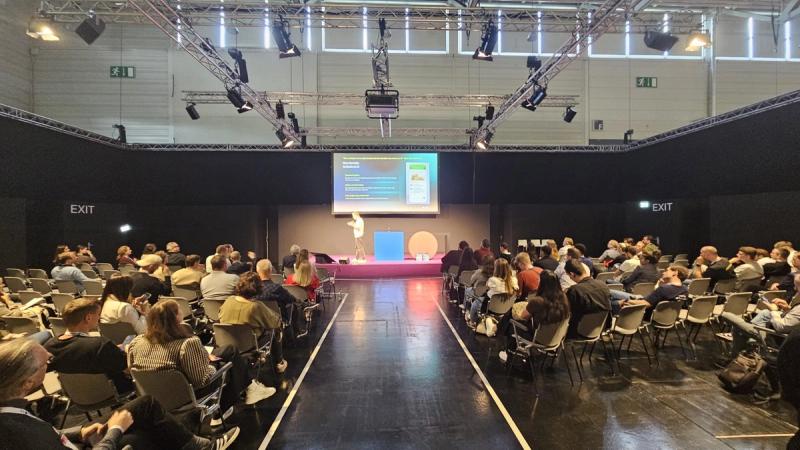
Digiday spoke to the agencies on 1 October. Accuracast ran a UK lead campaign, saw the form fills arrive, and ChatGPT reported zero conversions two weeks later. Where ChatGPT counted about 100 clicks, the agency's own tracking counted 20. Conversions take 24 to 36 hours to show, the reports carry no prompt data, and budgets stay at test level. AdRoll and Jellyfish saw no click gap, and many legal teams refuse to sign OpenAI's tracking terms at all. OpenAI declined to comment, Digiday. OpenAI's update of 30 September adds bulk product feed campaigns from a spreadsheet, review status per product, and attribution windows in the API that default to 30 days after a click and one day after a view, Search Engine Roundtable and OpenAI Developers. Arjan showed our own numbers at Emerce Academy on 2 October: six euro accounts at 2.42% CTR and 0.60 euro per click, 90% of impressions in the apps, and a three-webshop case where the dashboard reports 3.0 times the spend back on its own attribution and 0.7 on click-through orders alone, the case.
Our view: the German warnings describe the ad variant that is not live here yet. The same GDPR applies in the Netherlands, so decide now whether your brand wants to appear in ads built on a chat profile once OpenAI asks for consent. Until then the conversation is the only targeting, and the proof comes before the budget: pixel and Conversions API with one shared event ID, click-through read apart from view-through, your own order export next to the dashboard.
Also noted
• Google's guidance on generative AI content now says it is "critical to manually factcheck and review all AI-generated content" before publishing, title tags, meta descriptions, structured data and alt text included, and points to the rater sections on scaled content abuse, the document and Search Engine Roundtable on 1 October. A GEO plan that generates one page per fan-out query is the plan this document describes.
• Phase two of the September spam update landed on 30 September, with every volatility tracker up and Discover traffic swinging, Search Engine Roundtable on 1 October. The update was still listed as active on 5 October. Read no ranking or citation change before it ends.
• Ahrefs asked 301 marketers: 93% use AI for content, 69% publish more of it than a year ago, 29% check AI output with AI, up from 14%, and 2.7% publish without a human read. Claude is the most used model, at 83.2%, Ahrefs on 30 September.
• Model week: OpenAI's DevDay on 29 September brought GPT-6 Astra and dots, agents that run tasks between conversations, OpenAI. Google announced Gemini 4 Argon on 30 September, rolling out soon, Google. Neither changes which sources the answers read.
• Google appealed the EU's DMA order to share search data with competitors, AI chatbots with search among them, Search Engine Roundtable on 29 September.
That is the week. If you want to know what any of this means for your own AI visibility, our door is open.