This week in AI Search News: links return to Google's AI Overviews and some of them lead into AI Mode, Google turns on checkout inside AI Mode and Gemini for US Shopify shops, ChatGPT falls to half of all prompts but sends 95% of AI clicks, ChatGPT Ads reach 60 countries, and a two-week spam update begins.
Links return to AI Overviews, and some of them lead back into Google
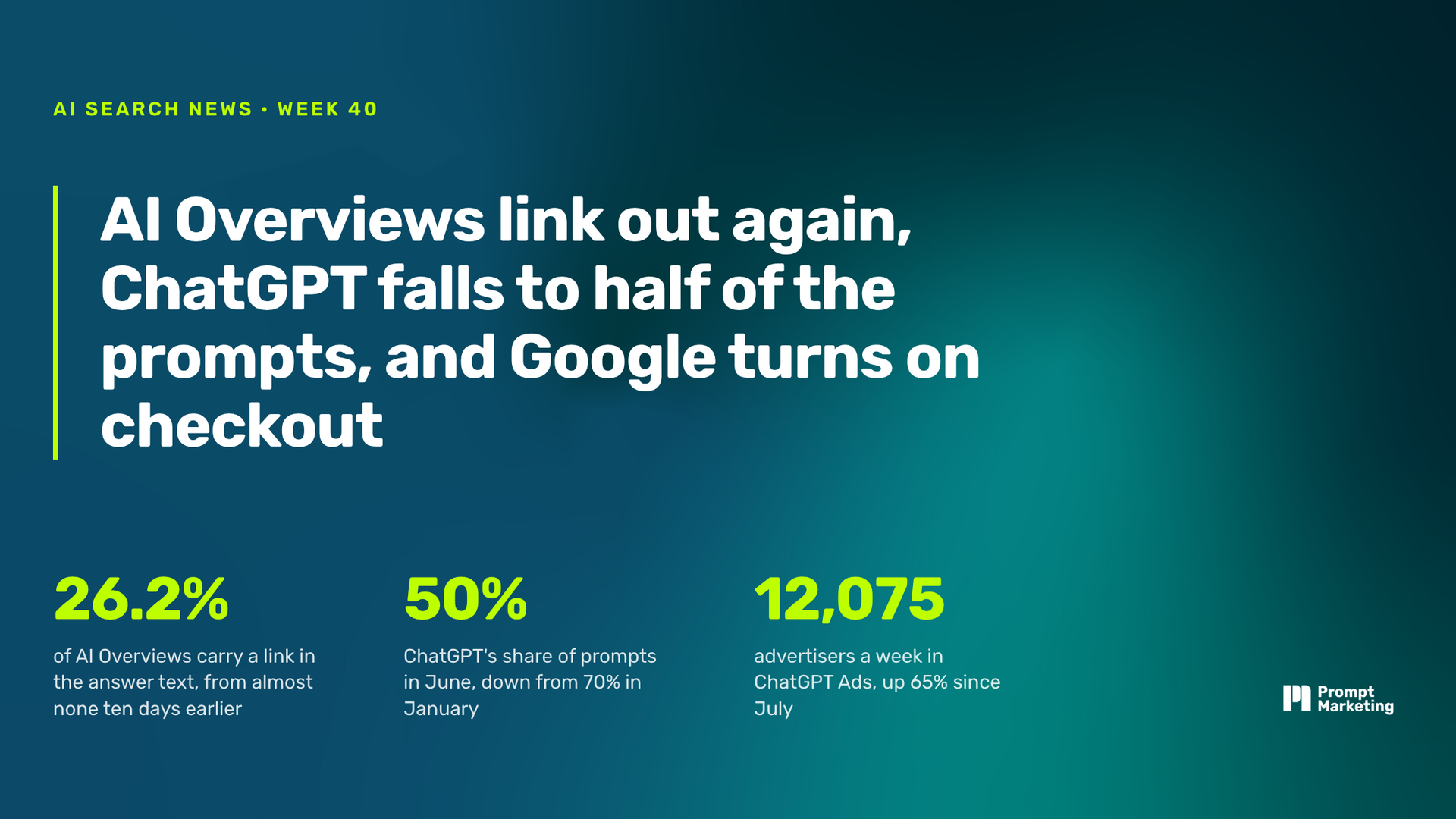
Malte Landwehr of Peec AI measured external links inside the text of AI Overview answers from 25 August to 20 September. Through 10 September almost no AI Overview carried one. From 11 September the share rose every day, to 26.2% by 20 September, Search Engine Roundtable on 23 September and Search Engine Journal on 25 September. Not every link goes to a website. Gagan Ghotra recorded links at the bottom of an AI Overview that open a follow-up conversation in AI Mode, on 22 September. Landwehr expects more of those over time.

The click that AI Mode replaces now has a measured value. Researchers at the University of Pennsylvania and Northeastern University ran a seven-day field experiment with 1,100 participants and a browser extension that forced one of three conditions: Google as it is, Google without AI, or AI Mode only. AI Mode cut click-through to websites by 18.8 percentage points. Removing the AI features raised it by 8.8 points. AI Mode also lowered trust and satisfaction, and use of other search engines rose by 11.2 points, Search Engine Land on 23 September and the paper on arXiv. Comscore put AI Overviews on 39.4% of US desktop searches in June, up from 25.8% in July 2025, via Digiday. Chartbeat's publisher network lost 40.2% of its Google Search referrals in the year to July 2026, Discover fell 34.3%, and AI referrals are 0.01% of its traffic, Search Engine Journal on 24 September.
Search Console will not tell you which link you had. John Mueller said on Reddit that Search Console treats an AI Overview as one block, so every link inside it is recorded at the block's position, usually 1, whether it is the card under the first sentence or a link behind Show more, Search Engine Journal on 24 September.
Our view: every AI Overviews tracker will show a jump in citations from 11 September. Add the destination. A link that opens AI Mode counts as a citation in every tool and sends nobody to your site. Read the data in three columns: cited or not, link to your page or into AI Mode, and sessions that arrived. Position is not a column. Google says so itself.
Google switches on checkout inside AI Mode and Gemini, and you have to switch it off
Google began enabling native checkout for Shopify stores on 18 September and sent the emails on 22 September: "Your Shopify store was matched to your Merchant Center, enabling native checkout on Google AI Mode and Gemini." There is "nothing for you to set up." A shopper who finds the product in AI Mode or Gemini buys it there with Google Pay, Search Engine Roundtable on 22 September and ppc.land on 23 September. The checkout runs on the Universal Commerce Protocol that Google published in January with Shopify. Products must be on the Shopify storefront and in Merchant Center, and eligible in the United States, Canada or Australia, per Merchant Center Help. In March a merchant applied through a form. Now the default is on. A merchant who wants the sale on its own site turns it off in Shopify under Sales channels, then Agentic. The product still appears, and the shopper is sent to the shop.

Two more agents arrived the same week. YouTube added shopping to Ask YouTube on 23 September: a search for reviews of a product returns videos in a comparison table of product attributes, with tagged products in the answer. It is limited to some US users in English, Search Engine Journal. Google also started a beta of Call for Me, in which Gemini phones a store or restaurant to check stock, book a table or hold an item, on Pixel 11 phones with a paid Gemini plan in the US, TechCrunch on 24 September.
Our view: last week Google removed the free product listings in Europe. This week it turned on checkout in the US, by default. Both take the shop page out of the journey and make the feed the product page: title, attributes, price and stock now decide the sale. A Dutch shop is not eligible yet, and the US went from form to default in six months. Decide now whether an agent may sell for you, and how you attribute a sale that never touched your site. On Shopify, know where the Agentic switch is. On another platform, ask whether it supports the protocol.
ChatGPT falls to half of the prompts, and sends 95% of the clicks
Comscore's Q2 2026 AI Intelligence Report, released on 22 September, puts ChatGPT at 50% of US prompt volume in June, down from 70% in January. Gemini went from 17% to 30% and Claude from 2% to 11%. 35% of US desktop visitors used an AI assistant in June, against 25% in January 2025, Digiday on 22 September. BrightEdge measured clicks and found the opposite shape. In its client dataset ChatGPT sent 95.1% of AI referral traffic in August, after growing 101% since January, with Gemini at 2.4%, Perplexity at 1.1% and Claude at 0.8%, in the release of 24 September. ChatGPT loses share of the conversations and gains share of the clicks.

The engines also disagree on which brands to name. Searchable put 38,966 unbranded "best X for Y" questions to ChatGPT and Gemini from 8 July to 15 September and counted a brand as recommended when it appeared in at least half of an engine's answers. The two sets overlapped 42% of the time. Each engine agreed with itself about three quarters of the time. ChatGPT cited sources in 96% of answers, Gemini in 69%. Competitor comparison pages were 37.3% of Gemini's sources, and institutional pages were 19.4% of ChatGPT's against 3.7% of Gemini's, in the study of 22 September. Place changes the answer too. FTA Global ran 1,200 software questions in 12 cities and seven languages, five times each. The same question produced the same top brand in 35% of the repeats, and 159 of the 206 brands seen appeared in one country only, in its Context Report of 17 September. Digiday added that YouTube was the most cited platform across eight AI systems in August, that long videos take 94% of those citations, and that the 10 to 20 minute video is the most cited length at 32.1%, in its data roundup of 23 September.
Our view: one AI visibility score averaged across engines hides all of this. Gemini reads your own site and the pages that compare you with competitors. ChatGPT reads press, directories and review sites, and still sends almost every AI click. Measure per engine and per market, and fix the input that engine reads. A 10 to 20 minute video that answers the buyer's question is now a source in every engine, and most brands have none.
ChatGPT Ads reach 60 countries and 12,000 advertisers a week
OpenAI opened ChatGPT Ads in Indonesia, Malaysia, the Philippines, Singapore, Thailand, Vietnam and Taiwan on 23 September, with self-serve buying from day one. That takes the programme past 60 countries. Ads show on the Free and Go plans, and OpenAI reported a $1 billion annualised run rate at the end of August, ppc.land. Adthena counted 7,306 unique advertisers in the week of 9 July and 12,075 in the week of 31 August, a 65% rise. In the EU, one and two word queries now produce 62.4% of the 110.8 million AI Overview ad appearances Adthena measured, ppc.land on 25 September. Comscore measured density: the share of US desktop ChatGPT conversations about gaming that carried a sponsored ad went from 3% in March to 47% in June. Toys and hobbies went from 5% to 24%, and books, music and video from 9% to 22%, Search Engine Journal on 23 September.

Two items sit under the growth. OpenAI put a ChatGPT Ads app in the Shopify App Store on 16 September. It syncs the catalogue and commerce events through the OpenAI Pixel and launches product campaigns from the Shopify admin. US merchants got it first, and OpenAI said every ChatGPT Ads market would follow from 23 September, BetaKit on 18 September. OpenAI's help page, updated on 28 September, still says US only and "shortly" for the rest, in the Help Center. A Dutch merchant cannot confirm availability from OpenAI's documentation today. The pixel itself drew a researcher's attention. Jamie Larson of Buchodi showed on Android Chrome that a one-year cookie named __obi, set on the openai.com domain, travels with OpenAI Pixel requests from advertiser sites, and that the pixel sends hashed email, phone and name plus cleartext country, region, city and postal code, across 936 advertiser pixels on 1,029 hostnames, on 20 September. Larson did not observe OpenAI joining those events to an account and says so. OpenAI classes the cookie as analytics. Safari blocks it.
What we see ourselves
We run ChatGPT Ads for clients in the US and the Netherlands, and two dashboard columns need a check before anyone reads a CPL. The click column: in our accounts GA4 records about 25% fewer sessions than the clicks OpenAI's Ads Manager reports. UTM tags do not close that gap. iOS strips them when a click goes from the ChatGPT app to the browser, so the session lands untagged or not at all. The fix is server-side: connect the Conversions API and send pageviews as a conversion signal, so the landing is counted on your server instead of in the browser. The conversions column: advertisers we talk to report that it includes view-through conversions by default, so we split it and read click-through CPA on its own. Our CPCs sit between 1.50 and 3.60 in both markets. In B2B accounts the ad groups built around one specific problem take more than 80% of the clicks, and the groups that list services take almost nothing.
Our view: from 3% to 47% inside a quarter is what a category looks like once advertisers find it. Dutch advertisers are in the programme already. Measurement comes first: connect the Conversions API, send pageviews as a conversion signal, split view-through, and only then judge the channel against Google. Put the pixel through the consent manager the way you treat a Meta pixel. The cookie lives a year, and OpenAI's European privacy policy puts personalised ads on consent.
A two-week spam update, and 12,000 spam pages on Google's own domain
Google released the September 2026 spam update on 24 September at 9:15 Pacific time. It applies globally and to all languages, and the rollout "may take up to two weeks," on the Search Status Dashboard. The three earlier spam updates this year finished in 19 hours, two days and one hour, and two days and 16 hours, Search Engine Journal on 24 September. Two days earlier, Charles Floate found that spammers were using public Gemini Notebook pages, the shareable NotebookLM notebooks, to rank in Google for sex toys, peptides and coupon codes. More than 12,000 were indexed, and Google removed every notebook page from its index within a day, Search Engine Roundtable on 22 September. Malte Landwehr dates the start to 17 September, when every Google AI surface began citing those pages, on LinkedIn. Search Engine Journal then linked a Google research paper on SAFE, four AI agents that investigate networks of AI-generated content, to the update. ppc.land read the paper: it is dated 28 May, it is about YouTube channels, and it does not mention websites or search. OpenAI had a version of the same problem. 404 Media reported that OpenAI fired contractors who were paid to train its models and used AI to do it, via Search Engine Roundtable on 25 September.
A Dutch study from the same week shows what volume earns a year later. Remon Hendriksen of Internet Impact tracked ten programmatic SEO sections from agency case studies in Ahrefs, from September 2024 to September 2026. Nine of the ten sections older than a year sit 40% or more below their peak, the range runs from minus 7% to minus 82%, the peak came 2 to 12 months after launch, and the visitors those pages brought were worth 35% to 76% less than the site average, in the study of 21 September. The sections that held had data nobody else had: price pages, calendars, comparison tools.

Our view: if your GEO plan is volume, hundreds of generated pages that each answer one fan-out query, the spam update is aimed at you, and the Dutch numbers say the traffic leaves within a year anyway. Read no ranking or citation change before 8 October.
Also noted
• Google's /goto redirect on search result links reached near-full rollout on 26 August, and Google blocks the lightweight HEAD requests trackers used, so Nozzle's Derek Perkins counts 500 to 1,000 requests to unwrap one five-page ranking, Search Engine Land on 24 September. It explains part of last week's tracker outages.
• Search Console's Performance report gained a multimodal filter on 24 September for searches that start from an image through Lens, Circle to Search or an upload. The same filter is rolling out to the generative AI report, the data exports, and there is no query data, Google's announcement.
• The UK's Competition and Markets Authority proposed a search choice screen on Android and Chrome at first use and once a year, with AI assistants allowed on it, and attribution of publisher content as a condition. The consultation closes on 9 October, the decision is due by year end, on gov.uk.
• Two Business Profile changes for the local panel we covered last week: an owner has four days to reject a user-suggested edit before Google may apply it, and Google emails owners about spikes in spam reviews it removed.
• Google described R4T-Diffusion, a 53.9-million-parameter model that generates the fan-out queries behind an AI answer 12 to 20 times faster than before, on 15 September, six months after the paper, Search Engine Journal on 24 September. Production use is not confirmed. Our August measurement of the fan-out is what it speeds up.
• TinyFish launched the Data Partners Alliance on 24 September with 15 data companies, Similarweb, Crunchbase and Tracxn among them, that license records AI agents cannot crawl, per the announcement. For company size, funding and legal status the agent will read the licensed record, not your About page.
• Scrunch and Scribewise surveyed 602 US marketing and PR professionals: 62% are still judged on rankings and traffic, 56% cannot say how AI search optimisation differs from SEO, and about a third look at AI bot traffic, Newsweek on 18 September. SE Ranking added that across 100,000 keywords about two in three AI Overviews cite a social or community source, on 22 September.
• On Google's payment pilot from last week: a page that is only linked in the answer, or used to check facts after the answer is written, earns nothing. Only content that shapes the answer during generation qualifies, Semrush on 22 September.
That is the week. If you want to know what any of this means for your own AI visibility, our door is open.