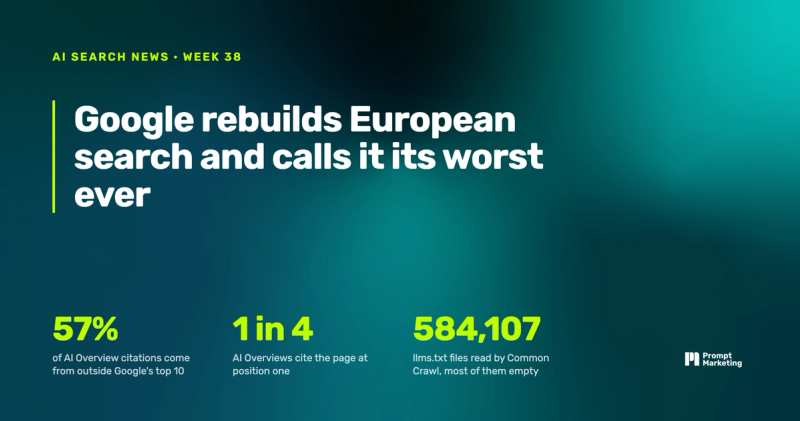
This week in AI Search News: Google dropped free product listings from Europe and added local businesses to its DMA units, turned the local knowledge panel into an AI Overview while shutting out the scrapers that measure it, Peec published the 69 search engines behind ChatGPT, a 30,000-answer audit showed which Reddit comments Reddit's own AI picks, and Profound raised $180 million as sentiment became the category's next metric.
Google drops free product listings from Europe and adds local businesses to the DMA units
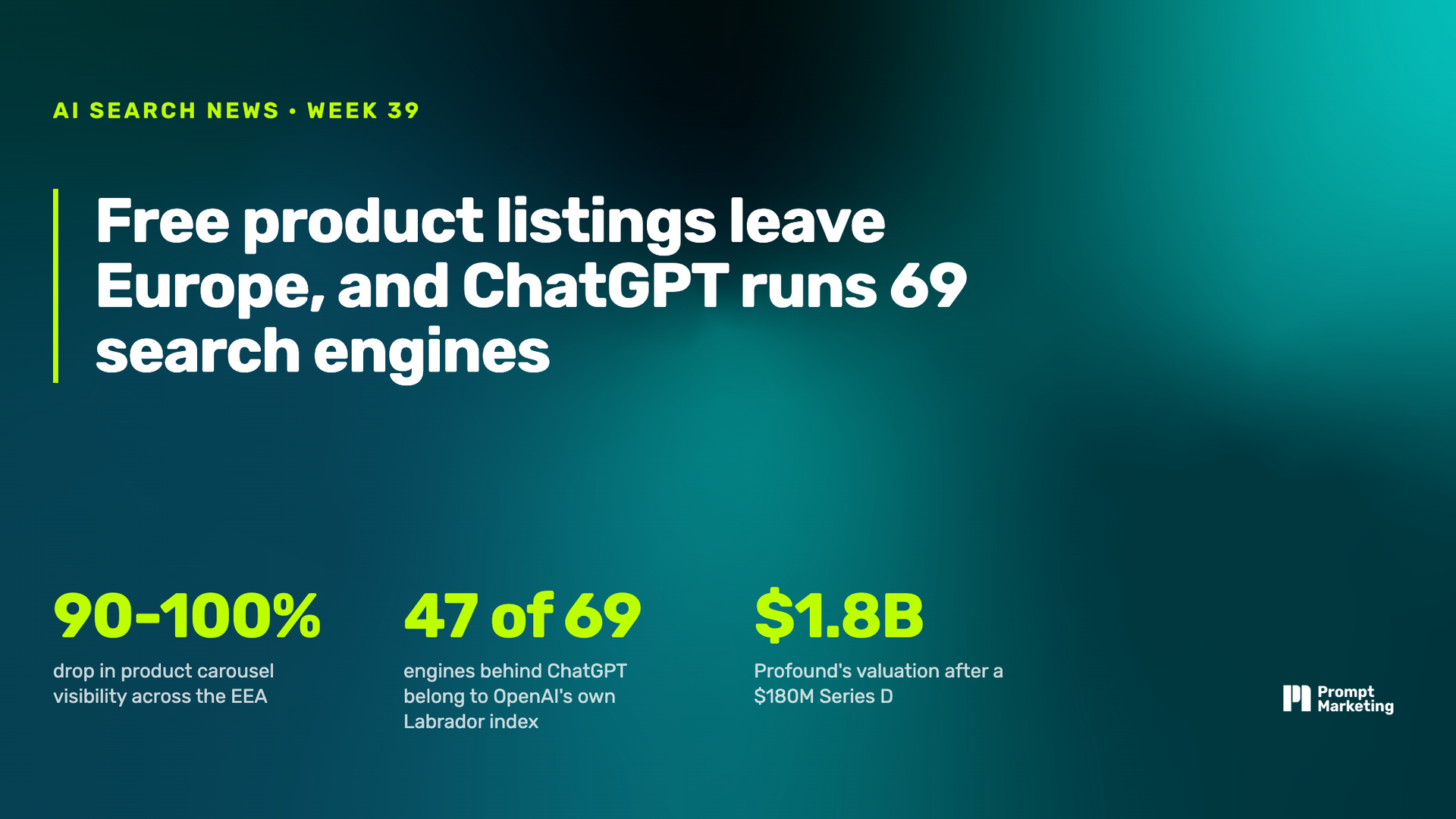
The free product listings and the product carousel disappeared from Google Search in the European Economic Area on 16 September. Adriaan Dekker spotted the drop, Hugo Huijer of Productrise measured carousel visibility down 90 to 100% in every monitored EEA country, Semrush's SERP data agreed, and Ginny Marvin of Google confirmed it, as Search Engine Roundtable reported on 18 September. The space goes to comparison shopping services, the approved aggregators from last week's redesign. Google's own developer documentation lists the change under the regional differences it made for the Digital Markets Act.

The same week Google widened the two new units. The aggregator unit and the supplier unit now cover local business queries as well as hotels, flights, transport and products, and Search Engine Journal read the updated documentation on 18 September. Local means restaurants, services such as salons, and attractions. A directory has to be approved as a vertical search service and supply a point-of-interest feed with name, address, phone, category, images and ratings. A restaurant or salon itself needs nothing beyond what Google can crawl, and appears in the supplier unit next to the directories. The Ecosystem Carousel, a row of related sites under weather, sports, finance and translation answers, went live in the EEA on 15 September.
Our view: for a European retailer the free shelf under the search box is closed. The organic product carousel was the one place a shop appeared with an image and a price without paying, and from now on that place belongs to whichever comparison service carries your feed. Check this week which comparison services list your products in the Netherlands, and get a feed into one that Google approved, because the aggregator unit shows one service expanded and the rest behind a dropdown. For a local business the supplier unit is free and needs only a crawlable page with the address, opening hours and services in plain text, so check that page now. Last week's edition said the AI answer above these units did not change. It still has not, and the units below it keep getting worse for the business itself.
Google's AI surfaces grow while the window to measure them narrows
The local knowledge panel is becoming an AI Overview. Ben Fisher spotted panels headed "AI Overview" with a "Show more" button that opens an AI Mode chat about the business, and Barry Schwartz reproduced it on 17 September. Google writes the description, and Schwartz found some of it out of date. The material Google uses to write it is now partly visible: the Collected Info tab in Business Profiles, live since 14 September, shows what Google's automated assistant gathered from calls, texts and WhatsApp conversations with the business, and lets the owner delete outdated details, per Search Engine Watch. AI Mode is also testing text link ads that look like the answer's own links under a Sponsored label, and the AI Mode button now sits in the search bar on results pages.

At the same time Google is winning against the tools that watch all this. Since about 13 September, Google blocks search scrapers and third-party trackers far more effectively, and Search Engine Roundtable collected the damage on 18 September. Derek Perkins of Nozzle reported an 80% drop in the data he can pull from Google. Sistrix runs at a reduced rate. Semrush lags. Ahrefs still collects. Steve Paine of Sistrix: "Google has been continuously changing how search results are delivered for about a year now, currently at a very high pace." John Mueller added on 16 September that Search Console's AI position reporting will "evolve over time" as Search, AI Mode and AI Overviews evolve.
Our view: every AI Overviews tracker on the market scrapes Google. A dip in your AI visibility numbers between 13 and 18 September is the tool, so ask the vendor for its collection rate per day before you read the chart. The knowledge panel is the sharper item. Google now writes a paragraph about your business on your own brand name, from reviews, from the web and from what its assistant was told on the phone. Search your brand name this week, read the paragraph, and then open the Collected Info tab and delete what is wrong. That is the one part of the description you control directly. The rest comes from the same third-party corpus that feeds ChatGPT, which is the point of the last section.
ChatGPT runs 69 search engines, and Bing is one of them
Metehan Yesilyurt found ChatGPT's retrieval configuration in the server-sent events the app streams to the browser, and Peec AI's research team published the full list, David Konitzny on 17 September and Tomek Rudzki in a longer piece on 18 September. ChatGPT dispatches queries to 69 named engines from 13 sources. About 47 belong to Labrador, OpenAI's own index, split by content type and vertical: general web, PDF, YouTube, news in several freshness tiers, arXiv, Wikipedia, local, finance, legal, medical, shopping and images. Around it sit external backends: Bing, SerpAPI for Google results, Microsoft's Web IQ, Bright Data for Google results and Maps, Oxylabs for news, licensed Yelp and TripAdvisor for local, and two unidentified pipes. Job postings describe the index at exabyte scale, and Nick Turley's 2024 testimony put its start after Google refused a search deal. About 70% of the engines are tagged internal, and Peec says some have no clear purpose yet.

Our view: "optimise for Bing and ChatGPT follows" has been dead advice for a while, and now the reason is documented. The question is which engine answers the prompt your buyer types. A restaurant is answered from the local engine, where Yelp and TripAdvisor are licensed inputs. A product is answered from the shopping index, where the feed is the input, as the July shift to feeds showed. A claim about your category is answered from the web engine, which ran its own rewritten sub-queries before it read anything, the fan-out we measured across 235 prompts in August. So the audit per brand is short: which three engines answer your prompts, and are you in the inputs of those three. A Dutch shop that is on Google and nowhere else is in one of the 69.
Reddit's own AI picks the loudest comment and cuts the "I"
Researchers at the University of Illinois audited Reddit Answers, the site's AI search, with 10,000 questions from 20 advice and support subreddits, asked three times each, and traced the 30,000 answers back through 14.68 million comments. The paper is on arXiv and Search Engine Journal summarised it on 17 September. The median selected comment sat at the 91st percentile of votes in its thread, against the 45th for the comments not selected. One standard deviation more votes multiplied the odds of selection by 2.88, and comments at zero or below were 0.53% of everything selected. Selected comments were posted a median 1.2 hours after the thread opened, the rest 5.9 hours. More formal comments were selected more, first-hand experience less, and after the model wrote the answer the words "I" and "my" fell from 3.3% of the quoted text to 0.06%.

What we see ourselves
We run a Reddit programme of our own, and the view counts on 600 of our comments say the same thing from the other side. Seven days after posting, 67% of comments have gained no views at all. The same author in the same week took between 2 and 446 views per comment, and the thread explained the difference. A comment under a post that had already stopped moving took single digits. A reply under our own post took 1,800, against a median of 12 for replies elsewhere. Early, top-level, in a thread that is still rising: that is the whole reach model, and it is the same selection the Illinois audit found in Reddit's AI.
Our view: two Reddits now exist for a brand. Reddit's own AI, which quotes the early, well-voted, plainly written comment and drops the anecdote, and ChatGPT, which cut its Reddit citations by 73% in August while Semrush still counted Reddit at 28.9% of ChatGPT citations over the first half of the year. If Reddit is in your plan, the work is one clear, early, top-level answer per thread that is moving, written as advice, without the "I", because the "I" is the first thing the model removes. Ten replies deep in a dead thread reach nobody on either Reddit.
Profound raises $180 million, and the category's next metric is how AI describes you
Profound raised $180 million at a $1.8 billion valuation on 15 September, co-led by Sequoia Capital and Kleiner Perkins, seven months after its $96 million Series C, and the announcement is here. It claims more than 1,000 enterprise brands and a third of the Fortune 100. The money goes to AI Marketer, an agent that reads the brand's answer data and deploys sub-agents to do the marketing work, and Context Manager, which keeps that agent aligned with the brand's own positioning.
Two competitors shipped the same new metric in the same week. Peec AI launched brand perception on 17 September, and its post explains the mechanics: an association score from 0 to 100 for each attribute AI links to your brand, a prominence score for how you rank on that attribute against competitors, a brand shape plot across up to eight attributes, the recurring objections AI raises against you, and a fact check that marks each claim in an AI answer as supported, contradicted, inconclusive or not covered by the facts the company supplied. Searchable published a case on 19 September: Bloom & Wild loses to Interflora on visibility and position, and scores 86 on sentiment against Interflora's 59. Named less, described better.

Our view: this is the second axis of our Visibility and Representation matrix, and the market has arrived at it. Bloom & Wild sits in the Hidden Expert cell, described well and named too little. A brand named often and described wrongly is the Misrepresented Brand, and that is the cell a visibility score alone will never show you. Keep the two numbers apart, because they run on different clocks. Visibility is retrieval and moves inside a quarter. Representation lives in the third-party corpus, in reviews, comparisons and what the assistant was told, and moves in years. A dashboard that averages them into one score hides the only cell that needs work. On the valuation: $1.8 billion prices in the assumption that AI visibility becomes a permanent budget line, and a measurement company shipping agents that do the work concedes that dashboards alone do not move a citation.
Also noted
• Google is paying invited publishers when their content "contributes significantly" to an answer in Gemini, AI Overviews or AI Mode, with a monthly figure in Search Console and no calculation behind it. Digiday broke it on 14 September, one executive called the money "peanuts" and a critic called the programme "a legal fig leaf", and Search Engine Journal set it against Cloudflare's pay-per-crawl and Microsoft's marketplace.
• Cloudflare's new defaults went live on 15 September. The Disallow AI Training setting writes Google-Extended and Applebot-Extended blocks into robots.txt while Googlebot, Applebot and Bingbot keep crawling, and Bing will not read the training rule until early 2027, per Search Engine Journal. Semrush tested 1,046 sites and found ChatGPT search refusals on Cloudflare-hosted sites fell from 16.9% to 3.0%, in its write-up. Google also rewrote the Mediapartners-Google documentation so that rules for that crawler now affect "various ad-related Google products", without listing them.
• Ahrefs measured the first nine days of AI Overviews in France across 963 domains: median click-through rate down 5.7%, domains with AI Overviews on more than 20% of queries down 23.1%, health down 20.4%, and 48% of sites lost more than a tenth of their daily clicks, in the study from 16 September.
• OpenAI is testing Sponsored Agents in the US, ads that open a chat with the advertiser's own agent inside ChatGPT, with Wayfair as the named tester, and shipped conversion optimisation, view-through attribution windows, per-platform targeting and Shopify and HubSpot integrations the same day, per Search Engine Roundtable on 16 September and Digiday on 14 September.
• Mike King argues there is no accuracy in AI visibility tracking, only precision, because no true value exists for two tools reporting 41% and 23% to be close to, on iPullRank. A controlled test on arXiv agreed from the other side: swapping source order moved citation rates by 0.0 points once the content was held constant, and 15% of retested answers cited differently on rerun, summarised by Search Engine Journal.
• A correction to our Siri post of last week: Siri AI shipped with iOS 27 on 14 September as an opt-in beta, and Apple's release note says it "will not be available initially in the EU in iOS, iPadOS, and watchOS", only on Mac and Vision Pro, in Apple's own words. Our robots.txt checks stand. The Dutch iPhone traffic does not arrive yet.
• Digiday reports that brands with long consideration journeys, State Farm, Mercedes-Benz and Hoka among them, are using AI search to argue for bigger upper-funnel budgets, and the IAB raised its US ad growth forecast from 9.5% to 12.3% partly on that spending, on 15 September.
That is the week. If you want to know what any of this means for your own AI visibility, our door is open.