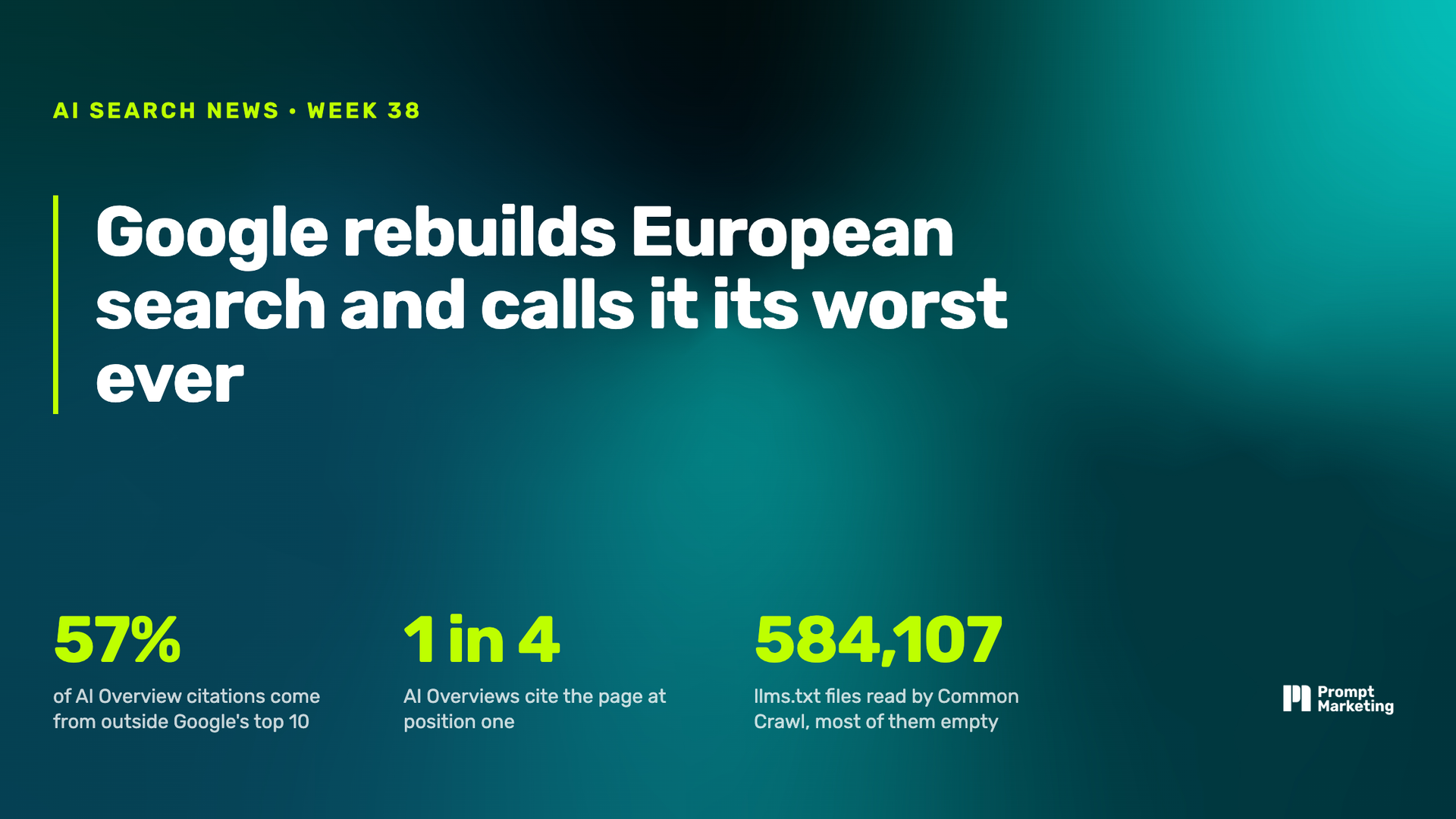
This week in AI Search News: Google rebuilt its European results under the DMA and calls it the largest quality cut in its history, Conductor found 57% of AI Overview citations come from outside Google's top 10, Profound showed the same question gets different brands depending on who asks, Common Crawl read 584,107 llms.txt files, and Apple confirmed its training crawler has nothing to do with Siri's search.
Google rebuilt its European results under the DMA, and calls it the largest quality cut in its history
Google rolled out a new results page for commercial queries across the European Economic Area on 8 September, and Search Engine Journal has the layout. For hotels, flights, long-distance trains and buses, and products, an aggregator unit now sits at the top. It shows one approved comparison service expanded by default, with the other approved services behind a dropdown, and only one such unit appears per search. Next to it sits a supplier unit for the hotel, airline or shop itself. The supplier unit needs no feed, only what Google can already crawl, and it only appears when an aggregator unit appears. Google's documentation lists the forms for comparison services that want in. Reuters describes the page as one specialised service on top, two below it with less detail, and a carousel that has lost its live prices.

The trigger was the 460 million euro fine of July for self-preferencing, with a 60-day deadline, as Quartz reports. Google told Reuters the changes "mark the largest reduction in quality of service at the world's most popular internet search engine in its 29-year search history", and Search Engine Land has the statement. Nick Fox, Google's SVP of Knowledge and Information, says the changes "degrade the user experience for Europeans" by boosting intermediaries at the expense of local businesses. Google adds that its earlier DMA measures had already cut free direct-booking referrals to European businesses by 30%, and that this round will deepen the decline. Users outside the EU are not affected. The booking widgets now also carry a disclaimer that the prices shown are customised "based on factors such as your device type", reported by Search Engine Roundtable on 7 September. A Dutch search for hotels in Paris on 14 September still showed the older "Sites voor plaatsen" carousel above a hotel list with prices, so the new units are not on every query yet.
Our view: the 30% is Google's own number, published in a press fight with the Commission, so hold it loosely. Two things are firm. If you are a hotel, airline, carrier or shop in Europe, the supplier unit is a free placement that runs on crawled data, so check this week that your booking and product pages are crawlable and carry price and availability in structured data. And nothing in the documentation touches AI Overviews or AI Mode. The page below the AI answer just got worse for direct businesses, and the AI answer above it did not change. That moves more of the decision into the answer, which is the part you can still earn.
57% of AI Overview citations come from outside Google's top 10
Conductor counted 167,867,680 AI Overview citations on US Google searches between 15 June and 15 August, across every industry and without keyword sampling, and published the split on 10 September. Pages ranking in the organic top 10 supplied 43% of all citations. Pages outside the top 10 supplied 57%. Positions one to three together supplied about 20%, and position one alone 8.5%. Read per position, the page at number one is cited in 24.9% of the AI Overviews on its query, number two in 21.1%, number three in 17.9%, and number ten in 10.2%. Conductor calls the relationship a correlation and stops there.

Our view: read the 57% with the denominator in mind. The top 10 holds ten pages and everything below it holds millions, and the ten still take 43% of all citations, so per page a top-10 result is cited far more often than anything beneath it. The number that matters for a brand is the other one. The page at position one is cited in one AI Overview out of four. Three times out of four Google writes the answer from somewhere else, and that is where a page you have never ranked can get in. Rank tracking cannot see either side of that, the point we made in January, and the AI performance report in Search Console now gives every site the citation count per page to put next to the rank.
Same question, different brands: the answer changes with who is asking
Profound ran 71,147 responses through ChatGPT, Claude and Gemini between 11 and 24 August, on credit card, clothing and furniture prompts, and published the results on 9 September. Each prompt was prefixed with a persona line such as "I am in my 30s", varying gender, age, income and occupation. The same persona asked twice got 40% brand overlap and 34% overlap in cited domains. Two different personas got 25% and 20%. Income moved the most. A low-income persona got 5.8 brand mentions and 4.1 citations per answer, a high-income persona 7.5 and 4.8. Clothing brands recommended to the low-income persona sat at $8 to $24, Poshmark and Depop among them. The high-income persona got The Row, Brunello Cucinelli, Loro Piana and Hermès at $140 to $1,650. On income alone, two different personas shared 17% of their brands, against 40% for the same persona asked twice. In Gemini's clothing answers the high-income persona saw brand-owned sites cited 24 points more often than the low-income persona, and earned media 17 points less. Clothing answers for a persona in their 50s were 39 points more likely to contain the word "women" in ChatGPT and Claude.

Our view: the tracker you pay for asks its prompts with no persona at all, which is a customer that does not exist. Profound's method is a text prefix, and ChatGPT's memory does the same thing silently for every logged-in user, from months of chat history. So your visibility score is one slice of a distribution, and the slice depends on who your buyer is. The sources you need to be in depend on the buyer too. For the high-income prompt the model reads the brand's own site. For the low-income prompt it reads what others wrote. This is why we score two axes on our Visibility and Representation matrix: a brand can be a Category Leader for the high-income persona and an Invisible Brand for the low-income one on the same question, and a Misrepresented Brand for a third. One averaged number hides all three.
Common Crawl read 584,107 llms.txt files, and most of them do nothing
Common Crawl analysed every llms.txt file in its index, and Search Engine Journal has the numbers from 8 September. 68% of the 584,107 files came from a plugin or template, and Wix alone produced 41%. 22% contained no links at all. 49% had the full structure of a title, a summary and link sections, and 32% described each link. 1,570 files named specific crawlers and 32 tried to deny CCBot, which the format cannot enforce, and of 31 of those sites checked, none blocked CCBot in robots.txt. Across the sites Common Crawl could reach, 11% had an llms.txt. Ten files matched a strict prompt-injection test, four of them genuine.

Our view: an llms.txt is a reading list for a model, and a crawler rule inside it is a wish. Keep access rules in robots.txt, where they are read, and keep the llms.txt for what it can do: point a model at the ten pages that describe your products and your differences in plain language. A generated file with no links, which is one in five, tells a model nothing. And do not expect much either way. Otterly's crawl data, shared this week by way of a podcast, shows almost no crawler activity on llms.txt while sitemaps are hit constantly, which matches what we see in client logs.
Apple confirms Applebot-Extended has nothing to do with search, as Siri reaches 2.5 billion requests a day
Apple added one line to its Applebot documentation on 4 September: "Site rules for Applebot-Extended are not considered in ranking for Search", per Search Engine Roundtable. Applebot-Extended is the switch that keeps your content out of Apple's model training. Blocking it does not touch Siri, Spotlight or Safari results. At its 9 September event Apple also said that Siri handles 2.5 billion requests a day.

Today iOS 27 ships with Siri AI, which answers web questions with citations from Apple's own index, and we published what we expect from it. The index is fed by Applebot, active since 2015, which now serves search, training and answer generation from one crawler. In early September we counted 1,905 Applebot requests from 664 Apple addresses across the markets we monitor. Applebot-Extended does not crawl anything itself. And if your robots.txt has no Applebot rules, Applebot follows your Googlebot rules.
Our view: three checks, ten minutes. Open your robots.txt and look for any Googlebot disallow, because it now applies to Siri's crawler as well unless you write Applebot its own rules. Decide on Applebot-Extended on its own, as a training question with no visibility cost. And pull the Applebot lines from your server log for the past month, because that is the only place you will see Siri's interest in your pages until Apple ships a report. We expect local and factual questions to move to Siri first and shopping to stay with Google, so a restaurant, a clinic or a shop with an address has the most to check.
Also noted
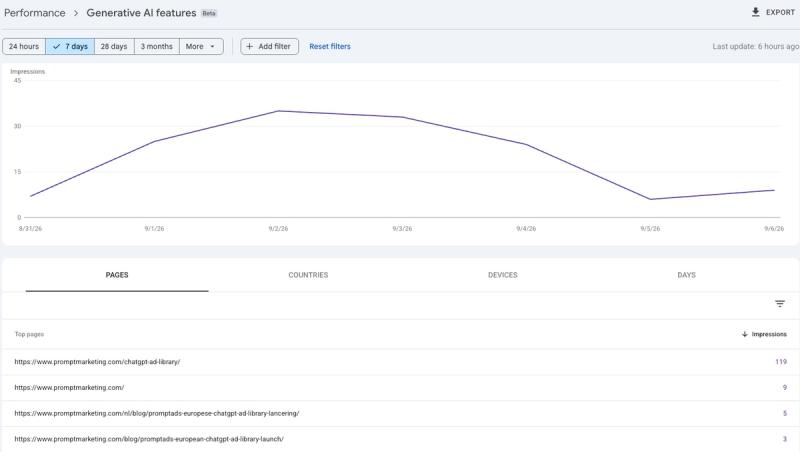
• John Mueller said on Reddit that a position inside an AI Overview "is hard to do in a way that makes it useful", so Search Console tracks the AI Overview as one block, and Search Engine Roundtable has the quotes from 10 September. An impression counts even when the user never scrolls to your link. In the same week AlsoAsked measured AI Overviews answering 97% of People Also Ask boxes, up from 86% in August and about 12% fourteen months ago, per Search Engine Roundtable, and Google started testing a thinner citations panel beside the AI Overview.
• A University of Washington working paper estimates AI Overviews cut search referrals to English Wikipedia by about 5% against the German and French editions, roughly 100 million referrals a month, and Search Engine Journal covered it on 11 September. Le Monde's CEO Louis Dreyfus says his audience has not fallen seven weeks after AI Overviews launched in France, with the app at 36% of group traffic, with the caveats here.
• Semrush studied 458 manufacturing keywords and AI mentions from January to July and found the most-mentioned brands, 3M, John Deere and Boeing, barely overlap with the most-cited sources, where only Vevor and Grainger appear on both lists, and AI search is 0.48% of sessions to manufacturing sites, in the study from 8 September.
• Perplexity's share of chatbot referrals worldwide fell from 7.91% in June to 4.31% in August on StatCounter's count, while Gemini rose from 7.94% to 10.9%, and Search Engine Journal asks whether it still belongs in your tracking.
• Google Merchant Center's AI Performance report gained three sections, AI Search intent, AI Search terms and AI attributes, with suggestions to add popular terms and missing attributes to products that appear in AI searches, spotted by Brodie Clark.
• AI Mode is testing paginated follow-up responses with a skip button, and Google DeepMind published a test of Autoregressive Ranking, a single model meant to replace retrieval and ranking, summarised by Search Engine Journal.
That is the week. If you want to know what any of this means for your own AI visibility, our door is open.