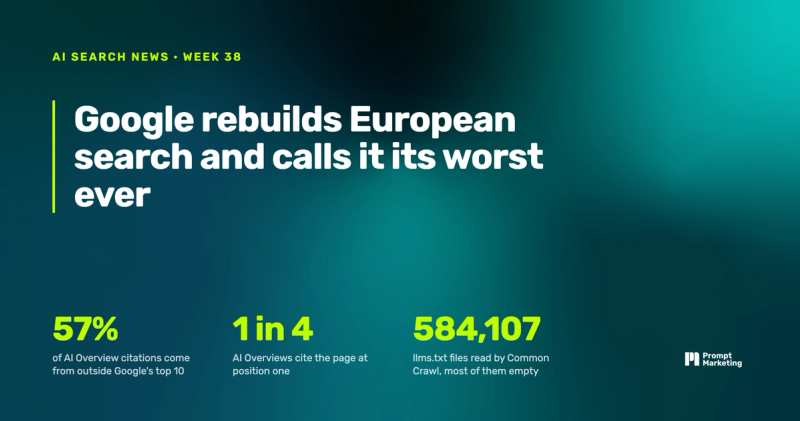
This week in AI Search News: Search Console shows AI Overviews and AI Mode impressions to every site, AI Mode dropped its links for a day, B2B comparison prompts cite product pages over Reddit, and ChatGPT Ads opens self-serve in Europe.
Search Console shows AI impressions to every site, and AI Mode dropped its links for a day
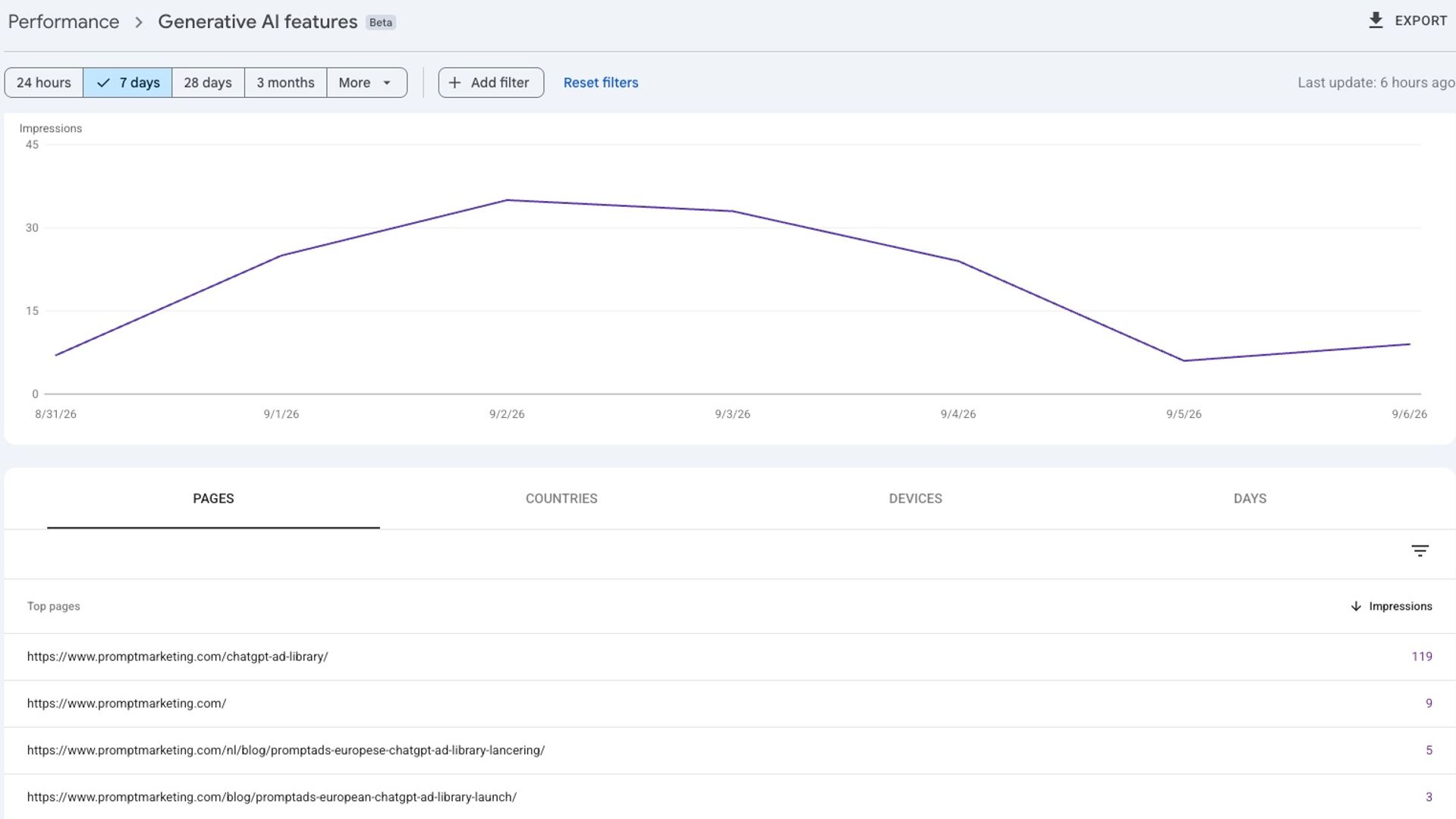
Google finished the global rollout of the Search Console AI performance report and the generative AI control on 31 August, and Search Engine Land has the details. The report shows impressions in AI Overviews, AI Mode and the generative AI features in Discover, split by page, country, device and date. It shows no clicks. The control is a switch that keeps a site out of those features. Google's wording: "sites that opt out will not receive traffic or impressions from our generative AI features." Opting out does not affect ranking elsewhere in Search. The rollout started in June.
Google put Gemini 3.8 Flash into AI Mode on 2 September for AI Pro and Ultra subscribers. Within a day, Gagan Ghotra and Glenn Gabe showed answers on broad questions with no links at all, and Search Engine Land covered it on 3 September. Robby Stein, VP of Product at Google Search: "This isn't working as intended, and we'll roll out a fix soon." Links returned on 4 September.
What we see ourselves
Clean the data before you read it. Jan-Willem Bobbink, a Dutch enterprise SEO, showed his own Peec tracked prompts appearing verbatim as Search Console queries, two rows at 131 and 128 impressions, about a third of the impressions in his filtered set. Your AI visibility tool runs its prompts through Google, and Google counts them. We see the same in client properties. Filter the tracked prompts out before you compare anything.
Our view: most brands can now see their AI Overviews exposure without a tool, for the first time. Export a baseline this week, because the report holds no history from before your site was switched on. Then compare AI impressions to web impressions per page. A page with rising AI impressions and falling clicks is a page whose answer is being absorbed, and that is the list to work on. Read the report for what it counts: only the answers where Google already used you as a source. It says nothing about the answers where you were absent, and those are the ones that cost you. The 3.8 Flash episode is the reason to keep watching. A citation is a choice the model makes on each answer, and a new model can stop making it. Google fixed this one in a day. The next one may be a design choice. And leave the opt-out switch alone. It removes you from the answers. The clicks do not come back.
In B2B comparisons, AI cites product pages and barely touches Reddit
Ten Speed analysed 7,387 citations across 170 evaluation-stage prompts, the "Pipedrive vs HubSpot" kind, for its B2B clients in ChatGPT, Perplexity, Claude and Gemini, and Search Engine Journal published it on 3 September after putting six fact-check questions to the authors. Product pages took 24.1% of citations. Articles, blogs and PR took 17.4%, comparison pages and listicles about 13% each, how-to guides about 9%, homepages 7.8%, and directories such as G2 and Capterra 7.2%. Reddit, YouTube and forums together took 4.2%. Content the brand controls added up to 88.3%. Comparison pages were cited 1.33 times more often than their share of prompts.
Ten Speed collected no per-platform breakdown, the data is one snapshot, and it cannot yet connect a citation to pipeline.
Last week's edition ran the opposite numbers: Trendos found community sources at about half of all citations across 107 million answers, and brand pages at 2% in IT Services. Both are right, and the difference is the prompt. A broad "best CRM for a small team" question pulls Reddit and editorial. A "X vs Y" question pulls the two vendors' own pages, because those pages hold the specifications the model needs to compare.
Our view: build the comparison pages yourself, on your own domain, one per competitor you actually meet in deals. State the differences plainly, including the ones that favour them, because a page that reads as a sales sheet gets skipped for G2. Write them in the phrasing a model would use to answer the question, which is the point our Felix made last week about how citations get chosen. This is the one place in B2B where your own site is the likely source, so it is the place to spend.
ChatGPT Shopping runs on product feeds now, and AI Mode prices differ from the carousel
Profound tracked 687 of its customers through ChatGPT's Shopping mode in July, and published the numbers on 3 September. Before 10 July, 8.26% of the products ChatGPT retrieved came from integrated product feeds. From 10 July it was 61.54%, and by August feed retrieval passed web search and reached about 65% of product recommendations. The top ten merchants went from 22.5% of retrievals to 41.8%. The number of unique merchants fell from 13,524 to 10,607. Shopify's integration carries about 35% of feed retrieval, which is the route in for a retailer without its own feed.
On the Google side, Productrise compared what AI Mode shows against the regular shopping carousel for the same queries, across more than two million product listings from 9 to 31 August in the US and UK, and Search Engine Journal reported it on 3 September. The two formats showed the same product 1.28% of the time. The carousel lists 27.8 products per query on average, AI Mode 3.9. Where the same product did appear in both, 49.6% listed a different first merchant, and 38.1% showed a different price. When prices differed, AI Mode was higher 68.4% of the time, by 21.6% on average. Google says both run on the same Shopping Graph.
Our view: for a retailer the feed is the product page now. ChatGPT went from web search to feeds in one day in July, and the merchant count shrank by a fifth in the weeks after, so the window to get a feed in is short. Submit one directly to OpenAI, or through Shopify if that is your platform, and keep price and stock current, because a stale feed shows the wrong price to a buyer who is ready to pay. On Google, 3.9 slots against 27.8 means AI Mode is a shortlist. Run your top twenty products through it and check whether the seller and the price it shows are yours.
The EU now calls ChatGPT a search engine
The European Commission designated ChatGPT a Very Large Online Search Engine under the Digital Services Act, and Search Engine Journal reported it on 31 August. OpenAI reported 159.1 million average monthly recipients of ChatGPT search in the EU over the six months to 31 March 2026. The threshold is 45 million. ChatGPT is the first AI chatbot with the designation. Reddit, at 57.2 million, and Roblox were designated Very Large Online Platforms the same day.
The designation brings duties within four months: a systemic risk assessment, an annual independent audit, data access for vetted researchers, a recommender option that does not use profiling, and a public advertising repository where applicable.
Google, meanwhile, published the rules for who can license its EEA search data under the Digital Markets Act, and Search Engine Journal has the details. The data covers rankings, queries, clicks and views. Eligible parties need 50,000 monthly EU users and must qualify as an online search engine, which the decision says includes qualifying chatbots. Agreements go out from 17 September and samples follow on 16 November, and Google must keep a public list of every party that takes the data.
Our view: within four months, every ChatGPT ad in Europe should become inspectable, the way Meta's Ad Library is. The repository duty carries the words "where applicable", and ChatGPT sells ads in Europe, so we expect it to apply. Under the DSA the repository must show the ad, who paid for it, how long it ran and the main targeting parameters, in public. So your competitors' contextual hints become readable, and so do yours. Until OpenAI publishes one, ours is live and grows with every opted-in PromptAds user. About a third of the EU population uses ChatGPT search each month, and the law now treats that as search. A European brand that tracks Google and skips ChatGPT is tracking one of its two search engines.
ChatGPT Ads opens self-serve in Europe at a $1 billion run rate
OpenAI opened self-serve access to ChatGPT Ads on 31 August in 31 European markets, India, the Middle East and North Africa, and Digiday covered it the same day. The European list is the EEA plus Switzerland, so the Netherlands, Germany, France and Belgium are all in. Ads have shown to Free and Go users in those countries since 24 August. Until last week a European advertiser needed the OpenAI Ads Solutions team or an agency partner to get in. Now a business registered in any of the 31 markets can open its own account. We have been all over it: five new advertiser accounts opened in the first seven days of self-service, and we are in the platform every day, building campaigns partly through the ChatGPT Ads plugin inside the ChatGPT app. David Dugan, who runs global ad solutions at OpenAI, puts the footprint at 40 countries.
OpenAI put a number next to the launch: ChatGPT Ads reached a $1 billion annualised revenue run rate in under 200 days. Digiday points out what that figure is: one month of ad revenue, multiplied by twelve. OpenAI's own post is here.
The ad stack grew in the same week, and Search Engine Land listed the changes on 4 September. Custom audiences can now be edited instead of rebuilt, mix identifier types, run above 5 million members, and use Google's Android advertising ID. The measurement pixel and the Conversions API accept hashed phone numbers, names, regions and postal codes for matching. Campaigns with a total budget get pacing. A conversion model that counts view-through conversions is coming, with billing per impression. And an Ads Manager plugin lets you build and troubleshoot campaigns from inside ChatGPT or Codex in plain language. Barry Schwartz adds one suspicion: the shopping results in ChatGPT appear to come only from advertisers who submit product feeds, which fits the shopping data above.
The first European field tests landed on LinkedIn within days, and they disagree. Hans Boersma of DW in the Netherlands reported CPCs 60 to 80% below Google Ads, a click-through rate four to five times higher, and a low bounce rate. Fredrik Bjurstrom of Causalytics reported 5,435 impressions and 67 clicks in about twenty minutes, a bounce rate near 90%, and zero signups against a signup rate of about 50% from his LinkedIn Ads. He set a daily budget of 30 euro and OpenAI spent 60, which he reads as the daily budget working as an average. Erik van der Veen, who built a campaign on day one, adds the detail behind both results: you cannot buy keywords, OpenAI does the matching from the context hints you give it.
What we see ourselves
Our own campaigns run in the United States and the Netherlands, B2B and consumer, and we published the numbers today. Click-through rates sit between 0.5% and 1.4%. Cost per click runs from 1.50 euro to 3.60 dollars, and cost per thousand impressions around 20. Meta averages a 1.49% click rate, a 1.72 dollar click and an 11.54 dollar CPM. Google Search averages 6.64% and 5.42 dollars a click. Every public test, ours included, lands between 0.5% and 1.5%. That is a Meta click rate. A ChatGPT ad sits under an answer the user already has, and an advertiser who plans it with search expectations will call it a failure in week one, as several have.
The costs are where the tests part. Our CPMs of around 20 are a third of what Hostinger and Floyd Blaikie paid in the US, on the same platform in the same months. Read that as a contextual auction with few bidders in the Netherlands, and a US market that filled first. Inside our accounts, three quarters or more of clicks come from mobile, Android beats iOS and web on both CTR and CPC, OpenAI's suggested creative beats our hand-written ads, and in B2B the ad groups built around operational pain points take more than 80% of clicks while vendor-comparison ad groups barely register. Delivery is capped during the beta, and the walk through the self-serve Ads Manager is here, including the agent you call with @ChatGPT Ads Manager inside a chat.
What the interface does not give you: impression share, any view of how broadly OpenAI matched the context, or a topic report. You see your own impressions per contextual hint, and that is it. That gap is why we built the ChatGPT Ad Library on 21 August, fed by the PromptAds extension. At launch, one US business software category over ninety days showed 165 distinct advertisers and 808 sponsored placements. The Dutch consumer prompts we track showed zero. Five new accounts in seven days is our own count, and Bjurstrom's 5,435 impressions in twenty minutes on a 30 euro budget say the same thing from the buyer's side: the Dutch auction is thin.
The questions reaching us through Reddit are about the account itself. A Dutch B2B marketer asked r/DigitalMarketing whether uploading a contact sheet into the Target Groups option is a privacy problem, and nobody in the thread mentioned consent or match rates. A fifteen-year-old account in r/OpenAI listed six blockers with no workaround, from a $100 hold and user invites that fail to a business name pulled from the website that cannot be edited and no support channel. And an agency operator whose client took over billing cannot tell whether the campaign ever served.
Our view: the channel is real and the tooling is early. The second fact sets the work. Neither LinkedIn field test measured the organic answer above the ad, and that answer decides what the click is worth. Run the buyer prompts yourself before you spend. If the answer already names you, the ad buys a click you were getting. If it names a competitor, the ad pays to decorate their pitch, and a 90% bounce is a reader who was already answered above it. Then set up both sides of the ledger before the first impression: the pixel for the click, and the Conversions API sending a page view from your own server with the click ID from the landing-page URL. The difference between the two counts is the click-quality number the early critics are missing. Set the daily budget at half of what you can afford to see spent, and watch CPC rather than CPM, because we see CPM fall while CPC rises inside the same account. And before you upload a customer list, check that the consent you hold covers matching on a new platform. GDPR does not change because the platform is new.
Also noted
• Google confirmed a small test that lets regular Search campaigns with exact and phrase match keywords serve in AI Mode, and Search Engine Roundtable has Ginny Marvin's statement. It is limited to "explicit and direct user intent". Until now, AI Mode inventory needed AI Max, Performance Max or broad match with smart bidding. Brodie Clark also spotted inline shopping carousel ads inside AI Mode answers. And SE Ranking's ads tracker shows Shopify cited in all three "build a website" answers in AI Mode while buying no ads, with Wix and Squarespace paying for slots on prompts where they are already cited.
• David Konitzny of Peec AI read the freshness parameter across about 250,000 ChatGPT chats, and SEO Südwest summarised it on 2 September. Thirty days is the most common window. The second most common is ten years, and that one goes to Reddit in about 60% of cases, then G2, LinkedIn, Trustpilot and YouTube. Fast calls mostly run at 30 days and slow calls narrow to one to seven days. About 65% of retrieved URLs fall inside the requested window, so the parameter works as a preference. In a post from late August he added that 72% of the URLs ChatGPT cited after the 5.6 update were URLs it already knew, 27% were new URLs on known domains, and 1.6% came from domains it had never cited.
• Semrush's year-on-year traffic data for July shows ChatGPT at 1.09 billion US visits, up 48.4%, Bing down 50.4%, and Google up 10.7% to 25.3 billion. The top ten sites take 68.6% of all traffic to the top 150. Two academic studies collected by Search Engine Journal show the same shape: Bocconi found households that gained ChatGPT search cut traditional queries 9.4%, rising to 17% after 20 weeks, and Wang et al. put 1,100 Chrome users on AI Mode for a week and saw clicks to external sites fall 18.8 points.
• Update, October 2026: GoodFirms surveyed 343 business leaders in 30 countries for its AI Adoption Statistics 2026, and PromptMarketing took part as a research partner. 88.8% of respondents use AI in marketing and sales, the highest of any function, and 92.2% increased their AI investment this year. Adoption is no longer the open question. The open question is whether those same AI tools name you when your buyers ask them for a supplier.
• GMBapi, the Dutch local-search platform of Michel van Luijtelaar, found calls down 11.9% and website clicks down 12.5% for US Business Profiles in Q2 year on year, with direction requests up 21.1% and rankings stable. In the EU, desktop Maps impressions fell 34.7%.
• Profound's research roundup on 4 September resurfaced its Summer 2026 Index, built on 1.9 billion conversations across more than 50 industries. In 24 of 30 multi-region industries, at least one European market has a number one brand that is absent from the US top five. Airlines, banking, grocery, insurance, gyms and real estate diverge most. A prompt set built for the US measures the wrong competitors for a European brand.
• Digiday reports that creator briefs now carry AI search requirements: named products, checkable claims, chapter markers that match the questions people ask, and clean transcripts. At Tinuiti, AI visibility is about a quarter of creator strategy, up from a tenth six months ago.
• Cloudflare's new crawler defaults start on 15 September. On pages that carry ads, Search crawlers stay allowed while Training and Agent crawlers are blocked for new domains and all free plans, per Cloudflare's own post. An edge block never reaches your origin, so your server log will show ChatGPT-User and the others going quiet, as if they lost interest. Pull the last-seen timestamp per user agent now and compare it a week after the switch.
That is the week. If you want to know what any of this means for your own AI visibility, our door is open.