Last week we established that nobody tracks AI search visibility; everybody samples it. This week, in session 2 of our webinar series, the question was what you do with the measurement. The honest answer is that the work people call GEO, generative engine optimisation, is not page optimisation at all. It is brand building, with one new constraint: the audience is a machine. This post is the short version. The replay, the slides and the two-page cheat sheet are at the bottom.
Brand is the ranking factor
The pushback of the week came from three studies at once: less than 1% of site traffic comes from LLMs, Google still drives almost all conversions, so why bother. Rand Fishkin's conclusion is ours: AI visibility is a brand channel, not a traffic channel. The answer interface is not built to send you clicks. People read, decide, and then search your name on Google or type the URL. Measure it by sampling, engineer it as representation, never sell it as traffic.
And in a brand channel, brand is the ranking factor.
The model does not read your site
Here is the number that makes the point. On a client panel of 48 prompts across three engines, the brand was named in 96% of answers to brand prompts and in 17% of answers to category prompts. The model knows the name. It does not hold the brand: it does not use it to answer the category.
An LLM does not rank your pages. It reads everything the internet has ever said about you, then it judges. And the lever is moving off the page as models get smarter. Profound put it on a curve at Zero Click London: Claude's web search leans on existing evaluations, reviews and comparisons; ChatGPT's web search builds its own view from product facts and documentation; agents evaluate the product or service itself. At the right end of that curve the only thing left to optimise is whether the brand is true and legible.
So engineering the source is brand building. Not the old kind, awareness and feeling, but brand building with machine readability at the core: every campaign, PR hit, review request, product page and video made so a model can read it, verify it and quote it.
GEO Identity: four questions, three pillars
Everything in the session hangs on one picture: a triangle. Technical at the top, content and authority at the base, and in the middle the thing all three have to confirm, which we call GEO Identity: who you are, who you serve, what makes you different, and why buyers should trust you.
The three corners are the three questions a machine asks of a brand.
- Technical. Can the machine read it?
- Content. Does the brand say one thing, quotably?
- Authority. Does the world confirm it?
Work the three from one identity. Without it, the three pillars optimise three different brands.
Before any of that, test the identity. Ask every engine, across several runs: "What is {brand}?", "Is {brand} for {segment}?", "{Brand} versus {competitor}?", "Is {brand} reliable?" Clarity for a model is consistency: one name, one sentence, the same facts in every place it reads. What you learn from those four prompts tells you which pillar is yours.
One more diagnosis per prompt before you spend a euro: memory or retrieval. If the brands named in the answer are also the brands cited, retrieval is driving and content plus authority move it in weeks. If the named brands are not in the citations, the model is answering from memory, and that is an entity and distribution play that takes months and a model update. Report the two apart.
Technical: can the machine read the brand?
Every model runs three kinds of crawler: one that trains (GPTBot, ClaudeBot), one that builds the index (OAI-SearchBot, Googlebot, Bingbot, Applebot) and one that fetches live when you prompt (ChatGPT-User, Claude-User, Perplexity-User). Blocking the training bot is a legitimate choice. Blocking the index and fetch bots means you are never cited. Tijm de Jong's study on Frankwatching found 24 of 25 Dutch news sites blocking at least one AI crawler, and 13 organisations blocking GPTBot while saying nothing about OAI-SearchBot; the night before the webinar, nos.nl's robots.txt still blocked ChatGPT-User.
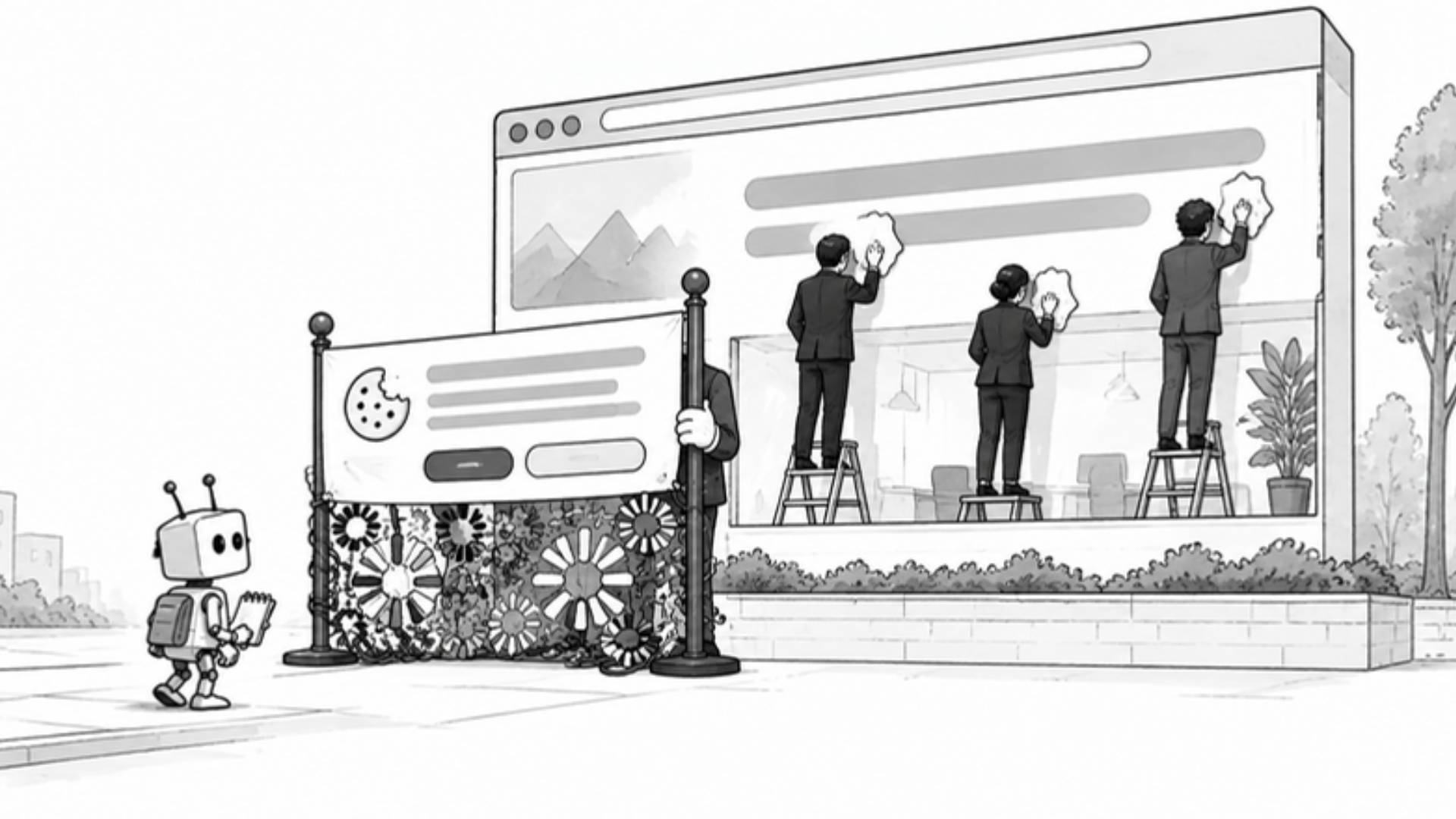
And robots.txt is not the whole story. Since July 2025 Cloudflare blocks AI crawlers by default for every new site on its network. The crawler gets a 403 at the edge, the robots.txt looks clean, and the marketing team never finds out. Check the logs, not the file.
Retrievable means in the HTML: no consent walls, no client-side rendered specs, no facts that only exist in PDFs. The cheapest test in the industry: paste ten key URLs into three assistants, ask them to summarise the page, once a quarter. If they cannot read it, nobody can. (Our own checker for this, built by Felix Koole, launches shortly.)
Then know which web each engine reads. Google's AI surfaces read Google's index. ChatGPT reads its own index, codename Labrador, which Peec AI showed to be twelve vertical indexes, plus scraped Google results; RESONEO measured 64% own index and 35% Google in free instant mode, 75% Google in paid thinking mode. Copilot reads Bing. Claude crawls with ClaudeBot and searches through Brave, so Brave's index decides what Claude can cite live. And agents draw a shortlist before they search: Profound showed Meta's Muse consulting a catalog of about thirty merchant sites first. Get into the catalogs and feeds, then earn the pick.
Two more: Bing Webmaster Tools is the only first-party tool that shows you the grounding queries behind AI citations, so verify, submit a sitemap with lastmod and use IndexNow. And schema last, in this order: Organization with sameAs to LinkedIn, Wikidata and the review profiles, then WebSite and Breadcrumb, Article, FAQ, Product, Offer, Review. Schema is packaging, not persuasion, but the Organization and author entities are packaging agents love.
Content: does the brand say one thing, quotably?
Start with the identity sentence: {Brand} is a {what} that {does} for {whom}, {the one thing that sets you apart}. Word for word on every key page, in the Organization schema, on LinkedIn and the review profiles, in every language you sell in. Then ask three engines what you do and for whom, and compare word for word.
Write for the fan-out, not for keywords. One prompt becomes several searches inside the engine, hundreds of URLs are retrieved, and almost none are read: RESONEO counted 760 pages opened out of 58,000 retrieved. The model judges most pages on a title, a URL and about 200 characters. Put the answer in the first 200 characters.
Five tactics from our Prompt Optimisation playbook: map pages to the fan-out queries; score and maintain freshness, with the update visible (content older than six to nine months reads as stale); entity-rich definitions; prompt-style phrasing in headings; factual tables and lists. And write pages that evaluate rather than describe: which product is right for whom, you versus the alternatives, the state of the industry, original research with the method shown. Among a brand's own pages, ChatGPT cites product and service pages, documentation and listings most (Profound: two thirds of first-party citations); the blog is last.
Authority: does the world confirm it?
This is where most of the brand gets built, and it is mostly off-site. Airops' research, shown by Ross Simmonds at BrightonSEO: 85% of brand mentions in AI answers are attributable to third-party content, 13% to the brand's own domain. Your website is the smallest lever.
Start with the list: from your own sampling, which domains do the engines cite in your category? Competitors' advice pages, a review platform, an independent comparison site, Reddit. That list is your PR plan; domain authority folklore is not.
Then build mentions. A link is a vote; a mention is a lesson. The model learns what you are from the sentence you are named in, so brand, category and differentiator go in the same sentence. Where to earn them, in order of leverage: the sites the engines already cite; press and trade media (HARO and Qwoted get expert quotes placed); independent comparisons and reviews; communities, honestly; YouTube and podcasts, because transcripts are text the crawlers read; and the entity layer, Wikidata, directories, partner pages. A word on the listicle industry: the format works, the AI-generated "top three agencies" pages with your own name in them do not. Expert-validated or not at all.
Reviews are the second opinion the answer sends people to. The fix runs in order: operational (fix what the reviews complain about), editorial (a facts page the engine can cite instead of the thread), reputational (reply to every review, collect fresh ones, get independents to confirm). Review replies are free text that the models read; use them honestly.
And Reddit: still a source, never a strategy. Build presence because the engines use it; never build a plan that depends on one source, because the share moves with every model update.
The 90-day roadmap
Call it a brand campaign with a machine audience, not GEO work. Weeks 1 to 2, diagnose: freeze the prompt panel, memory or retrieval per prompt, five key pages against the five tactics, the citation source list. Weeks 3 to 6, foundation: crawler access verified by IP, retrievable HTML, identity sentence everywhere, Bing and IndexNow, feeds and catalogs, schema in order. Weeks 7 to 12, build and earn: ten pages rewritten to the fan-out, facts and evaluative pages, mention building on the cited domains, reviews, communities. Week 13, prove it: same panel, same engines, same cadence; mention and citation rate per bucket; cited domains before and after; retrieval and memory apart. One owner and one metric per row. If a workstream does not move a metric, it stops.
Replay, slides and the cheat sheet
The full session is on YouTube: watch the replay of webinar 2. The slides are here: slides PDF. The two-page takeaway, the GEO cheat sheet and the 90-day roadmap template, is here: cheat sheet and roadmap.
A correction to last week's write-up: I wrote there that ChatGPT retrieves through Bing. RESONEO's measurements and Peec AI's work on Labrador show that is no longer the case; ChatGPT reads its own index and scraped Google results. That line in the session 1 post has been corrected.
Session 3, ChatGPT Ads, a masterclass, is Tuesday 3 November at 11:00 Amsterdam time on LinkedIn Live, with the first real European numbers: CTR, CPM and CPC next to Google and Meta, contextual targeting, and when the organic answer above the ad is cheaper than the ad. Registration: promptmarketing.com/webinars.
If you want to know which corner of the triangle is yours, the free GEO Audit is the first read. The full programme, technical SXO, on-page GEO and AEO and the off-page authority roadmap, is our Engineer service, from €2,000 per month, or the diagnosis and roadmap with your own team executing from our playbooks.
Sources: Peec AI, "ChatGPT built its own search index" (4 Sep 2026); RESONEO, "What ChatGPT pulls, what it shows, what it cites" (Jul 2026); Profound, Zero Click London 26; Ross Simmonds (Foundation), BrightonSEO keynote, with Airops Research; Ahrefs via Search Engine Journal (12 Oct 2026); Tijm de Jong, Frankwatching (14 Oct 2026); Graphite (16 Oct 2026); Microsoft Bing Webmaster Blog (Feb and Jun 2026); MIT Technology Review on Cloudflare's default AI-crawler block (1 Jul 2025).