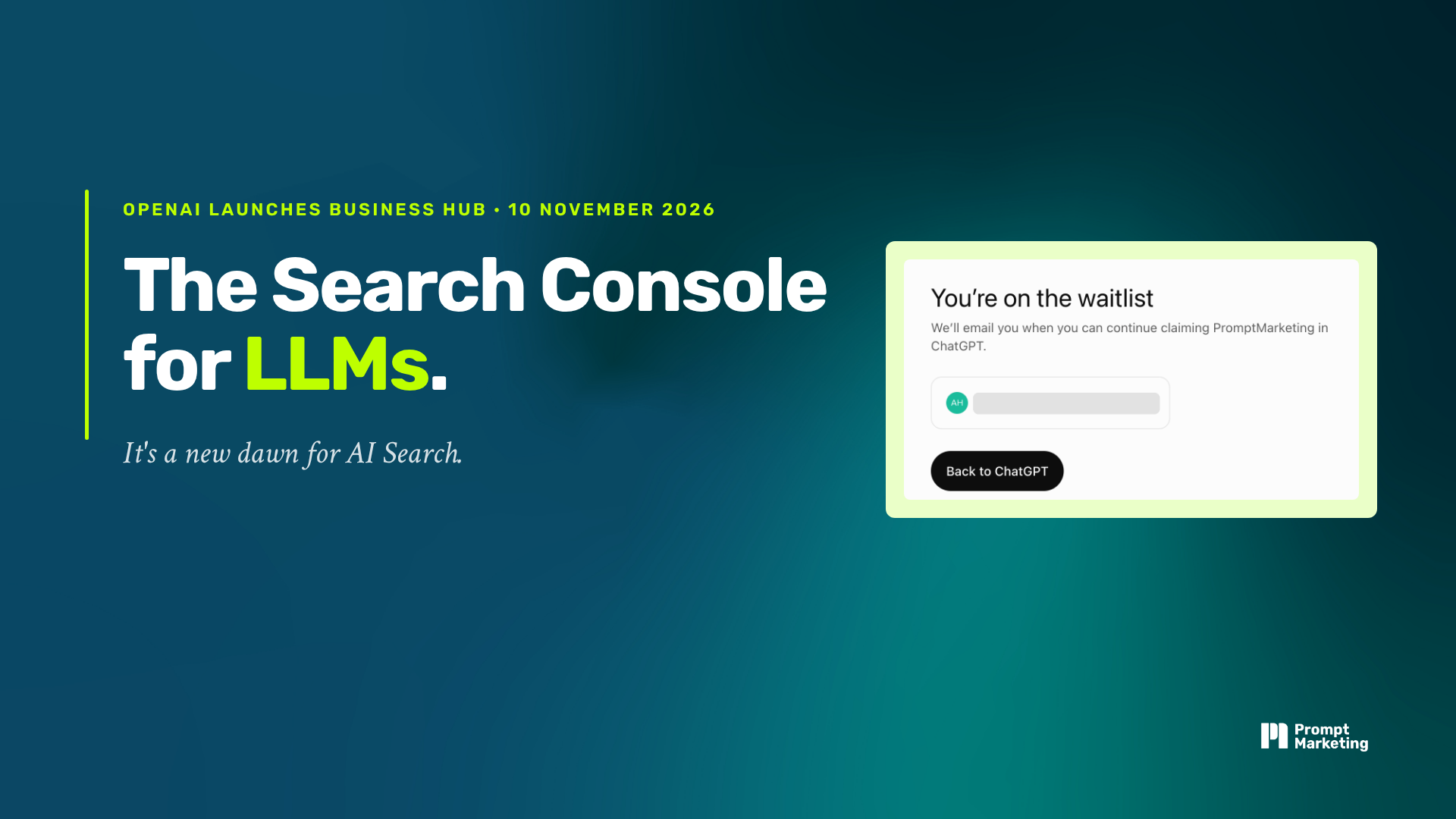
Three weeks ago, in the first session of our webinar series, I told the audience there is no query report and no Search Console for ChatGPT. On 10 November 2026 OpenAI launched one.
It is called Business Hub, and it is part of a wider release named Businesses in ChatGPT. You claim your business in ChatGPT, manage its facts, and see how often ChatGPT mentions you and how many clicks follow. For every business, in every country, this is the biggest AI search news of the quarter. We started our own claim the same evening, from Amsterdam.
From sampling to counting
Our session on 20 October had one message: nobody tracks AI search visibility, everybody samples it. A headless browser, logged out, types a prompt into the engine every day, and a tool records whether you were named. That is the engine's default answer. A logged-in user can see something else, and the sample does not say how many people asked.
Business Hub changes the basis for one engine. OpenAI counts what happened in real conversations and shares the totals with the business. You see how often ChatGPT cited your website or showed your location, how often people viewed your profile, and how often they clicked through. Those are counts from the source. No sample can give you that.
The two blanks from October stay open. OpenAI does not share prompts, and it does not publish how often a question is asked. You get the outcome on your side: how often you appeared, and how often that led to a click.
What Business Hub gives you
A claimed profile. You prove that you represent the business. After approval and an identity check you manage your business details: description, category, website, logo, delivery and return policy. Retailers connect a product feed with prices and availability. A verified profile carries a blue check.

Insights. Activity over the past 28 days: mentions, profile views, website clicks and discovery topics. A discovery topic is a theme in ChatGPT answers that mentioned or cited your business.

A Business Agent. A labelled chat that answers customer questions with your own information. It explains products and policies and links to your website. You can also sponsor your agent and use it as the destination of a ChatGPT ad. For now, publishing an agent is open to eligible ecommerce and online service businesses in the United States.
Business Hub is free today. Benji Shomair, OpenAI's VP of monetization, did not rule out a paid model later, according to Digiday.
What happened when we claimed from Amsterdam
We went through the flow on the evening of 10 November.
- ChatGPT asks how customers buy from you. At a physical location, through an online store, or through a service. The service option says "coming soon".
- We chose our office address. ChatGPT already had a profile for PromptMarketing, with our address, our website and directions. Nobody at our company created it.
- We landed on a waitlist. The screen says OpenAI is gradually opening access and will email us when we can continue. We joined.
- A retail brand with dozens of stores claims store by store. Each location is its own profile.

OpenAI's help page explains the waitlist: "Local stores and restaurants can currently claim only an existing U.S. listing." Availability depends on the location and the type of business. Online businesses may see an option to add their business. We have not tested that route from the Netherlands yet. Kevin Indig did get a profile for a business that fits none of the categories: see the update below.
So every business can start today. Open Business Hub, find your profile, and claim it or join the waitlist.

How verification works
Once your claim opens, you pick one of the methods ChatGPT offers. The options are a code to your business phone or business email, a DNS record on your website domain, or a connection to your Shopify store. OpenAI reviews the claim and emails its decision.
A second step follows: identity verification through Persona. Expect to provide a government-issued ID, your business registration details and proof that you may represent the business. Editing your details, connecting a feed and the blue check open after that approval. The Insights tab is visible earlier, as the update below shows.
One detail matters for teams: the admin who claims the business can add teammates and give an agency access. Decide who that admin is before you start.
Update, 10 November, 23:30: what a live dashboard shows
Kevin Indig, who writes Growth Memo, got further than we did. He shared his dashboard on LinkedIn a few hours after launch and calls Business Hub "a sort of Search Console for ChatGPT". Four points add to what we wrote above.

- A business outside the three categories got in. Growth Memo is his newsletter, and by his own account it fits none of the three categories. He could still create a profile. He does not say which option he picked. So try with your website, even when no category fits. That route is next on our own list.
- The Insights tab is there before the ID check. His profile has the status Draft, and the tab already shows, with a 7 day and a 28 day view. The banner above it asks for a government-issued ID before he edits business info or publishes a business agent. His numbers are still blank. OpenAI withholds numbers below a reporting threshold, so blank does not mean zero. It looks like the ID check stands between you and editing or an agent, and not between you and the data. We will confirm that once we see numbers in a draft profile.
- Two tabs. Next to Brand insights there is a tab for Agent insights, for businesses that publish a Business Agent. Discovery topics show the top five.
- What is still missing. His list matches ours and adds three items: no audience segmentation, no documented way to attribute conversions or revenue, and no documented public API or bulk export. The last one matters for the tools. They cannot take in OpenAI's counts yet.
Advertisers may have a head start
OpenAI says existing advertisers and Enterprise customers can claim through their OpenAI representative. For brands with many locations the help page points to the same door. Central management of locations is not available yet, claiming the main brand does not claim its stores, and your OpenAI account contact knows the supported route. If you run ChatGPT Ads, ask your contact before you join the public queue. We are asking for the accounts we manage.
Search Console, with one report missing

The comparison with Google Search Console holds for the headline numbers:
- Impressions become mentions: counted when ChatGPT cites your website or shows your location.
- Clicks become website clicks from ChatGPT.
- Queries have no equivalent. You see discovery topics and no prompts.
Business Hub also does two jobs that Google splits over other products. You manage your listing, as in Business Profile, and your product feed, as in Merchant Center.
Read the definitions before you read the chart:
- For an online business, your brand name without a reference to your website does not count as a mention.
- A website click is a click on a link inside ChatGPT. OpenAI does not count completed visits or purchases.
- A blank metric does not mean zero. OpenAI withholds numbers below a reporting threshold.
- The data covers ChatGPT alone. Gemini, Google AI Mode, AI Overviews, Claude and Copilot are outside it.
- Claiming is no ranking lever. OpenAI's help page says it does not guarantee more visibility, and adds that advertising does not influence ChatGPT's independent answers.
What this does to the AI visibility tools
A whole sector grew up around sampling: Promptwatch, Searchable, Peec, Otterly and many more. We use Promptwatch and Searchable every day. Many of these tools have already moved beyond measurement, into agentic optimisation and full marketing platforms. We still expect this launch to hit the sector hard, in three ways.
- Their numbers can now be checked. A visibility score from sampled, logged-out sessions can be put next to OpenAI's own mention count. Farhad Divecha of Accuracast told Digiday he wants to see how far off the tools were, and whether they can take in OpenAI's data. Every buyer of such a tool will ask the same.
- The headline metric moves. "How visible are we in ChatGPT" was the reason to buy a tool. For claimed businesses OpenAI now answers the volume part for free.
- The value shifts to what OpenAI does not show. Which prompts you win and lose, what the answer says about you, who is named in your place, and how you do on the other engines. Tools that combine their samples with Business Hub counts become more useful. Tools that only report a score face a hard year.
The trade press reads it the same way. Adweek wrote that OpenAI's tool competes with the GEO startups, and Trending Topics headlined that ChatGPT takes them on. Analyst Debra Aho Williamson of Sonata Insights added the nuance in Digiday. OpenAI will not share everything it knows, and ChatGPT is one of several platforms. She expects demand for AI visibility services to stay strong. We agree. Sampling stays. It finally gets a reference point.
What to do this week
- Start the claim. Open Business Hub from the ChatGPT sidebar, or go to chatgpt.com/business-hub. Use a company account: the invite and the admin role attach to it.
- Run ChatGPT Ads or sell through Shopify? Use that route. Ask your OpenAI contact, or connect your store.
- Check the profile ChatGPT already shows. Name, address, website, directions. Note what is wrong. You can correct it after verification.
- Prepare the identity check. An ID of the admin, your business registration details and proof of authorisation.
- Multi-location brands: ask for the managed route first. Then pilot one location.
- Service businesses with an office: claim your office address. That is what we did while the service option is closed. Also try with your website: a business outside the three categories has already got a profile.
- Keep sampling your prompts. Business Hub tells you how much. Sampling tells you which questions you win and lose, against whom, and on which engine.
Our read
Search Console moved SEO from guessing to measuring. Business Hub starts the same move for ChatGPT, and it puts a counted number next to every sampled one. We will publish our own counts next to our sampled data as soon as our claim is through.
Want us to guide you through the claim and read the first numbers with you? Write to arjan@promptmarketing.com. The free GEO Audit shows where your brand stands in AI answers today. The session this post builds on: You are not tracking AI search visibility. You are sampling it.
Sources: OpenAI, Introducing Businesses in ChatGPT (10 Nov 2026); OpenAI Help Center, Setting up your business on ChatGPT (10 Nov 2026); OpenAI, Businesses in ChatGPT policy and Business Agents Policy (10 Nov 2026); Digiday (10 Nov 2026); Adweek (10 Nov 2026); Trending Topics (10 Nov 2026); our own claim flow, Amsterdam, 10 Nov 2026; Kevin Indig on LinkedIn, 10 Nov 2026.