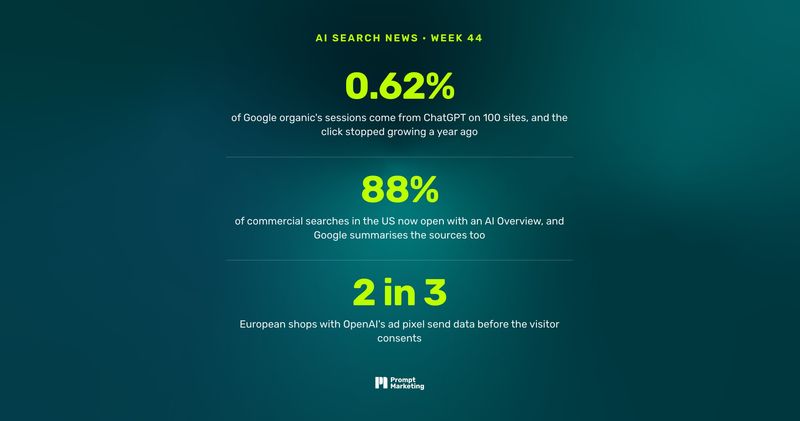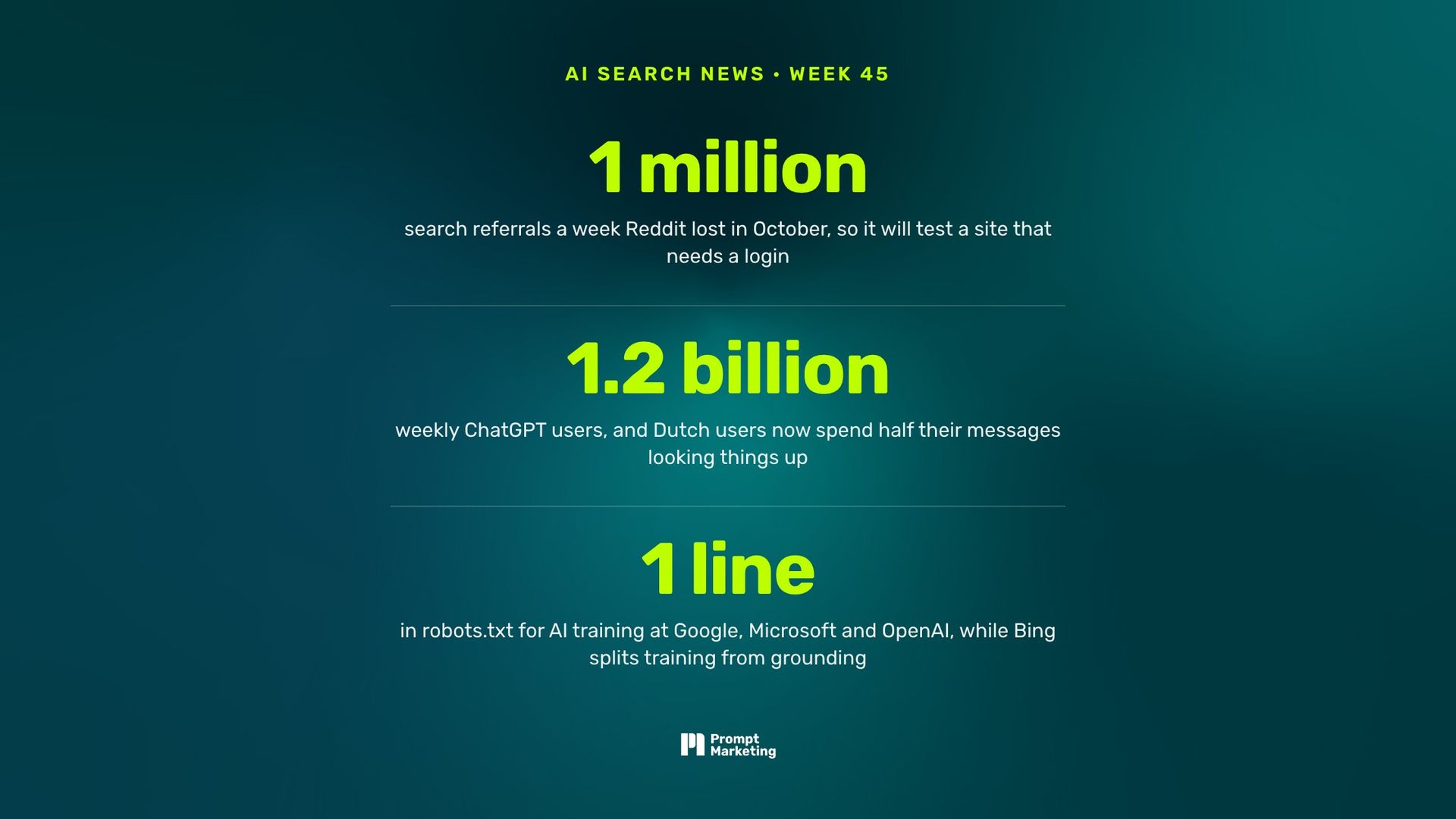
This week in AI Search News: Reddit moves to a logged-in-only site after losing more than 1 million search referrals a week, and ChatGPT reaches 1.2 billion weekly users while Dutch users now spend half their messages looking things up.
Reddit goes logged-in only and Google says AI Mode earns less: two earnings calls, one message for the open web
Alphabet reported on Wednesday 28 October. Search revenue grew 12% to 63.3 billion dollars, after 17% in Q2 and 19% in Q1. Sundar Pichai said the year-over-year query growth rate "is the highest it's been in the last five years", that queries in AI Mode are on average three times longer than traditional searches, and that one in five AI Mode searches uses voice, images or documents. The Gemini app passed one billion users, Pichai's remarks on 28 October. Philipp Schindler named three reasons for the slower growth: currency, the retail and media verticals, and "the lower monetization we were seeing in AI Mode". His answer is more ads: Google is "scaling ads within both AI Overviews and AI Mode to more users and more queries", with multiturn ads in the US, Search Engine Roundtable on 29 October and Search Engine Journal on 28 October. Findrix looked at where the links in AI Mode go: in 55,198 US product answers, 57% of the links led to Google Shopping product pages and 46.5% of the answers linked only to Google's own pages, with swimwear at 60.4%, Search Engine Land on 29 October.
Reddit reported the next day. Revenue grew 53% to 895 million dollars, and the shareholder letter says search referral traffic "was down meaningfully in Q3, with the decline accelerating later in the quarter". In October it lost "more than 1 million referrals on average per week", and if that holds, daily users could fall by a low double-digit percentage in Q4 from a base of 130 million. Logged-out users in the US fell 4% to 27.3 million, Reddit shareholder letter, 29 October. On the call Steve Huffman put the cause on Google's AI features: "what started as a feature is now the full search experience and at the minimum it pushes everyone down the search page", and "the AI mode does not drive traffic, not for us and not to anybody as far as I know". Demand has not changed, he said: "Google is crawling us as hard as ever." To CNBC he called it "a fundamental shift in how the Google product works, from being a traffic driver to whatever's going on now", CNBC on 29 October. The answer is a login wall. Reddit starts "fully testing" a logged-in-only experience in select markets outside the US in Q4, and "this is a test, but we are going to make this transition". The reasons he gave: better ad targeting, protecting the corpus because "the vast majority of the scraping and stealing of Reddit happens in our logged-out user base", and regulation. The licensing deals with OpenAI and Google continue, and any new deal "does potentially include not doing a deal", Reddit Q3 call transcript and Search Engine Journal on 30 October. The stock lost 36% in a week, Search Engine Roundtable on 2 November.

Reddit matters to GEO because it is a source that sticks. Ahrefs compared 10,000 US brands against 260 million unbranded prompts on AI Overviews, AI Mode and ChatGPT and found that the number of Reddit threads mentioning a brand correlates 0.75 with the brand's AI mentions, the strongest of seven off-site mention types, ahead of domain mentions and news articles at 0.70 and 0.67. Ten times more Reddit threads went with 5.5 times more AI mentions. The authors note the result may partly reflect Reddit's licensing deals with Google and OpenAI, Ahrefs on 3 November. In Ahrefs' separate tracking study, Reddit stayed cited on AI Overviews for all 20 days on 12 questions and more often kept the same thread than YouTube kept the same video, Ahrefs on 29 October.
What we see ourselves
Our daily Reddit run hit the wall before the earnings call did. Since 14 October, anonymous reads of Reddit's JSON endpoints return a 403, so a comment's survival can only be checked logged in. On 28 October the old.reddit.com feeds started redirecting to a "blocked by network security" login page even for RSS, and only the www.reddit.com Atom feeds still answer a logged-out request, at one request per 61 seconds. The wall is already up for machines.
Our view: the login wall does not change what Google and OpenAI can read, because both pay for the corpus. It changes what every engine without a licence sees, and what an agent sees when it opens a thread a user was pointed to. Reddit threads in your category remain the citation that sticks, and Reddit's own numbers say fewer people will read them through Google. Google's call says the same thing from the other side: queries grow, AI Mode answers them, and the monetisation plan is ads inside the answer, not links out of it. Budget for presence in the answer, and for a direct relationship with the customer the answer sends you.
ChatGPT at 1.2 billion weekly users and a fifth of Google's search volume, and Dutch users now spend half their messages looking things up
Adam Fry, ChatGPT's consumer product lead, gave Alex Kantrowitz the numbers at an OpenAI dinner in New York on Monday 2 November. ChatGPT went from 1 billion to 1.2 billion weekly active users in 60 days, "roughly 100 million users in 30 days, and another 100 million in another 30 days". Its users create 1.5 billion images a week, voice mode has 250 million weekly users, and "ChatGPT's volume of search-like queries is now roughly one-fifth the volume of queries of Google". What came first was writing and coding help, "those wouldn't be things that you really search for"; what grew over the last year is "looking up a person or people or a place or a thing", finance and health questions, "basically anything that a user would have traditionally gone to a traditional search engine for", Big Technology on 3 November. OpenAI's own pages carry the user figure: the GPT-6 post describes a model "built for more than 1.2 billion people who use ChatGPT each week", OpenAI. Search Engine Journal lists what Fry did not say: which Google figure, which period, which regions, and whether twenty prompts in one conversation count as twenty searches. Ahrefs estimated in February that ChatGPT's search-type volume was about 12% of Google's. Referral traffic runs the other way: in Ahrefs' October tracker across 118,671 sites, Google sent 24.74% of visits and ChatGPT 0.36%, Search Engine Journal on 3 November.
OpenAI's Signals data, updated on 26 October, shows what those messages are. It is a monthly sample of messages on Free, Go, Plus and Pro accounts from July 2024 to September 2026, classified by topic, with CSV files per country. Globally, Writing fell from 34.1% of messages in July 2024 to 21.4% in September 2026, while Practical Guidance rose to 28.1% and Seeking Information to 20.2%. The Dutch file is sharper. In July 2024, 41.2% of Dutch messages were Writing and 36.6% were Seeking Information or Practical Guidance. In September 2026, Writing is 21.1% and the two search-like categories together are 50.9%: Practical Guidance 29.3%, Seeking Information 21.6%. The Netherlands ranks third in the world in ChatGPT messages per person in Q3 2026, after Azerbaijan and Singapore. The share of Dutch messages that are work-related fell from 60% to 31% over the same two years, which means the growth came from private use, OpenAI Signals individual data and the CSV download. Eduard Blacquière made the point first on LinkedIn: Dutch users now use ChatGPT for more than 50% to "google", and that share grows, Eduard Blacquière on LinkedIn.

Two studies from the same week show how those search-like messages differ from searches. iPullRank matched 16,310 US desktop users across two Datos panels and compared what the same people typed into Google and into Perplexity, Copilot and you.com in November 2024. On Google, 84.8% of queries were a keyword or an entity and 8.1% were questions. On the AI tools, 26.8% were questions, 3.3 times the Google rate, and 6.9% were requests such as "write" or "summarize". For the same need, the AI prompt ran a median of 9 words against 5 on Google. One in twelve AI prompts (8.0%) revealed the asker's role, situation or purpose, against one in a hundred (1.2%) on Google. For 96% of AI prompts the same user never ran the topic on Google within 30 minutes, and a person's Google habits explained 4% of how they prompted an AI. The data is from November 2024, 99.9% desktop, and ChatGPT is 0.1% of the AI panel, iPullRank on 29 October. Profound then showed what the personal detail does. Eight synthetic personas, 14 consumer electronics prompts, ChatGPT and Muse Spark with search on, ten repeats each, 2,240 answers on 19 October: repeated runs for the same user overlapped 42% on ChatGPT and 18% on Muse Spark, and a user with relevant saved context got about half that overlap against the no-memory control. Muse Spark named 4.5 options with relevant context against 6.5 without, and the memory was referenced in 88% of ChatGPT's explanations, Profound on 29 October.
What we see ourselves
Under Eduard's post, freelancer Richard Theuws reported his own lead mix: 10 of his last 16 enquiries came from ChatGPT, 4 from Google. One freelancer, one month, but it is the pattern we described last week: the chatbot convinces, and the visit comes later or not at all. In Arjan's ChatGPT Ads training on 29 October the same Signals ranking came up from the other side: a country third in the world in messages per person, on a platform where most users sit on the free plan, which is the plan that shows ads. And a Dutch peer put the tracking consequence on LinkedIn this week: prompt tracking works like voter polling, fixed questions, rerun over time, read as a trend.
Our view: one in two Dutch ChatGPT messages is now a search, with a user base that grew by a fifth in two months. That is the demand side of GEO, and it does not show in your analytics, because the answer rarely sends a click. Build the prompt set from sales calls, support tickets and search data for the topics, write it in the two shapes real users type, the four-word lookup and the 28-word situation, keep a share in first person, and then do not touch it. And write the page for the person who already told the model who they are: who the product suits, what it works with, what it costs, what it does not do.
One robots.txt line for AI training: Google, Microsoft and OpenAI sign up, and Bing separates training from grounding
On Friday 30 October, Google, Microsoft and OpenAI each announced support for a shared AI training preference in robots.txt. The signal comes from an Internet Draft by Kevin Kelley of Anthropic in the IETF's AI Preferences working group. It is a rule group with a policy token and the ordinary Allow and Disallow lines:
User-Agent: __usage_ai-training Disallow: /
The token does not control crawling, a wildcard group never matches it, and a file without the group states no preference, Search Engine Journal on 1 November. Google "aims to support this new control along with other AI providers in 2027". If a site opts out through the token and does not name Google-Extended, Google will "interpret that as if the publisher had disallowed" Google-Extended, which also covers grounding in Gemini Apps. The control does not touch Search, and AI Overviews and AI Mode keep their own Search Console control, Google Search Central on 30 October. OpenAI "aims to implement the signal in the coming months" and keeps its existing GPTBot controls in place, OpenAI on 30 October. Microsoft went furthest. Bing adopts the robots.txt training preference, extends it to the page level, and adds a separate page-level AI Grounding preference with two restrictive values: Disallow, and DisallowExtended, which allows grounding in Microsoft's own products such as Copilot and Bing's AI Overviews but not in the grounding services Microsoft sells to third parties. Both default to Allow. The new preferences take effect on 1 February 2027. Sites that use NoArchive or NoCache today must publish the new preferences and record a temporary grounding preference in Bing Webmaster Tools, which opens on 15 December, before 1 March 2027, because after that date the old tags are no longer read. Microsoft's own warning: "If you select DisallowExtended or Disallow for grounding, you will see reduced brand visibility in AI experiences", Microsoft Bing on 30 October.

Cyrus Shepard tested what the Google side of that choice costs. He opted one site out of Google's generative AI features through the Search Console control and watched. AI impressions went to zero at once. The estimated click-through rate on those AI impressions had been about 0.9%. And "regular organic clicks ALSO DROPPED when AI features were disabled". AI Overviews kept showing on the result pages, only without his site in them, and the URLs with the most AI visibility lost clicks and recovered when he switched back on. He calls it a small case study, one site, and a "Search SERP Halo Effect": the more places your brand appears on the page, the more likely a user clicks one of them, Cyrus Shepard on LinkedIn and Search Engine Roundtable on 30 October.

What we see ourselves
The robots.txt check is the first item in every GEO audit we run, and this week it moved from "which bots do you block" to "which of three uses do you allow". In the ChatGPT Ads training Arjan gave on 29 October, the first homework for all eight participants was the same file: open robots.txt and the CDN rules and confirm that OAI-SearchBot and OAI AdsBot get through, because an ad or a citation cannot point at a page the crawler never read.
Our view: treat training and grounding as two decisions. Training is a licensing question for legal and management, and the shared token makes saying no cheap. Grounding is visibility, and Microsoft wrote the consequence into the announcement. Shepard's one-site test adds a Google-side reason to keep the generative controls open: a citation seems to lift clicks on the rest of the page too. Before February, list every site in your portfolio that carries NoArchive or NoCache, because those tags silently expire as an AI preference on 1 March.
ChatGPT Ads rewrites your ads by default, and the first academic paper prices a ChatGPT click at 26 cents
Since Friday 30 October, creative enhancements are on for every new and existing self-serve ChatGPT Ads campaign that did not opt out; sales-managed accounts are not affected. OpenAI may write new headlines and descriptions, translate the ad text into another language, resize images and change the destination URL to another page on your site, "prepared in advance or created in real time based on the conversation". There is no preview: "The experience does not provide a preview of every variation." The switch sits under Manage settings in Ads Manager, campaign settings override the account default, and existing opt-outs are preserved, OpenAI Help Center. Search Engine Journal lists what the help page does not say: whether tracking parameters survive a changed destination URL, whether you can exclude landing pages, and whether any report shows the enhanced versions one by one, Search Engine Journal on 30 October. The same day OpenAI's weekly advertiser mail listed the rest: multi-image ads with four to six square images are now in open beta for all advertisers, the Shopify integration works in every country where ChatGPT Ads run, and a wider standard ad card that uses more of the conversation width on desktop is rolling out on existing creative, Search Engine Roundtable on 30 October. Google used its earnings week to expand on the other side: ads in AI Mode are live in Australia, Canada, India, Kenya, Malaysia, New Zealand, Nigeria, Pakistan, the Philippines and Singapore, with Brazil, Mexico and the UK planned for Q4, multiturn ads launch in the US, and Google's internal data for 20 August to 3 September says "click-through rates are already similar between sponsored and organic product list items within AI Mode", Google Ads blog on 28 October.

Maximilian Kaiser of the Vienna University of Economics and Business and Christian Schulze of the Frankfurt School put the first academic numbers on what a ChatGPT ad click is worth. Their working paper, dated October 2026 and under review, uses Google Analytics e-commerce data from Grips Intelligence for 1,898 websites and about 10 billion sessions from June 2025 to August 2026, and treats the EU, where ads had not launched, as the comparison group for OpenAI's country-by-country rollout. In the US, a paid ChatGPT visit produced 0.89 dollars in revenue against 2.45 dollars for a paid Google Search visit, and converted at 0.37% against 1.17%. At paid search's rate of return, a ChatGPT click is worth about 0.26 dollars; the largest publicly known account paid 1.72 dollars per click, more than six times that. The ads cut organic ChatGPT referrals by an estimated 5.9% in the first 13 weeks, with no change in the conversion rate of those referrals. Last-click data, 102 advertisers in the paid comparison, a single data provider whose scientific advisor is an author, Kaiser and Schulze, October 2026 and Search Engine Journal on 2 November.

What we see ourselves
Arjan taught the Emerce Academy "Deep dive ChatGPT Ads" on Thursday 29 October: three hours with eight marketers from travel, e-commerce and B2B, with live time in Ads Manager and the desktop plugin. The points that took the most questions: ChatGPT Ads has no keywords, so the context hint has to describe the user, the situation and the need, and the full 100 characters of the headline carry relevance signal. There is no search term report and no auction insight, so the organic side, what ChatGPT already says about your category, is the only window into the conversations. The Conversion API is not optional, because the iOS app strips UTMs and ad blockers eat the browser pixel. And creative enhancements get switched off for every brand with strict guidelines.
Our view: open Manage settings today, on every account you manage, and decide per campaign. Translation is the quiet risk for Dutch advertisers: an English campaign can now serve in Dutch in a wording nobody approved, and under the Ad Tools Terms of 21 October the advertiser is responsible for creative "applied to their campaigns". The Kaiser and Schulze numbers are a US retail average with one dominant advertiser inside it, not a verdict on your account, but they set the bid: start at the parity price your own paid search implies, not at the 3 to 5 dollars OpenAI suggests.
Also noted
• Ahrefs followed about 37,500 websites cited on day one across AI Mode, ChatGPT, AI Overviews, Gemini and Copilot for 20 days. By day two 60% of the citations on AI Mode and ChatGPT were gone, and only 4 to 7% lasted all 20 days on Google's tools and ChatGPT. About 75% of dropped citations came back. The brand's own site on a brand-named question was cited on 60 to 68% of days, against 16 to 20% for other sources, Ahrefs on 29 October.
• TJ Robertson rated 193,507 answers from ChatGPT, AI Mode and AI Overviews to 4,167 unbranded buyer questions. In blind ratings, cited pages opened with a direct answer 20% of the time against 5% for Google top-10 pages the AI never pulled up. A year in the title came with double the odds of a citation, a date in the past 12 months with 88% higher odds, a table with 69%, TJ Digital, 25 October.
• SIXT changed nothing on sixt.com and published AI-generated content on 11 listings across four travel partner domains, one of them an untouched control. Citation frequency rose 320% on the two full-treatment domains and 12.2% on the control, over two weeks, 24 prompts, one brand, measured in Peec's own tool, Peec AI on 28 October.
• Google moved AI Overviews on many brand searches to the right-hand column on desktop, where the Knowledge Panel used to sit, spotted by David McSweeney on 31 October and Chris Long, Search Engine Roundtable on 2 November. Google may also be testing the removal of the citations card from desktop AI Overviews, Search Engine Roundtable on 29 October.
• Kevin Indig took Similarweb estimates for 10,000 domains each in the US and France. Organic visits fell 13.2% in the US and 24.4% in France from August 2024 to August 2026, publishers lost about 42% in both, small sites were roughly flat, and AI referrals are about 0.5% of all visits in both countries, Growth Memo on 26 October.
• Adobe: in September, AI traffic to US retail sites grew 71% year over year, converted 90% better than non-AI traffic and generated 83% more revenue per visit, against 9% worse conversion in August 2025, on more than 1 trillion visits, Adobe on 29 October. HubSpot's blog lost about 80% of its organic traffic from a peak above 20 million visits a month while revenue grew 19%, Search Engine Journal on 29 October.
• Gemini stopped appending utm_source=gemini to cited links around 28 September, three weeks after it started. The web version still passes a referrer, the iOS app opens links in a WebView and sends none, so those visits land in Direct, Search Engine Roundtable on 30 October.
• Google opened the preview of its Connected Apps Platform on 28 October: apps connect through a remote MCP server, pick a category and at least three capabilities, and the policy bars misleading descriptions written to get an app picked, Search Engine Journal on 31 October. Shopify now pays the company behind an AI shopping agent 0.3% of orders on promoted products, with an extra store commission paid only when the shopper buys in Shop, Search Engine Journal on 30 October.
• The Daily Mail runs 12 to 15 GEO tests with brands in the US, UK and Australia before it launches an AI visibility product early next year, Digiday on 26 October. Foundation and Writesonic ran 1,235 single-brand B2B buying prompts weekly from 29 June to 21 September: 21.7% of the 15,716 AI Overviews cited a direct competitor, 35.8% on "alternatives" prompts, Foundation, updated 24 October.
That is the week. If you want to know what any of this means for your own AI visibility, our door is open.