This week in AI Search News: four studies say AI assistants send almost no traffic and we say they measure the wrong moment, AI Overviews now sit on 88% of commercial searches and Google writes the line under your link, SISTRIX and High Salience show what gets cited, and OpenAI's ad pixel fires before consent on two in three European shops.
Four studies say AI sends almost no traffic. They measured the click, and the chatbot does not invite one
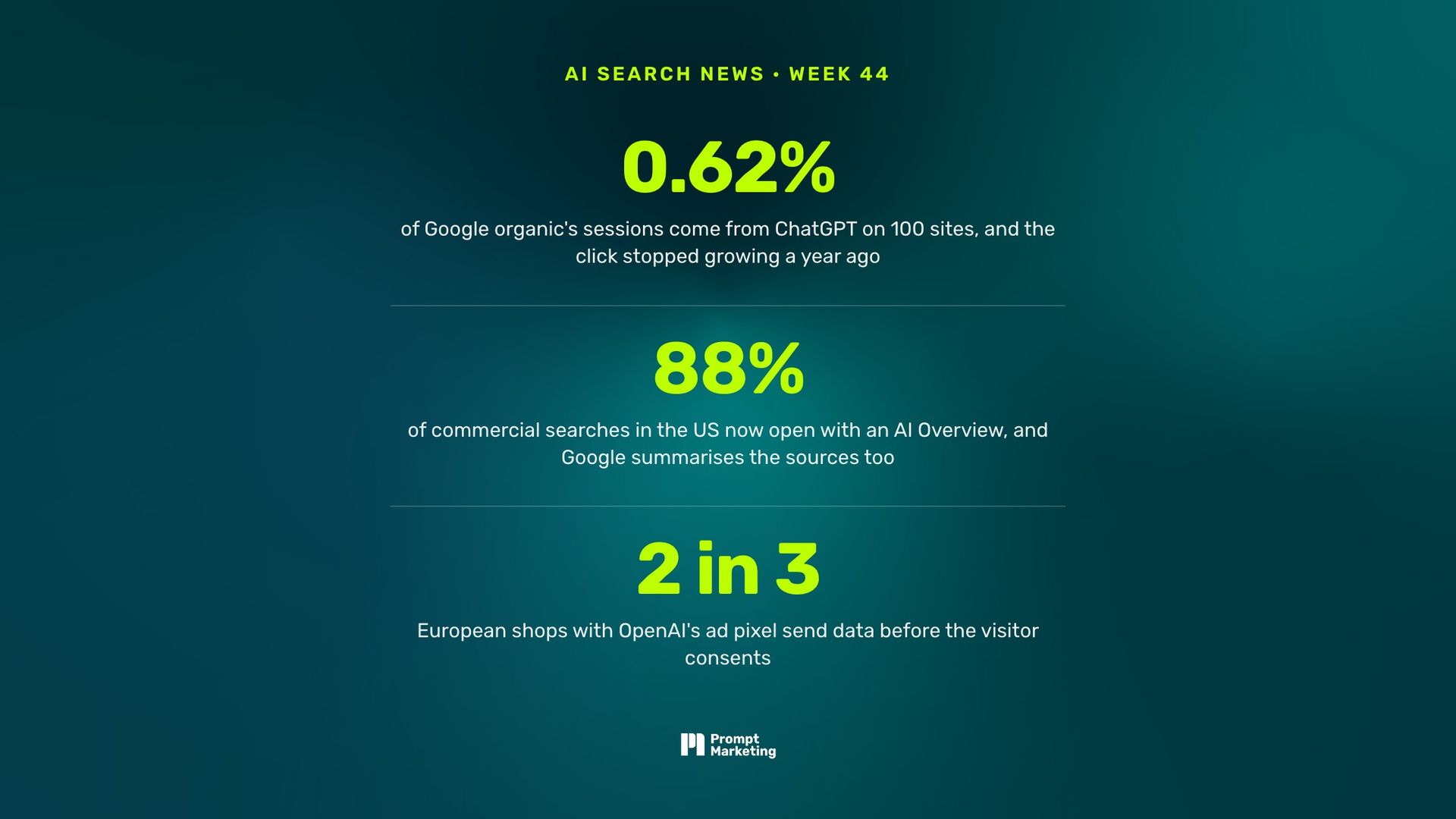
Marie Haynes pulled 12 months of GA4 data from 100 websites, more than 145 million sessions. ChatGPT sessions came to 0.62% of the volume Google organic sent. All LLMs together came to 0.73%. On the 55 sites that track conversions, ChatGPT visitors converted at 13.8% against 3.02% for Google organic, and Google still drove 96.5% of all conversions, 27 times more than every LLM combined. Her growth chart is the detail to keep: "the exponential growth of ChatGPT sessions ended" in August 2025, around the GPT-5 release. Mike King notes that ChatGPT's weekly audience went from 700 million to 1.2 billion over the same months. Her title is "GEO is a distraction", Marie Haynes on 21 October and Search Engine Journal on 23 October. SEO Works in the UK summed 95 GA4 properties from September 2025 to August 2026: 2.8 million organic sessions against 72,095 AI referral sessions, so organic sent 39 times more. AI visitors converted at 7.18% against 6.08% for organic, but that advantage held on only 40 of 63 sites, and B2B product companies saw AI convert at 0.62 times the organic rate. For every 100 organic conversions, AI delivered 3.2, SEO Works and Search Engine Land on 22 October. Kevin Indig went looking for the hidden part, AI visits that land in Direct. On 12 sites, 8 showed Direct growth from August to September, some above 100%, and most of it was bots: one site logged 409,000 Direct sessions of which 198 were engaged. Direct sessions with an identifiable AI trace averaged 0.003% of Direct. Across four brands and 632 tests he found correlations of 0.72 and 0.47 between AI share of voice and Direct traffic, then shifted the dates and found wrong alignments that scored as well. "I couldn't establish a reliable link between AI visibility and subsequent branded search or Direct traffic," Kevin Indig on 19 October.

Barry Schwartz bundled the three as "3 New Studies Suggest AI Visibility & Search Not Worth Investing In", Search Engine Roundtable on 22 October. Rand Fishkin asked "Is AI Visibility a Marketing Boondoggle?" and answered mostly yes: traffic from AI assistants is "nearly non-existent", less than DuckDuckGo in Haynes' data, Google's referral volume is 30 to 50 times larger, and a budget should follow that ratio, SparkToro on 22 October. Mike King answered the same day that all three studies "grade a brand channel with a traffic ruler". His case: Semrush puts zero-click sessions at 43% with an AI Overview and 93% in AI Mode, Pew found 1% of searches with a summary led to a click on a source inside it, and in Indig's own think-aloud study the median number of external clicks per AI Mode task was zero. An AI answer is "earned media composed by a machine", so budget it like brand and measure it with the tools brand uses, iPullRank on 22 October. Graphite added the mechanism a week earlier: in 3,115 entity-question pairs on logged-out ChatGPT, brands that the model barely knew without search reached a median visibility of 11% even when their pages were cited with search, while brands the model already knew appeared almost always. The share of ChatGPT comparison answers that ran a search rose from 56.6% in early August to 88.5% in late September, and the knowledge-cutoff gap for models released since July sits at 2.4 to 4.6 months, so nothing you publish today reaches the model's memory before spring, Graphite on 16 October.
What we see ourselves
Arjan answered under Rand Fishkin's LinkedIn post about the three studies. All three put the focus on referral clicks from chatbots, and the third went looking for Direct traffic to long-tail landing pages. "But the user experience in a chatbot does not invite a click. It invites to chat more. Chat more. Get informed better." Then, overwhelmingly, users open another browser or app and Google the product, service or brand they were just convinced by. You hear this when you talk to users in proper qualitative research. "At the moment, talking to real people beats trying to use Analytics tools built for a different time." Indig's own article holds a data point that fits: Ramp's team estimated that 30 to 40% of its Direct traffic came from answer engines, and confirmed it by asking customers how they found Ramp, Growth Memo. That is why the measurement funnel in our webinar on 20 October ends in two layers no analytics tool fills: Declared Discovery, where buyers tell you where they heard of you, and Qualitative Research.
Our view: the three studies answer one question, does AI send clicks, and the answer is no. It will stay no, because the chat interface is built to keep the conversation going. The influence shows up one step later: in the branded Google search, in Direct, in the sales call. Analytics built for a click-based web cannot see that hand-off, so a weak correlation in GA4 tells you about the instrument before it tells you about the journey. Add one question to every form and every sales intake: how did you first hear of us, and did you ask an AI assistant? Talk to ten customers a quarter. Use visibility tracking for what it does measure: how often the assistant names you, and what it says.
Google's AI Overviews now sit on 88% of commercial searches, and Google writes the line under your link
Semrush tracked a fixed panel of 400 US commercial keywords across banking, ecommerce and software, in five groups: alternatives, "best X for Y", price and cost, reviews, and brand versus brand. In September 2025 an AI Overview appeared on 45.75% of them. In August 2026 it was 88%, and the 12% of keywords without one carried less than 3% of the search volume, so on a volume basis it is 97.08%. Reviews moved most, from 30.14% to about 90%. "Best X for Y" ended highest at 96.12%. Brand versus brand started highest at 63.41% and ended above 86%. Ecommerce keywords went from 32.62% to 85.11%, and ecommerce price queries from 4.76% to 71.43%, Semrush on 21 October and Search Engine Land on 22 October. The cards next to the answer changed too. Brodie Clark spotted that the citation cards beside an AI Overview now show an AI-written line about each source, built from "the information that Google thinks is most relevant to the query", instead of the page's own snippet. Barry Schwartz sees it on some of his queries and not others, and Google has not commented, Search Engine Roundtable on 23 October. Two smaller changes in the same week: a "Source preferences" button inside the AI Mode citation panel, which opens the preferred-sources list for editing, Search Engine Roundtable on 19 October, and some desktop AI Overviews that lost their "AI Overview" label for two days, which Google restored on 22 October after Schwartz asked, Search Engine Roundtable on 20 October.

Jarno van Driel reported from a Search Central Deep Dive that Google's LLM results use only Product markup, and only for queries that trigger Google Shopping, where merchant data from markup and feeds grounds the answer. Gary Illyes told him Recipe might follow, nothing else is planned, and in his tests no other LLM reads markup at all, Jarno van Driel on Bluesky, 22 October. Illyes also answered the question every legal team asks: can robots.txt allow AI crawling but block training? No. Robots.txt "is an access preference protocol" and "doesn't dictate what a system does with the data after it has already crawled it"; to keep a crawler out you name its user agent, Search Engine Journal on 22 October. Google rewrote its "Control what you share with Google Search" page the day before to list the robots meta tag, data-nosnippet, X-Robots-Tag and the Search generative AI control in one place, Search Engine Roundtable on 21 October. The Search Console control behind it, live for all sites since 31 August, removes a site from AI Overviews, AI Mode and the AI features in Discover within one to two days. It "isn't used as a ranking or inclusion signal affecting other parts of Search", it does not override Merchant Center or Ads, and it "doesn't affect AI training", which is Google-Extended's job. A child property inherits the setting of its closest configured parent, and the domain owner gets a notice when a child overrides it, Search Console Help. And Semrush published a small case that shows the other direction works: Feature Upvote found an AI Overview claiming it had no REST API, traced it to two old blog posts, updated them, submitted the pages for indexing, and the answer flipped within an hour and settled in a few days, Semrush.

Our view: the citation card used to be your snippet. Now it is Google's one-line verdict on your page for this query. The page has to state plainly who you are, what you do and for whom, in the first screen, or Google writes that line from whatever it finds. For webshops the Semrush numbers close the "AI Overviews are informational" argument: nine in ten review and comparison searches in the US now open with an answer. Check your own category's review, alternatives and versus queries this week and record which domains Google cites. And before anyone flips the new Search Console control to keep a site out of AI answers, record the current traffic and visibility baseline, and check which child properties inherit the switch.
What gets cited, and how quickly it changes
SISTRIX took 48,527 URLs cited by ChatGPT, AI Mode and AI Overviews in the DACH region in the second quarter, paired each with a non-cited page from the same domain, and ran conditional logistic regression on 96,418 URLs from 17,380 domains with 43 features each. A table of contents multiplies the citation odds by 1.7, and only 14% of pages have one. Article schema 1.6, at least five H2 headings 1.6, FAQPage schema 1.5, a table with a header row 1.5, a question as an H2 1.4, a visible last-updated date 1.3 on the 5% of pages that show one. The current year in the title scores 2.7, and an older year alone 0.7. Pages that combine many of these were cited 2.1 times as often, and only 10% of cited pages do. llms.txt shows no effect at all, 11.7% of cited URLs against 14.0% of all domains; HowTo, QAPage and breadcrumb schema sit at 1.0; readability at 1.03; Product schema at 0.8 overall and 0.5 in AI Overviews. SISTRIX also ran the same FAQ test at three sample sizes and got "23% less common", "31% more common" and "19% more common" from 833, 4,600 and 96,418 URLs, and concludes: "Don't trust a GEO study with fewer than 5,000 URLs", SISTRIX on 22 October. RESONEO's Gemini study, published in October from 76,450 shared conversations and 222,753 Google searches, adds where in the page the citation comes from: 33% of cited passages start in the first 10% of the text and 80% in the first half, half the passages are 43 words or shorter, and since May 43% of exchanges with a search show no source at all, RESONEO.

High Salience checked where ChatGPT's sources stand in classic search. On 21 October it asked 100 everyday questions twice, logged out in the US with web search on, and read Google's and Bing's first page for the exact searches ChatGPT ran. In the 33 answers it could check against both engines, 79% of the cited pages, 175 of 221, were on neither first page. ChatGPT still leaned on established sites when it chose what to cite: small sites made up 26% of the pages it pulled up and 14% of the pages it cited. The study states its limits: one day, one country, two runs per question, top ten results only. "Google rankings are a weak stand-in for ChatGPT visibility," High Salience, 21 October.

Envoyra ran 2,720 answers across ChatGPT, Claude, Gemini and Perplexity over four weeks: only 144 of 680 assistant-question pairs returned the same brand list in all four weekly runs, and Zendesk was the only brand ranked first by all four assistants. In the AI visibility category Claude recommended Profound in 89 of 96 answers, and Gemini never named it, Search Engine Land on 22 October. BusySeed asked 160 buying questions every week from 27 April to 3 August on ChatGPT, Claude and Gemini, and the study surfaced in trade press on 16 October: the first-named company changed from one week to the next 56.4% of the time, most often on Gemini at 61.2%, and only 85 of 480 question-assistant pairs kept the same leader all period, BusySeed. Seer Interactive captured the search stream behind one ChatGPT prompt on 3, 16 and 17 September: the retrieved URLs went from 14 to 40 while the cited ones stayed at 5 to 6, two runs eight minutes apart shared zero query strings, and the stream itself lost the fields that showed the fan-out, so "ChatGPT is already shrinking what it reveals about its own search process", Seer Interactive on 22 October. A preprint by Yunxuan Jiang, Xiaokui Xiao and three co-authors, submitted on 11 October and picked up this week, puts a number on the gap between the two counts: Google results and the OpenAI Responses API together recover only about a quarter of the URLs ChatGPT Web actually cited, and the match is far better at hostname and entity level than at exact URL, arXiv, 11 October.
Our view: this week reads like a checklist of how we already work. We fix structure first: headings, a table of contents, tables, the year in the title, a visible update date. We leave llms.txt alone. We measure each engine directly, because four in five ChatGPT citations sit outside Google's and Bing's first page, so a ranking report is no proxy. We never report a single run: every prompt panel runs across the engines through the week, and we report the share over the window, because the leading brand changes from week to week more often than not. And we read vendor studies with fewer than 5,000 URLs as anecdotes, which now has a SISTRIX chart behind it.
OpenAI's ad pixel tracks before consent on two in three European shops, and from 30 October ChatGPT Ads rewrites your ads too
CipherCue found OpenAI's measurement pixel in the markup of 341 retail sites, most of them European. On 22 October it loaded each one in a clean headless browser, left the cookie banner untouched, and recorded every request. 224 sites, 66%, sent a measurement event to OpenAI before any consent. 95 of those did it while a consent banner was still on screen asking the visitor to choose. 104 held the pixel back. Poland had the largest share of the firing sites, followed by Germany, the Netherlands, France, Italy and Spain, but Germany stands out the other way: barely a third of German sites fire before consent, against three quarters in Poland and the UK. One Dutch travel retailer on Cookiebot set OpenAI cookies before the visitor chose, and sent a new event after the visitor clicked "only necessary cookies" and moved to another page, CipherCue, 23 October.
The cause is the default. OpenAI's documentation says the pixel "initializes consent to true by default unless you set it to false or the Pixel finds a stored denial". The install snippet ends at the init call without a consent line, and "Control measurement consent" sits in a separate section further down, OpenAI pixel documentation. CipherCue tested the SDK: with the consent call set to false before init, no measurement event left the browser in any run. The control works. Most shops never add it. In 2025 the French regulator CNIL fined Shein's operator 150 million euros and American Express 1.5 million euros for the same sequence: cookies before the choice, and cookies after a refusal.


The second change lands on Friday 30 October. OpenAI switches on "creative enhancements" for every new and existing self-serve campaign: the system may write new headlines and descriptions from your ad and landing page, translate the text, resize images and send the click to a different page on your site, in advance or in real time, and "without requiring you to review or approve each version". You opt out under Manage settings in Ads Manager, at account level with campaign overrides, and existing opt-outs are kept, OpenAI Help Center, updated 26 October and Search Engine Roundtable on 20 October. The Ad Tools Terms OpenAI published on 21 October put the risk with you. You are responsible for "all Generated Creatives that you approve or use, or that are applied to your Campaign", including the substantiation of claims about price, availability and performance, and OpenAI "does not guarantee that Generated Creatives will be accurate, complete, error-free, non-infringing, compliant with law, consistent with your intended meaning", OpenAI Ad Tools Terms. The same day OpenAI opened ads in 26 more countries, 89 in total, said more than 100,000 advertisers have run a campaign, and wrote that ChatGPT Ads reached a 1 billion dollar annualized revenue run rate less than 200 days after launch, OpenAI on 21 October and OpenAI engineering on the ad stack.
What we see ourselves
AFAS published the first Dutch advertiser account on Monday 26 October, one day after the covered week. After a month, Jasper Boot writes, the conversions stand out because they are surprisingly high, and he credits the timing: people have often described their problem in detail before the ad appears. He discloses no spend, CPA or conversion count, and says a completed form is only a first result: the value of the leads still has to be proven, Marketingfacts. The best-read ChatGPT Ads thread on Reddit this week went the other way: a vendor's own post-mortem in r/ChatGPTPro, "We paid for ChatGPT ads", with 97,000 impressions, 1,260 clicks, about 3.16 dollars per click and almost no sign-ups, because its audience sits on the paid tiers that see no ads, r/ChatGPTPro. The CipherCue article reached r/OpenAI at 12 points and zero comments, r/OpenAI. Most Dutch shops will hear about it from their privacy officer first.
Our view: open the network panel on your own shop today, filter on openai, and load the home page without touching the banner. If a request leaves before the click, add the consent call before init, and wire the OpenAI pixel into your consent platform the way you did with Meta's. Then switch creative enhancements off before Friday 30 October on every account you manage, and switch them back on per campaign only where you are willing to sign for every version OpenAI writes, because under the new terms you do.
Also noted
• The EDPB's public consultation on its draft guidelines on web scraping for generative AI closes on 30 October at 23:59 CET. It has been open since 8 July and matters if you scrape, buy or commission scraped data for AI training, EDPB.
• Walmart published terms for AI agents on 21 October: each agent gets its own profile in the customer's account with per-purchase approval or a spending limit, developers get an MCP-based Agent Gateway in beta, agents that overstep are blocked, and "we price products, not people". Muse, ChatGPT and Gemini are the named integrations, Walmart. Google's Universal Cart is now live in US Search and Gemini, with purchases completed on the merchant's site, Search Engine Roundtable on 23 October.
• Sundar Pichai, asked how agents will reach the web, said both paths will develop: browser-based agents that click through pages "because that's what you as a user would do", and protocols such as MCP and UCP, which are "a far more scalable approach" but will take longer, and "there's going to be a chaotic evolution there", Search Engine Journal on 22 October.
• Glenn Gabe re-ran his JavaScript test 434 days after the first one. ChatGPT, Claude and Perplexity still fail to read main content that renders client-side, on all three test sites. Gemini passed all three, Copilot two, GSQI on 19 October. Server-render the pages you want cited.
• Shopper research collected by Modern Retail: 16% of shoppers start a product search on ChatGPT and 5% buy on the spot after an AI recommendation. After an AI suggestion, 33% check reviews first, 22.3% compare prices and 14.8% visit the brand's site, Digiday on 23 October. The recommendation starts the journey. The reviews still close it.
• GSC Wizard classified queries on 155 Search Console properties from June 2025 to September 2026 and found "reply artefacts", answers typed at an AI that end up as Google searches, on 94 of them, up 21 times per million impressions. Dutch replies are polite in 67% of cases, German in 75%, English in 40%. AI-shaped queries click through at 2.9% against 35.6% for the rest, GSC Wizard, 14 October.
That is the week. If you want to know what any of this means for your own AI visibility, our door is open.