This week in AI Search News: a bug dropped ChatGPT out of GA4 for a week and the referrals went Direct, Google moves the links up in AI Mode and AI Overviews, OpenAI gets a map of the web from Cloudflare, Ahrefs and Profound show what ChatGPT reads now and that Reddit is no longer on the list, and OpenAI rebuilds how ChatGPT Ads counts a conversion.
A bug causes ChatGPT to drop from GA4 for a week, and the referrals went Direct
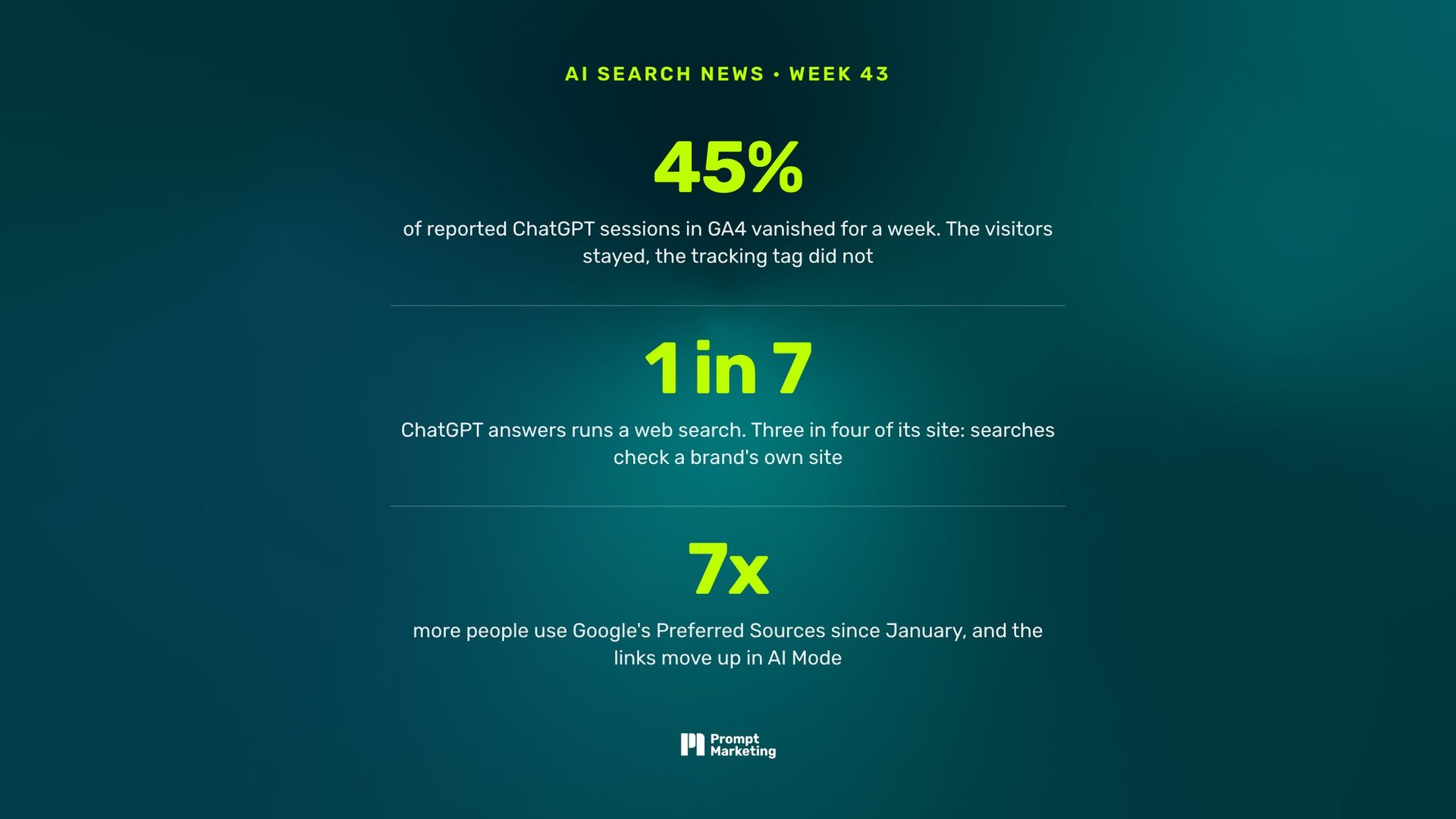
GPT-6 reached paid plans on 7 October and Free and Go users on 8 October. From that evening the links inside ChatGPT answers opened without the utm_source=chatgpt.com tag and without a referrer. Cedric Huesler of Adobe found the cause: GPT-6 opened links with a noopener, noreferrer call and dropped the tag. "There's no tag and no referrer, so your analytics files the visit under direct," Search Engine Roundtable on 14 October. Adobe compared 9 to 13 October with the week before on about 500 pages where ChatGPT drove at least 5% of visits: ChatGPT visits fell by about 31,000 a day, Direct visits rose by about 26,000 a day, and Direct rose on two of every three pages that lost ChatGPT traffic. Graphite saw ChatGPT sessions in GA4 fall 22% to 57% from 9 October, about 45% overall. LLM Pulse measured 46% fewer ChatGPT sessions on 9 to 11 October than on the same days in the two weeks before, with total traffic flat, Search Engine Journal on 15 October and Search Engine Land. Pontus Vippelius of AdRelevance saw the same in aggregated data for Swedish webshops: sessions from chatgpt.com and the AI assistant channel ran 54% lower per day after GPT-6, and the visitors landed in Direct, Pontus Vippelius on LinkedIn, 15 October. Chris Long's "ChatGPT has officially killed their UTM tracking parameter" collected more than a thousand reactions before he added the correction: a bug, now fixed, Chris Long on LinkedIn, 15 October.
Profound timed it. Before 8 October about 99% of the answers it collected with cited links carried at least one tagged link. On 9 October that was 75%, on 14 October 67%, and from 14 October 19:00 UTC it sat between 5% and 12% for 27 hours. Over the same days the share of answers in the new Intelligent UI format went from 2% to 35% to 96%. Tags came back on 16 October at 06:30 UTC, to 99%, Profound on 14 October, updated 16 October. OpenAI confirmed a bug to Huesler on 14 October and started a fix on 15 October. By 9 a.m. Pacific time tagged clicks across the thousands of domains he tracks were back at 95% to 100% of the same hour a week earlier. OpenAI's release notes for the period do not mention it, Search Engine Journal on 17 October. Tomek Rudzki of Peec AI ran about 1 million prompts in two windows, 2 to 7 and 9 to 13 October. ChatGPT put a direct URL into 42% of its answers, against 8% to 10% before GPT-6, and 54% of those URLs pointed to a home page.

What we see ourselves
The busiest GEO thread on Reddit this week was "ChatGPT is apparently stripping UTMs now. RIP attribution lol" in r/DigitalMarketing, at 43 comments and 97 points by Monday morning, r/DigitalMarketing. The OP's objection to the "Direct went up on cited pages" clue was that it is circumstantial. Arjan's answer in the thread, the most-read comment of our Reddit lane this month at 725 views in four days: give it a control. Note which of your pages ChatGPT cites on your buyer prompts, then compare Direct on that set with a matched set of your pages that never get cited, same age, similar traffic. If only the cited set moves, and keeps moving, you have an effect size. A German shop owner posted his server log in r/SEO_for_AI: tagged ChatGPT clicks down 73% to 79% from 8 October 22:00 UTC, while ChatGPT-User fetches of the same shop, from OpenAI's published IP ranges, fell only 20% to 23%, with recovery from 15 October, r/SEO_for_AI. The visitors kept coming. The label did not. In r/aeo a tracker vendor reported 16 ChatGPT sessions in GA4 against 64 in its CDN log for the same site in the same week, r/aeo. Both numbers are wrong in different directions. GA4 only counts what carries a tag or a referrer. A CDN log counts every bot fetch as a visit until you filter the published fetcher ranges, the ChatGPT-User agent and the requests that never loaded a second file.
Our view: the GA4 line called ChatGPT is a count of tags, not of visitors. Annotate 8 to 16 October in every report before someone reads it as lost demand, and annotate the recovery before someone reads it as growth. The bug is fixed. The structural part is not. Huesler says most ChatGPT clicks still arrive without a referrer, the phone app never sent one, and 42% of answers now carry a bare link, half of them to your home page. Keep a second count that does not depend on OpenAI's JavaScript: the server log with the tag or the chatgpt.com referrer, and Direct on the pages ChatGPT cites against a matched set that it does not. Mike King put the wider rule in one line last month: in AI search tracking "accuracy is a category error, the only thing you can have is precision," so a visibility number is a poll with a sample size, not a reading on a scale, iPullRank. Ask the same of your referral number. One run per prompt is a screenshot. One week of GA4 is a screenshot too.
Google moves the links up in its AI answers, and still will not say how many clicks they get
Google announced five link changes to AI Mode and AI Overviews on 15 October. It has made "continued and substantial increases to the presence of inline links" and is testing them higher in the answer more often. It is testing a section at the top of some answers for tasks where "there are only one or two official places on the web to complete a specific task," with a line on why each page is useful. News carousels, which highlight the searcher's Preferred Sources, roll out to more countries and languages, unnamed. Related links at the end of an answer get thumbnails. Creator and publisher names on video results in AI Mode become clickable, to their Search profile first. And "the number of people who now use our Preferred Sources feature has grown by more than 7x since the start of the year," Google, Search Engine Journal and Search Engine Land. The source count behind that 7x: nearly 90,000 preferred sources in December 2025, more than 345,000 in May and more than 600,000 in August, PPC Land. What Google did not announce is a click number. Barry Schwartz asked, and Google said it "will introduce additional metrics over time," Search Engine Roundtable on 15 October. In Search Console every link inside an AI Overview still shares the overview's single position, so a link that moves up inside the answer does not move in your report.

On the publisher side Google said more than 400 publications now take part in its News AI pilot, which pays for enhanced content in AI features, with Axios, CNN, the Financial Times and Forbes among the newest, Google. Reach, the UK publisher of the Daily Express and the Daily Star, signed a two-year deal with Google for its UK and Ireland portfolio and calls it a template for the deals it wants with Amazon, Meta and Microsoft, Digiday on 16 October. Also in the week: Gemini 4 Argon went into AI Mode for AI Pro and Ultra subscribers worldwide, Search Engine Journal on 13 October, and Google tested the AI Mode sidebar, with chat history and a start-a-chat button, on the main results page, Search Engine Roundtable on 14 October.

Our view: Google moves links up because carousels, Preferred Sources and licensing deals only hold if someone clicks, and the new section for "one or two official places" is the part to win. For every task a buyer completes with you, apply, book, cancel, download, return, there should be one page, with the task in the title, the steps in plain text and no second page competing for it. For the carousels, ask the readers you already have to add you as a preferred source. Google will tell you how many did, by email, and will not tell you how many clicked. Count that yourself.
OpenAI gets a map of the web from Cloudflare
Cloudflare and OpenAI published the first results of a pilot that started in July. About 1% of Cloudflare's network sends OpenAI discovery signals: which pages are new or changed, which addresses do not exist, redirect or duplicate another page, and which pages look harmful, flagged per page. In three months that helped OpenAI "discover and index hundreds of millions of new web pages." Cloudflare says it shares "metadata about the web for search and discovery, rather than sharing page content for model training," a signal about a page grants no access to it, and site owners keep control through AI Crawl Control, Cloudflare on 15 October. ChatGPT's crawler no longer waits for a link or a sitemap to find a deep page on a Cloudflare site. The pilot covers 1% of Cloudflare's network, so the question for every other site is when its host joins. The same week showed what OpenAI's crawling looks like from the other side. Reach, the UK publisher of the Daily Express and the Daily Star, sent OpenAI a cease-and-desist letter. Its CEO Piers North counts "well over 100 million successful scrapes" of Reach content in six months and OpenAI bots "millions of times a month," and says bot traffic is hard to tell from human traffic in his own logs, Digiday on 16 October.
Our view: discovery is becoming an infrastructure signal, not only a link or a sitemap. For a site behind Cloudflare, a soft 404, a redirect chain or a duplicate variant is now a signal OpenAI receives before it fetches anything, so clean status codes, one canonical per page and a true last-modified date matter for ChatGPT the way they have mattered for Google for years. Separate the permissions for OAI-SearchBot, which finds pages for answers, from GPTBot, which trains the model, and check in AI Crawl Control what each one gets. Being found is not being cited, and the pilot promises nothing about the second. It removes one excuse for the first.
ChatGPT searches in one answer out of seven, reads your product pages, and has dropped Reddit
Ahrefs analysed 66.6 million free, logged-out GPT-5.6 Luna answers from August and September and the 15 million fan-out queries behind them. Only 14.4% of the answers ran a web search at all, about one in seven. When ChatGPT did search, it ran 1.6 queries on average. 6.8% of those queries used the site: operator to search one website, across 116,000 domains, and 75.9% of the most common site: searches went to brand sites, 11.9% to retailers and 1.9% to Reddit and Facebook combined. Apple, IKEA, Nike, Adidas and Samsung top that list. "Price" rose from 6.04% to 8.88% of fan-outs between August and September, "2026" from 17.6% to 22.9%, and "official" from 10.1% to 13.1% of English fan-outs. In a separate set of 20,000 US prompts, 84.4% of factual questions cited at least one official source, against 68.3% of comparison questions, Ahrefs on 12 October. Josh Blyskal of Profound showed the same shift at brightonSEO on 9 October from 3.2 million ChatGPT citations: since ChatGPT changed how it picks sources in August, citations of documentation are up 80%, product pages up 30% to 40%, listicles down 35% and user content such as Reddit down 71%, as recapped by Vinoop Thayatt on LinkedIn.
The same data holds the Reddit story. Across 2.4 million US answers in March and 3.8 million in September, Reddit went from 19.1% of ChatGPT's answers to 2.3%, a drop of 88%. Wikipedia went from 14.1% to 2.9%. PubMed climbed from 64th to 4th among cited domains, WebMD fell from 18th to 79th, and Britannica, Investopedia and the New York Post left the top 200. Publishers with an OpenAI licensing deal went from 7.5% of citations in March to 15.8% in July and 12.5% in September, Search Engine Journal on 12 October. Searchable dates the Reddit drop to one week: from 24.1% of ChatGPT answers with a Reddit source before 8 August to 1.9% after 14 August, across 60,000 prompts, and 275 of the 283 brands that regularly had Reddit sources saw that share at least halve, Searchable. Google reads a different web. SE Ranking checked 100,000 keywords and found a link to a social platform in 67.66% of AI Overviews and 32.39% of AI Mode answers, against 8.4% of ChatGPT answers. YouTube leads in AI Overviews, Facebook, YouTube and Reddit in AI Mode, and in AI Mode non-branded queries carried social sources more often than branded ones, 48.58% against 39.34%, Social Media Today on the SE Ranking study. Last week Google built Reddit a fast lane into Search. This week the numbers say why it matters for Google and no longer for ChatGPT.

The local web counts too. OtterlyAI compared 3.95 million German and 3.73 million American citations across seven engines, 16 August to 28 September, on buying questions in 16 industries. On German prompts 64.9% of citations pointed to a source with a German language or region signal, 51.1% on .de, .at and .ch domains and 13.8% on German sections of global domains. On US prompts the share with a local signal was 5.3%. Perplexity leaned most on German sources at 75.2%, Claude least at 57.7%. Finanztip, Chip, Handelsblatt and Test.de lead the German list, Forbes, CNBC, Bankrate and NerdWallet the American one. Reddit was 0.60% of German citations, OtterlyAI, 6 October. No Dutch edition exists yet. Our own-brand tracker suggests the Dutch pattern is the same: the pages that answer "which GEO agency" in Dutch are Dutch trade media and Dutch competitors, not the American guides.
Being named and being cited are two different lists. Semrush's AI Visibility Index for the second half of 2026, published on 13 October, ran 2.5 million UK prompts and 25 million US prompts a month from January to July on ChatGPT, Gemini, AI Mode and AI Overviews. In every month and both markets, fewer than half of the 100 most-mentioned brands were also among the 100 most-cited domains, 36.7 to 45.3 out of 100 in the UK, and ChatGPT had the lowest overlap. Tesco and Asda both sat in ChatGPT's top ten for mentions in July. Tesco was its 25th most-cited UK domain. Asda was 606th, Semrush. Searchable's October numbers across 3,989 brands and 23 million answers: the median brand is named in 95% of answers to branded prompts and in 7% of answers to unbranded ones. On unbranded prompts the brand's own site earns about 5% of the citations and competitors' sites about 40%, Searchable. Two warnings for anyone reading those numbers. OtterlyAI added "2026" to the titles of 11 blog pages and saw citations rise 56% and 61% in two test groups, then checked the control: an untouched page rose 63% over the same two weeks, and one URL produced 93% of one group's gain. They filed the test as inconclusive, OtterlyAI on LinkedIn, 15 October. And a preprint from the National University of Singapore and Xi'an Jiaotong University, run on GPT-5.3 and GPT-5.5 from March to July, found that Google results plus the OpenAI API together recovered 26% to 28% of the pages ChatGPT actually cited and 49% to 50% of the sites. Google alone found 6% to 9% of the pages. 44.5% of the cited pages appeared in only one of 20 runs, Search Engine Journal on 18 October.

What we see ourselves
Our own-brand tracker ran 31 Dutch prompts about choosing an agency through 1,357 answers in the week to 14 October. PromptMarketing was named in 2.2% of them. Four Dutch competitors sat between 4.5% and 6.6%, all from pages written by Dutch trade media and the competitors themselves. The one page of ours the engines do cite is the ChatGPT Ads service page, which states a price and a scope. On the Reddit side, our daily Reddit run has now read the Dutch business subs 22 days in a row without one thread on AI visibility or GEO, while ChatGPT stopped reading Reddit altogether. A survey of 47 B2B agency leaders posted on Saturday says 64% now sell GEO and 32% can tie it to pipeline, r/DigitalMarketing. Arjan's answer there: part of that gap is measurement, because an AI answer ends in a branded Google search, not in a tracked click, and three numbers survive a finance director: referrals as the floor, with the October outage annotated, the "how did you hear about us" field, and branded search impressions set against the citation log.
Our view: six of every seven ChatGPT answers come from what the model already knows, which is what it read during training and what it has fetched before. The seventh checks your own site, for price, specs and support, with "official" in the query, and since August it prefers your documentation and product pages to the listicle about you. Put those facts in plain text on the page, with the year. A mention comes from memory, and memory is built by the pages that describe your category, mostly not yours. A citation needs a page that answers one question completely. Build both, in the language of the market, and test every change against a control page, or the 61% you report is the week's weather. And ask your tracking vendor whether it reads the ChatGPT app or the API, because the paper says the API finds a quarter of the pages.
OpenAI rebuilds ChatGPT Ads measurement: modeled conversions, a GA4 pipe and a weekly email
OpenAI sent advertisers its product update on 16 October. The measurement partners announced on 5 October now have setup guides, Northbeam, DV Rockerbox and INCRMNTAL for attribution and incrementality, Kochava, Tenjin and Airbridge for apps. Ads Manager gets a redesigned Conversions page that puts event volume, the share of campaigns optimising for conversions and event-quality warnings on one screen, linked to the Diagnostics tab. Every active account now receives a weekly performance email with week-over-week changes. A bug-report and feedback button sits in the account menu. And "alongside the Intelligent UI launch," OpenAI is testing wider cards and larger images on desktop and full-width images on mobile, on existing campaigns and creative, with the multi-image format inside image generation starting in the US with selected advertisers, OpenAI Ads. Advertisers also started getting mail from a human. "My name is Warren Smith, and I'm your Account Manager for ChatGPT Ads," with an offer of a biweekly check-in, Search Engine Roundtable on 14 October.
Two documentation changes matter more than the formats. The conversion guidance, updated around 15 October, now asks advertisers to send every conversion event they are permitted to share, including events without an oppref click reference, so OpenAI can match them through advanced matching on hashed email and phone number and report modeled conversions where a click was never seen. Pixel and Conversions API together need one event ID per event, or the same order counts twice, OpenAI help centre. The GA4 connection, in beta through an account manager, sends OpenAI an aggregate of your property's last 30 completed days across all traffic sources, source and medium, campaign names, event counts, key events and purchase revenue, then a daily update. A separate GA4 Conversions column shows what GA4 itself attributes to the campaign, OpenAI help centre. 404 Media tested the targeting side and found advertisers can match uploaded email addresses, phone numbers and device identifiers to ChatGPT users and target on the prompts they type, 404 Media on 15 October. For the EEA and Switzerland OpenAI's own documentation says to leave custom audiences off while personalisation is unavailable, and elsewhere a list needs 25,000 matched users before it can target or adjust bids, OpenAI help centre.
The European evidence of the week shows why the measurement rebuild comes first. At AdWorld in Bologna ten practitioners compared notes with Adthena: one agency saw "three or four clicks, seventy conversions" in the ChatGPT dashboard while GA4 with server-side tagging put the cost per acquisition four times worse than Google Ads, another campaign showed 344 conversions in-platform and a different story in GA4, and a B2B marketer found about 50 Salesforce leads without a single attached opportunity. Test budgets sit at 5% of monthly spend or less, Adthena on 16 October. Overt Intelligence read 1,499 company sites on 11 to 13 October and found the ChatGPT Ads pixel on 110 of them, 7.3%, rising to 14.5% among SaaS companies, Overt Intelligence. ThoughtMetric put ChatGPT Ads at 0.45% of the combined Google and ChatGPT spend in its ecommerce customer base in September, with no advertiser count or geography disclosed, ThoughtMetric on 12 October.
What we see ourselves
A bot-refund vendor posted in r/adops on 15 October that it spent 900 dollars on ChatGPT Ads and found "58% of billed clicks were bots, 99% Microsoft data centers," r/adops. Arjan answered with the arithmetic: the 58% is 788 flagged requests out of 1,356 arrivals, while the vendor was billed for 923 clicks, and 665 of those arrivals came from Azure. ChatGPT runs on Azure, OpenAI publishes its fetcher IP ranges, and a fetch that previews a page before a human clicks is neither a billed click nor a bot. The vendor conceded the Azure point and kept about 300 non-Azure bot clicks as its refund case. In r/OpenAIAdvertising a hydration-pack webshop showed what the new conversion guidance produces in practice: Ads Manager reported 3 orders on 332 dollars of spend, two of them view-through matched on email, while Shopify showed 41 orders that day and none attributed to ChatGPT, r/OpenAIAdvertising. Our own three-webshop case still reads 3.0 times the spend on the dashboard's attribution and 0.7 on click-through orders.
Our view: OpenAI is building the reporting layer of a grown ad network, and every new piece moves the count further from a click. Modeled conversions, email matching and a GA4 import of all your traffic sources mean the dashboard will report more orders next month than it does today, from the same campaigns. That is the design, not a bug. Before you connect GA4, decide who in the client's organisation authorises sharing 30 days of all-source revenue data with OpenAI. Then run three rules: set the pixel's consent to false before init on a European site, give Pixel and Conversions API the same event IDs, and match the dashboard's orders against your own export by email and date before the weekly email reaches anyone. The number that survives that match is the ChatGPT Ads result. Everything above it is modeled.
Also noted
• SE Ranking checked nearly 300,000 domains for an llms.txt file. 10.13% had one, spread evenly across traffic levels, and there was no correlation with how often AI systems cited the domain. Removing the variable from its model improved the model, SE Ranking on 15 October. Spend the afternoon on robots.txt instead.
• The same question in another language gets another brand. Reza Moaiandin asked six buying questions in English, Arabic, Russian, Chinese and Persian, 40 runs each. For a London to Tenerife flight Persian answers picked British Airways 52.5% of the time, Russian answers picked easyJet 72.5% of the time and never named British Airways. With web search on, the winning hotel changed in all five languages, Search Engine Journal on 13 October. Track Dutch prompts in Dutch.
• Profound compared Claude Sonnet 5 and Sonnet 5.5 on 711 prompts, 20 runs each. The new model searches in 77% of answers, almost always with a single query, puts "2026" in 59% of its queries, cites pages with a median age of 107 days instead of 164, and asks for the buyer's budget, use case or location in 60.6% of answers against 12.5% before, Profound on 13 October. A page that says who the product is for gets the follow-up.
• Bing Webmaster Tools added a Topics Portfolio to its AI Performance report: your cited queries grouped by theme, with the size of each theme, how many sites it cites and the queries where other sites are cited and yours is not, Search Engine Roundtable on 13 October. It is the source-gap report Google does not give you, and the one AI-search report with a baseline you can start this week.
• Nozzle says Google now answers rank-tracker requests with a full page of wrong results. 8% of the 17.8 million result pages it collected between 13 September and 9 October were missing most of a keyword's usual sites, up from 0.17% in the weeks before, with a peak of about 25% on 27 to 29 September. On an affected page the customer's site was absent from the top ten 58.6% of the time, Search Engine Journal on 14 October and the 17 October update. Confirm every drop in Search Console before you believe the tool.
• Google's Universal Cart went live in the US across Search and the Gemini app on 15 October: one cart across retailers, price and stock alerts, Google Pay checkout for some merchants and a hand-off to the merchant's own cart for the rest, with Nike, Sephora, Target, Walmart, Wayfair and Shopify merchants on board and the merchant as seller of record, Google.
• Bill Hunt tested the top 122 Shopify stores for agent readiness. 89 served an agents.md file, 83 of them Shopify's own template. All 74 stores with a live checkout endpoint created a checkout for an agent, none returned a delivery estimate, 36 priced shipping, and the policy tool gave a usable answer on the cost of shipping to Boston for zero stores. No store passed all nine purchase-decision checks, Search Engine Journal on 14 October.
• Meta's new Commercial Terms, in force from 30 October, let it crawl the website of any business that uses a Meta product, including by creating test credentials. After Nieman Lab and publisher groups objected, Meta dropped the word "train" from the purposes on 17 October and narrowed the clause to its ads and business products. The crawling permission stays, and robots.txt is still the stated control, Search Engine Journal on 16 October and FourWeekMBA on the revision. Check which Meta crawlers your robots.txt names.
• Similarweb's September split of generative AI web traffic: ChatGPT 56.4%, Gemini 25.0%, Claude 9.6%, DeepSeek 3.4%, Grok 2.3%, Copilot 1.5%, Perplexity 0.9%. Claude was at 8.0% in April and Gemini has lost share four months in a row, OfficeChai on Similarweb data. Claude is the third engine to track.
• Google is hiring a team that "leads by recommending AI-generated content" in Discover and a design lead to turn Discover into a "proactive, hyper-personalized concierge experience," Search Engine Journal on 12 October. Chartbeat put Discover at 13% of publisher referrals last week, against 7.3% for Google Search.
• Fender rebuilt its website around heritage video and Marshall stages gigs in closed venues on YouTube, both partly to be cited by AI. A Kantar survey from early October found 75% of marketers plan to spend more on AI assistant visibility next year, Digiday on 15 October. Nobody in the piece could show a result yet.
That is the week. If you want to know what any of this means for your own AI visibility, our door is open.