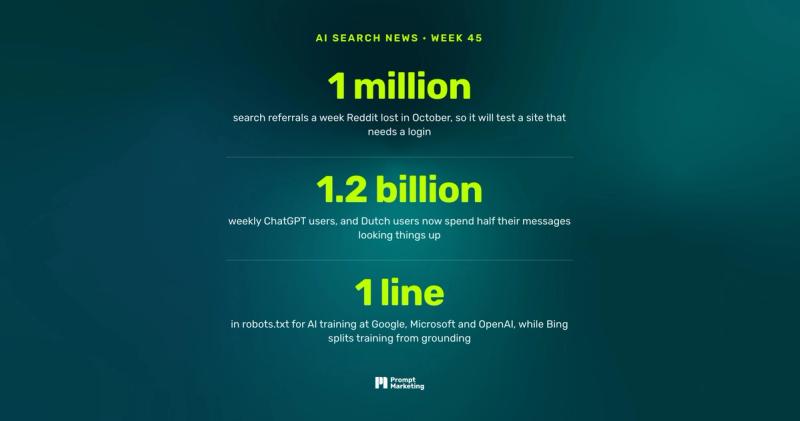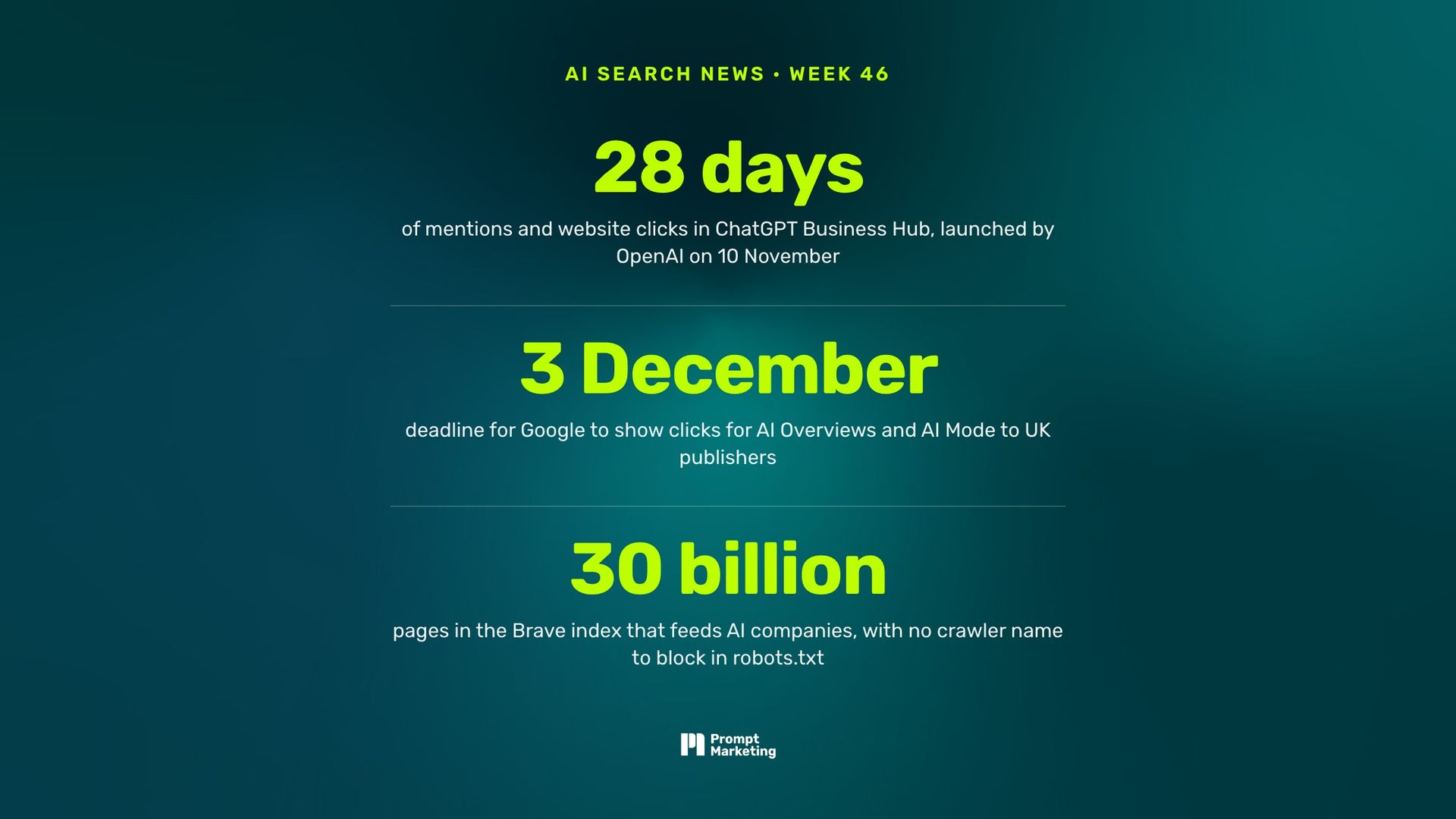
This week in AI Search News: OpenAI launched Business Hub, where you claim your business in ChatGPT, manage your profile and product feed, and see mentions and clicks. Google still shows no clicks for AI Overviews and AI Mode.
Claim your business in ChatGPT: Business Hub brings a profile, a product feed, insights and agents, while Google still shows no AI clicks
On Friday 6 November Juozas Kaziukėnas of Marketplace Pulse posted a screenshot of an unreleased banner, "Claim your business in ChatGPT", his LinkedIn post. Four days later it was live. The launch falls just after the week this edition covers, and we lead with it because it changes how ChatGPT visibility is measured. On Tuesday 10 November OpenAI introduced Businesses in ChatGPT in beta, "giving businesses a new way to connect with the 1.2 billion people who use ChatGPT each week". Through Business Hub, companies "can claim their business, manage their information, and see insights on how people engage with them on ChatGPT". Verified businesses can update key details and add product feeds with pricing and availability. Insights include "the number of mentions and website clicks a business receives" and discovery topics, "common themes across conversations where their website is cited". OpenAI does not share conversations, and insights "are only available when there are enough conversations or interactions to meet certain thresholds". The third part is the Business Agent, a labelled chat that answers customer questions with the business's own information, "now available to eligible ecommerce and online service businesses in the United States", OpenAI on 10 November.

The definitions are on the help page, and they decide how to read the chart. Insights cover the past 28 days. "For an online business, a mention counts when ChatGPT references the business's website. The brand name alone doesn't count. For a local business, a mention counts when ChatGPT shows a result for that location, even if the customer doesn't open the listing or visit the website." A blank metric "doesn't necessarily mean zero activity". Discovery topics "don't reveal individual prompts". Claiming runs through a code to the business phone or business email, a DNS TXT record on the website domain, or a Shopify connection. After approval, an identity check with Persona is needed "to publish changes to your business information, connect a product feed, view insights, or create a business agent". You need no Ads account and no Enterprise agreement. "Local stores and restaurants can currently claim only an existing U.S. listing." Central management of several brands or locations "isn't currently available". And claiming "doesn't guarantee increased visibility or give you direct control over ChatGPT's independent recommendations", OpenAI Help Center, read 11 November. The tooltip on the click metric adds: "Clicks don't confirm website visits or conversions", Search Engine Roundtable on 10 November. An OpenAI spokesperson told Digiday: "Share of voice isn't part of this beta." Benji Shomair, OpenAI's VP of monetization, called the Business Agent "the organic experience" and the sponsored agent "the paid experience", and said "We aren't allowing folks to bring their own agents", Digiday on 10 November.

Google went the other way in the week before. The Generative AI performance report in Search Console counts impressions for AI Overviews and AI Mode together. It shows no clicks, no click-through rate and no queries. Gary Illyes on the question whether click data is coming: "The team is super interested in giving more data, data that makes sense, but we don't have anything to announce yet", Search Engine Journal on 2 November. In the UK there is a deadline. The Competition and Markets Authority obliges Google to provide "transparency metrics for search AI features, including impressions, clicks, and click-through rate, aggregated across features such as AI Overviews and AI Mode", and "Google has until 3 December 2026 to comply", CMA summary of 3 August 2026. Until then, estimates fill the gap. Cyrus Shepard opted the Zyppy site out of Google's AI features from 1 to 29 September and compared the 28 days off with the 28 days after. AI impressions were about 10% of the site's search impressions and added up to "about 21% of our total clicks", 23% with the lift on regular listings. He calls it "a single experiment on a single site", Zyppy on 5 November.
What we see ourselves
We started our own claim from Amsterdam on the evening of 10 November. ChatGPT asks how customers buy from you: at a physical location, through an online store or through a service, and the service option says "coming soon". We chose our office address. ChatGPT already had a profile for PromptMarketing with our address, website and directions, and nobody at our company created it. The claim ended on a waitlist. Kevin Indig got further with Growth Memo: his draft profile shows the Insights tab with a 7 day and a 28 day view, and the numbers stay blank until the identity check. The full walk-through is in our Business Hub post.

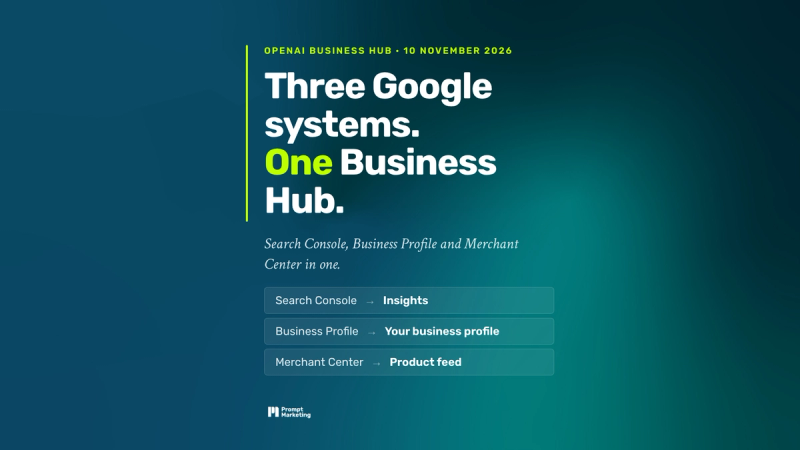
Our view: Business Hub puts a counted number next to every sampled one. It also does in one place what Google splits over Search Console, Business Profile and Merchant Center, so the first decision is who owns it in your company. Start the claim today with a company account, and check the profile ChatGPT already shows for you. Read the mention count as a citation count, because a brand name without a link is not in it. Keep sampling your prompts: OpenAI shows how much, and sampling shows which questions you win, against whom, and on which engine.
Agents start to book and buy: Google checkout in AI Mode reaches Canada, and Clarity and Cloudflare show which agents visit your site
On Wednesday 4 November Google began rolling out direct checkout to Canadian shoppers in AI Mode and the Gemini app. It runs on the Universal Commerce Protocol (UCP) and starts with lululemon, select Shopify merchants, Shoppers Drug Mart and Simons. Shoppers pay with Google Pay from the details saved in Google Wallet, and "retailers remain the seller of record". Other retailers wait until next year, when Google adds a simplified UCP integration to Merchant Center. Google's own research says 59% of holiday shoppers in Canada plan to use an AI tool this season, Google Canada on 4 November. The same day Robby Stein announced booking for home services in AI Mode in the US, with direct links through Angi, Thumbtack, Housecall Pro and Jobber, and ServiceTitan "coming soon". The way in for a plumber is the partner account. Jobber asks for a paid subscription, a full address, a Google Business Profile connected to Jobber and a booking or request form assigned to Google. It says there are no lead fees, Search Engine Journal on 4 November.
Microsoft and Cloudflare shipped the measurement side on the same day. Microsoft Clarity opened an Agent Activity dashboard to all users. It shows which agents visit and whether they search, submit forms, log in, book or reach checkout. Simulation assessments test whether an agent can complete a task, starting with commerce and travel. Clarity says weekly sessions from AI agents "nearly doubled in three weeks to almost 2 million", Microsoft Clarity on 4 November. The study behind that number covers more than 5.2 million sessions involving AI agents across 230,511 Clarity projects between 13 August and 9 September 2026, with agents from the OpenAI, Google and Anthropic ecosystems. Checkout was 25.21% of the actions recorded in agent sessions against 14.65% in human sessions. Outbound clicks were 14.28% against 26.99%, and form submissions 19.85% against 18.56%. Clarity cannot separate the agent part of a session from a human handoff, so these are sessions that involve an agent, Microsoft Clarity on 29 October. Cloudflare renamed its bot setting to "AI Crawler and Agent access policies". Site owners can now set an action per personal agent, and a Personal Assistants widget in Security Analytics shows the paths each agent requests and the status codes it receives, Cloudflare changelog of 4 November and Cloudflare blog. On Cloudflare's earnings call Matthew Prince said OpenAI pays for hints that tell its crawler when a page changed. He called the work of helping customers attract agents "sort of the new version of SEO", Search Engine Journal on 8 November.

What we see ourselves
We run an agent of our own every day for our Reddit research, and on Sunday 8 November it was blocked. After about 40 listing requests in a few seconds, Reddit answered every JSON request with a 403 and the text "You've been blocked by network security" for the rest of the run, logged in. We finished the run on the rendered pages. A site that blocks at that speed also blocks the agent a customer sends.
Our view: none of the checkout or booking features is live in the Netherlands yet. The entry points are already clear: the product feed in Merchant Center for retail, and the booking software plus the Google Business Profile for local services. Complete those now. Then open the Agent Activity dashboard in Clarity or the Personal Assistants widget in Cloudflare and look at two things: which agents reach your forms and checkout, and where they receive an error. Set the policy per agent. A blanket block also stops the agent that came to buy.
Brave sells its index to AI companies and ChatGPT leans on its licensed publishers: who supplies the answers
The New York Times sued Brave Software on Monday 2 November. The complaint says Brave "crawled and copied content from the over 30 billion webpages in the Brave Index without identifying itself or providing website owners with any mechanism to block its crawler". It calls Brave the supplier of that content to "GenAI companies, including Anthropic, Perplexity, Mistral, xAI, and Cohere", the complaint and Search Engine Journal on 2 November. These are claims, and Brave has not answered them in court. Brave's own pages confirm how the index works. The Brave Search API is "Used by some of the biggest names in AI, including Cohere, Mistral, Perplexity, and You.com", Brave. The index holds "over 30 billion pages, with millions of new pages indexed each day", Brave AI. The crawler "does not advertise a differentiated user agent because we must avoid discrimination from websites that allow only Google to crawl them. However, if a domain or page is not crawlable by Googlebot, then Brave Search's bot will not crawl it either", Brave Search help. A robots.txt rule cannot name Brave. A page that Googlebot may read is a page that Brave may read. The only exit is noindex, and that removes the page from Google too. Whether Claude still searches through Brave is unconfirmed: Anthropic listed Brave Search as a subprocessor in March 2025, Search Engine Journal on 6 November.

Ahrefs measured the second supply line on 3 November: the publishers OpenAI pays. OpenAI has signed content deals with more than 20 publishers since 2023. Ahrefs checked 85 partner domains against 5.5 million US ChatGPT answers in its November snapshot. Ten partner domains are among the 50 sites ChatGPT cites most, and 47 are in the top 500. Among ChatGPT's 200 most-cited domains, partner sites went from 7.5% of citations in March 2026 to 15.8% in July, and held 12.5% in late September. The most-cited partners are review and lifestyle titles: Vogue, Car and Driver, Tom's Guide, Good Housekeeping and TechRadar each appear in more than 30,000 answers. The data is US-only and one snapshot, Ahrefs on 3 November.
What we see ourselves
We ran the check on our own site on Monday 9 November. A search for site:promptmarketing.com in Brave Search returned our homepage, the team page, the blog index, and posts from January, May and August on the first page. Our robots.txt has no line for Brave, because there is no crawler name to put in it.
Our view: search for site:yourdomain in Brave Search today and note which key pages are missing. That index feeds Perplexity, Mistral and Cohere, and possibly Claude. Do not try to block Brave, because the only switch also removes you from Google. For ChatGPT, list the OpenAI partner titles that cover your category and make them your first PR targets. A review in Tom's Guide or Good Housekeeping now has two readers: the person and the model.
ChatGPT Ads moves to target bidding on 9 November
OpenAI mailed advertisers on Thursday 5 November. From Monday 9 November, Target CPA replaces Max Bid for new conversion campaigns, and Target CPC replaces Max CPC for new click campaigns. Existing campaigns keep the old controls until Max Bid and Max CPC retire on 1 January 2027. Maximize results gets a new name: intelligent bidding. A target is an average: "Some conversions may cost more and others less; actual average CPA may be higher or lower than your target." The help page gives the warning as an example. A spend of 400 dollars with 10 purchases is an actual CPA of 40 dollars, and "Setting a $20 target does not mean the system can deliver purchases at half the observed cost." It adds: "A target below recent performance may restrict delivery." OpenAI recommends the new fields to API partners from 18 November, and the legacy fields stay supported through 31 December, OpenAI Help Center, read 9 November and Search Engine Roundtable on 5 November.

Adthena counted 1,082 brands with ads in ChatGPT in June, 3,741 in July and 6,333 in August. It logged 204,489 ChatGPT ad placements from June to September in five holiday categories, led by apparel with 90,517, consumer electronics with 56,569 and travel with 48,134. In the same months it found about 175,100 paid placements inside Google's AI Overviews and AI Mode in the US. The report counts placements and says nothing about clicks, spend or conversions, Search Engine Journal on 5 November. Digiday adds reach and mix. Per Similarweb and Graphite, 45.7% of ad-eligible ChatGPT users in the UK see ads, 43.4% in the US and 27.8% in Mexico. Per Sensor Tower, shopping fell from 38% of US ad spend on ChatGPT in April to 20% in September, while financial services rose from 2% to 13%, Digiday on 5 November. Google's AI Mode now shows up to four ads on one answer, Search Engine Roundtable on 4 November. Two additions from 10 November: a business can sponsor its Business Agent and use it as the destination of a ChatGPT ad, OpenAI, and the visual format that shows an ad while ChatGPT generates an image is live, Search Engine Roundtable on 10 November.
What we see ourselves
Arjan gave the third session of our webinar series, a ChatGPT Ads masterclass, on Tuesday 3 November. The recap holds the provisional numbers from our first European campaigns: 1.7 million impressions, a click-through rate of 2.48%, 0.59 euro per click and 98% of the traffic on mobile. On Reddit the budget question stays open. In one thread an advertiser reported that 3,000 Australian dollars in a month gave no usable data, others advised 3,000 to 5,000 US dollars as learning money, and nobody had a European click price, the thread.
Our view: set the first target at your recent actual CPC or CPA, never below it. Check the conversion signal before you switch a conversion campaign. With few conversions, Target CPA has little to learn from and the campaign stops spending. For small European accounts our advice is to start with Target CPC and move to Target CPA when the Conversions API delivers steady events.
Also noted
• SE Ranking sent 180 prompts to ChatGPT five times each, 60 positive, 60 neutral and 60 negative, for 900 answers about TVs, GLP-1 telehealth and airline loyalty programs. Prompt tone and brand sentiment correlated at 0.66. Negative wording moved sentiment about twice as far from the neutral baseline as positive wording, and neutral prompts returned mildly positive answers, a net sentiment of about +20. Record the prompt wording with every sentiment score, SE Ranking on 4 November.
• Google's defence against scrapers now hits rank data. SE Ranking checked 10,000 US desktop keywords: results unrelated to the query went from 0.09% of keywords to 57.3% overnight in September, with four more checks on 14 and 15 October. AI visibility tools that read Google results work from the same data, SE Ranking on 3 November.
• Meta publishes AI-generated answer pages under facebook.com/fb-answers/, built from Facebook posts. Google has indexed more than 6 million of them, and they rank, Search Engine Roundtable on 5 November.
• Profound and Searchable both added tracking for Meta's Muse Spark model in one week. Profound states the limit itself: tracking Muse Spark and tracking Muse "aren't the same thing", because the Muse agent knows who it shops for and the model does not, Profound on 4 November and Searchable on 5 November.
• Tripadvisor wrote down 369.5 million dollars on its hotels and advertising business, driven largely by traffic headwinds from "changes in the search landscape". Segment revenue fell 23% to 151.6 million dollars, and the CFO expects SEO to stay a headwind in 2027, Search Engine Journal on 8 November.
• Ask AI Mode for flights and every link goes to Google Flights, in Barry Schwartz's test of US and international routes, Search Engine Roundtable on 3 November. Google also shows pop-ups in AI Mode that ask users to turn on Personal Intelligence, Search Engine Roundtable on 6 November.
• Digiday spoke to 18 media buyers. Clients now question about 10% to 20% of their Google search budget, and some up to 30%, Digiday on 2 November. Kevin Indig's Similarweb data shows where visits grow while organic falls: email up 16.3% in the US and 17.0% in France from January to August against the same months of 2025, paid search up 20.8% and 20.3%, Growth Memo on 2 November.
• After the week closed: Graphite's update of 9 November puts six AI assistants at 76 billion sessions a month worldwide in September, up 37% year over year, and AI referral traffic up 92%, with ChatGPT at 60% of it. Graphite withdrew its comparison with search engines because it has no reliable data for Google's Android app, Graphite on 9 November and Search Engine Journal on 9 November. Google started its November 2026 core update on 10 November, a rollout of up to two weeks, Search Engine Roundtable on 10 November.
• Bing now uses Google's names. Microsoft's page says "Copilot Search has evolved into two distinct AI experiences on Bing: AI Mode and AI Overview", Microsoft Bing, read 9 November. Bing also tests an "AI visual summary" button on single results, Search Engine Roundtable on 6 November.
That is the week. If you want to know what any of this means for your own AI visibility, our door is open.