This week in AI Search News: Google made Gemini 4 Hydrogen the default model in AI Mode for every user, and two companies now send almost 90% of the AI agent requests that one security firm sees.
Google puts Gemini 4 Hydrogen under AI Mode for every user, and tests hiding the way in
On Thursday 12 November Google brought Gemini 4 Hydrogen to Search. Robby Stein, VP of Product for Search, calls it "the biggest model upgrade to Search yet". It is "available globally in Google Search for all users" and works in all supported AI Mode languages. Google names three changes. The model follows multi-part questions and typos better. It improves query fan-out, the technique that runs several searches at once, and Google says this helps "find sites you previously might not have discovered". Answers also get more visual: more images, comparison tables and "custom tools built for you", Google on 12 November. On X Stein added that Hydrogen "is now the new default model in AI Mode & being used for your hardest questions in AI Overviews", Search Engine Roundtable on 12 November. Google calls Hydrogen its "daily driver for agentic workflows", about 2.5 times faster than Gemini 3.8 Flash, Google on 12 November. Two days earlier the frontier model, Gemini 4 Carbon, reached AI Mode for Google AI Ultra subscribers only, Search Engine Roundtable on 10 November.
The November 2026 core update started two days before Hydrogen, on Tuesday 10 November. It "applies globally and to all languages" and "may take up to 2 weeks to complete", Google Search Status Dashboard. Search Console logged a bug for 9 to 11 November: "A logging error caused a decrease in impressions on the Generative AI performance report in Search", and it "affects data logging only", Google's data anomalies page. Google also tests the ways into its AI answers. Brodie Clark saw the source icons move from the top of AI Overviews to the bottom, Search Engine Roundtable on 11 November. Glenn Gabe saw AI Overviews for definition queries open fully by default, so the web results start below the fold, Search Engine Roundtable on 11 November. On 13 November he saw a test without the AI Mode tab in the search bar and without the "Ask anything" box under AI Overviews, Search Engine Roundtable on 13 November. In another test the AI Overview version of the local pack lost its action buttons, photos and reviews, Search Engine Roundtable on 10 November.
What we see ourselves
On Monday 16 November we asked AI Mode in Dutch for the best sofa for a small flat in the Black Friday sale. The answer was a list of four sofas, each with a retailer, and a checklist with widths in centimetres. Two sofas came with a Black Friday discount: 37% at JYSK and 10% at Bedroomshop.nl. The sources were Dutch retailers and guides, among them Sklum, JYSK, Goossens, Furni, Bedroomshop.nl and Beddenbriljant. One cited Furni page was published on 2 November. Beddenbriljant's extra discount on stock models, valid from 20 to 30 November, appeared in the answer with its dates. The source chips sat behind each claim, not in a row at the top. Three hours later the same question returned a different list, led by an IKEA sofa.

Our view: log three dates in your AI visibility reports. 10 November for the core update, 12 November for Hydrogen, and 9 to 11 November for the broken impression count. Treat a shift in citations after 12 November as a model change until you have proof of something else. For brands the fan-out change matters most. Google says the new model reaches sites it did not reach before, so a page that never ranked for the head term can enter an answer through a sub-question. Write those sub-questions out on the page, with the numbers. The interface tests go the other way: fewer visible sources and no AI Mode tab mean fewer clicks. Keep measuring mentions and citations, not only visits.
Two companies send 90% of agent traffic, United bars agents without a permit, and ChatGPT gets a wallet
HUMAN Security published its agent traffic report for October, based on the sites and apps it protects. Agents from Meta and OpenAI together made nearly 90% of all agent requests. Meta's Muse alone had 59%, up 19 points on September, with nearly four times the requests. OpenAI had about 30% across three agents. Perplexity's Comet fell from 41% in August to 3.6% in October. Total agent requests in October were about 8 times those of August. Product and search pages took 85% of requests, and checkout and payment pages 1.9%, down from 2.4%. The report covers HUMAN's own network and excludes crawlers, and a request to a checkout page is not an order, Search Engine Journal on 14 November and HUMAN Security.

United Airlines put its answer in its terms. The website terms, last updated on 11 November, define an "Automated Agent" as any software, including "an AI assistant or agent", that takes "autonomous or semi-autonomous action, whether or not a person supervises or approves its actions, to search, book, purchase or manage anything". The rule follows: "no Automated Agent may access or use this website or United's mobile app, without United's prior written permission." Nobody may use United's fares, schedules or prices "to train, fine-tune, ground, evaluate, or otherwise develop" an AI model. Search engines "indexing public pages of united.com" are exempt, United's terms. United's robots.txt names no AI agent, so the rule lives in the contract and in the bot protection, Search Engine Journal on 14 November.
OpenAI went the other way on Friday 13 November with ChatGPT Wallet, "the first wallet that lets agents pay without access to users' actual card details". It is built with American Express, Mastercard and Visa. After the user approves each purchase with Face ID or a fingerprint, the business receives a payment token. It starts in dots, the agents in ChatGPT, for Pro subscribers in the US with US cards. OpenAI admits that "some sites may unintentionally block purchases through ChatGPT Wallet". Its Commerce Partner Playbook covers four areas: claim your business in ChatGPT and upload a product feed, configure your CDN or firewall "to recognize signed requests using Web Bot Auth", work with your payment and risk providers so agent purchases are not declined, and give agents more ways in through a plugin or WebMCP tools. OpenAI names Adyen, Checkout.com and Stripe as payment providers on this, OpenAI on 13 November. The same day Google let every Gemini user in the US connect Google Wallet, read-only, so Gemini can answer from their spending, Google on 13 November.
What we see ourselves
Our own site shows the same concentration. From 9 to 15 November our crawler logs counted 1,510 requests from AI bots. Meta's crawler made 704 of them, 47%. OpenAI's bots made 410, Perplexity 316 and Anthropic 76. Meta's crawler is not the Muse shopping agent, but Meta reads the web harder than anyone else. Our own Reddit research agent stayed blocked all week: every listing request got a 403, logged in, in six runs since 8 November. From Sunday 15 November we read the listings as Atom feeds instead.
Our view: an agent policy now lives in three places, the terms, robots.txt and the bot protection, and the three have to agree. Check all three this month. Write down which agents may search, which may book and which may buy. A blanket block also stops the agent that came with a card. For Dutch retailers the Wallet is far away, but the playbook is not. The product feed and the claim are the same work you do for Business Hub. Web Bot Auth is a CDN setting. And Adyen is in Amsterdam, so ask them how they recognise an agent purchase.
Black Friday in AI answers: deals pages get cited, product pages rarely
Profound collected 279,741 AI answers and 1,219,663 citations between 27 October and 9 November in the US, the UK, Germany and France. It covered 25 retail categories with 50 prompts per category per market, on ChatGPT, Gemini, AI Mode and AI Overviews. Amazon leads the combined four-market board at 48.4%. Local leaders win at home: Currys has 71.3% in UK appliances, Ocarat 45.8% in French jewellery and watches, and Bergfreunde 43.7% in German outdoor gear. Bergfreunde's Black Weekend page is the most cited page in its category. A US comparison of one week in November 2025 with one week in November 2026, on ChatGPT and AI Overviews only, shows how fast the shortlist moves. AT&T rose 645% in phones, from 14th to 6th, and its Black Friday hub went from 0.7% to 11.7% of monitored answers. Wayfair went from 64.4% to 85.0% in furniture. The most cited furniture page is a Forbes guide with an 8.32% citation share, and 90.9% of the answers that cite it also name Wayfair. A Times Union retailer calendar was cited on the day it was published, 28 October, and became the second most cited page overall. The snapshot covers two weeks and the year comparison covers the US only, Profound on 13 November.

Semrush ran a September snapshot of 10,514 answers on four platforms. The big four US retailers, Amazon, Walmart, Best Buy and Target, lead only 23.6% of the 89 holiday topics in AI Overviews. Ashley Furniture has 66.5% of Black Friday furniture prompts against 13.4% for Walmart. A mention is not a citation: Gemini names Amazon in 40.5% of answers and cites amazon.com in none, and AI Mode names it in 33.1% and cites it in 5.3%. Each platform answered each prompt once, PPC Land on 11 November. Searchable's UK study, with daily runs from 30 September to 8 October, shows which pages win. Product pages are under 5% of the retailer pages the four engines cite. For deal questions, 82% of the cited retailer pages are deals pages. For gift questions, gift and category pages lead at 49%. John Lewis is cited in 30% of answers, Searchable, updated 21 October. In 5.5 million US ChatGPT answers in November, Walmart is named in 95,605, almost twice Target's 52,096, and stores take six of the top ten spots, Ahrefs on 11 November.
What we see ourselves
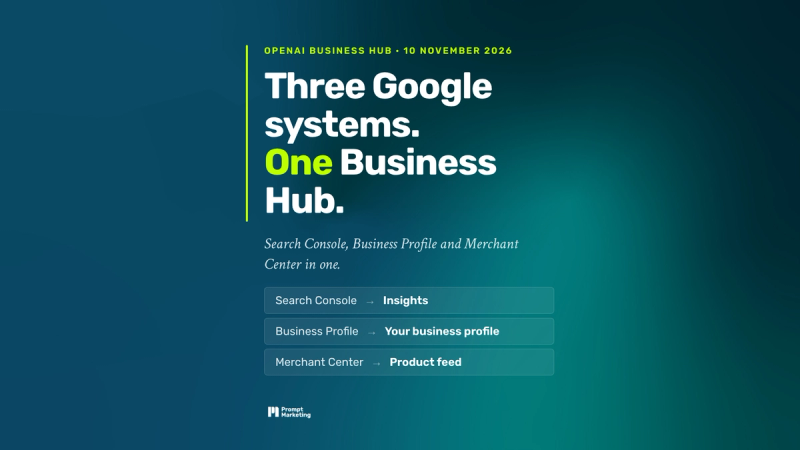
Our Dutch AI Mode query above shows the same thing: the answer took its deals from retailers' Black Friday pages and a guide. The Business Hub profile is the other route, and it is still closed to European stores. We asked OpenAI support how a retail client with about 50 stores in three countries can claim its locations. The answer on 12 November: "a parent brand's claim does not automatically claim its locations, and central management across brands and locations is not available at launch." On 13 November support added that "the standard local-store claim flow currently covers existing US listings". Support took the store list to look for a managed route and could not confirm one. The stores we tried ended on the waitlist. On Reddit, four Shopify stores saw every row of their Business Hub product feed rejected with "domain in url was outside this profile's allowed domains". The fix was a DNS TXT record: the shop domain had to be verified on the profile, and the Shopify connection did not do that, the thread.
Our view: put one Black Friday page per market live now, at a URL you keep every year, with confirmed prices, dates and conditions on the page. Add one gift page per recipient. Send the same facts to the editors who write the guides, because a Forbes or Which? page carries your brand into more answers than your own page does. And verify your domain on the Business Hub profile before you upload a feed.
Ads in AI Mode reach ten more countries, and ChatGPT Ads targets a region inside a country
Google rolled out English-language ads in AI Mode to Australia, Canada, India, Kenya, Malaysia, New Zealand, Nigeria, Pakistan, the Philippines and Singapore, with text ads only in Pakistan. Multiturn ads, which appear under follow-up questions when the conversation has commercial relevance, are live in the US only, Search Engine Journal on 10 November. Google's help page confirms the countries. Impressions, clicks, conversions and cost for these ads sit in the standard campaign totals, with no separate line, Google Ads Help. Barry Schwartz saw multiturn ads on the third and fourth follow-up questions, Search Engine Roundtable on 9 November. Bing shows search and shopping ads at the top of its AI Mode results, Search Engine Roundtable on 9 November.
OpenAI's product update mail of Thursday 12 November renames Maximize Results to intelligent bidding. It confirms the move to targets: for new campaigns Target CPA sets "the average amount you'd like to pay for a conversion", and "Max Bid and Max CPC will retire for existing campaigns on January 1, 2027". Two things are new. Product feed campaigns can "target specific regions or markets within a country", and product set filters can "combine multiple conditions on the same product field", Search Engine Roundtable on 12 November. The developer documentation still says that "New product-feed campaigns support geographic targeting and exclusions only at country level", OpenAI developer docs, read 16 November. Search Engine Land analysed AdClarity data on ChatGPT Ads in the US from 13 April to 31 August: 174,700 campaigns, an estimated 419 million dollars and more than 8 billion impressions. Monthly active advertisers went from 839 in April to 17,934 in August. Monthly spend stayed near 94 million dollars from May on, so average spend per advertiser fell about 85%. About one in three advertisers who tried the platform was not running ads in August. Retail and consumer brands are 7.6% of spend, and the top 100 advertisers are 43%, Search Engine Land on 10 November.

What we see ourselves
We received the 12 November mail as an advertiser. Our European webshop case ran at 0.44 euro per click in its first 25 days under a hard Max CPC cap, our Reddit write-up. That cap disappears on 1 January. The region option matters for us: until now a product feed campaign for the Netherlands could not skip a province. We also asked OpenAI support when the sponsored Business Agent comes to Europe. The answer on 12 November: sponsored Business Agents "require separate approval for each account; current English-language campaign markets are the US, Canada, Australia and New Zealand". There is no confirmed European date.
Our view: move your existing campaigns to Target CPC yourself before January, at your current actual CPC, so you see the change in delivery while you can still compare. Test the region targeting on one feed campaign and check the delivery report, because the mail and the docs disagree. The AdClarity numbers show flat inventory and many more advertisers, so a target below the market gets no delivery.
Also noted
• Similarweb's October update puts ChatGPT at 55.7% of generative AI website traffic, Gemini at 24.2% and Claude at 11.5%. Claude was at 9.6% in September and 2.1% a year earlier, and Perplexity is down to 0.8%, Similarweb on 10 November. These numbers count website traffic, and apps are not in them. Similarweb's own report says Meta AI and Claude "posted the sharpest US app growth of any platform between June 2025 and May 2026", Similarweb. Our view: read the web share as a trend line, not as total usage. Assistants that live in apps, such as Meta's Muse, barely show in it. We expect Claude, Grok and Meta to gain the most usage next.
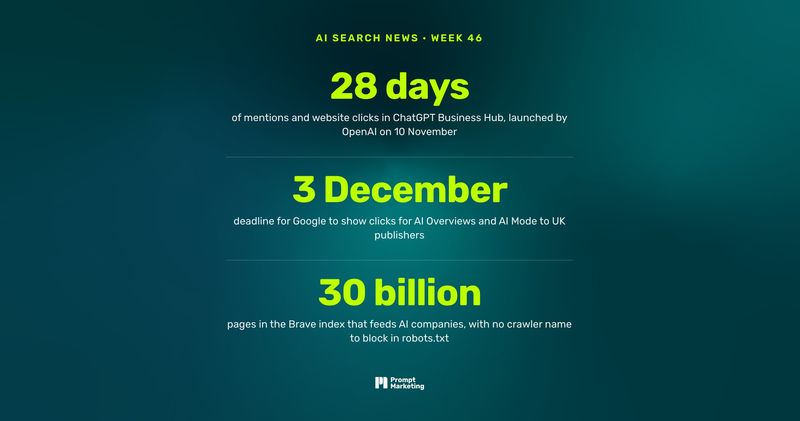
• The first Business Hub click ratios are in. Search Engine Journal's own profile counted 353,356 mentions and 2,663 website clicks from 14 October to 10 November, Search Engine Journal on 12 November. A Reddit user posted 139,356 mentions and 543 clicks, the thread. Both are below one click per 100 mentions.
• Searchable measured 3,989 brands in the 30 days to 15 October. The median brand is mentioned in 95% of answers to branded prompts and in 7% of answers to unbranded prompts. About 40% of citations on unbranded prompts go to competitors' websites, Searchable, updated 12 November.
• Two measurement standards in one week. The IAB published its AI-Era Attribution Blueprint on 12 November and names the gap itself: "What remains largely missing is the connection between those sourcing signals and downstream conversions", Digiday on 12 November. AirOps launched an AI Search Measurement Standard with Paramark, built around an exposure metric, AirOps.
• Reddit started testing Reddit Reviews on 10 November: AI summaries of product conversations for about 10,000 products in electronics, health and beauty, home and garden, and fashion, for US users first, with links to the original threads. "Businesses can't pay to have products featured", Reddit on 10 November.
• Google published a help page, last updated on 12 November, on how to find Google Search traffic in analytics and server logs. Google Search uses the origin referrer policy, so the Referer header "contains only the scheme and host", without the query. Google Images sends the same values, and analytics data "often doesn't match 1:1" with Search Console clicks. The page names no separate value for AI Mode or AI Overviews, so a referrer cannot tell an AI answer from a blue link, Google Search Central.
• Yahoo Scout left beta after 3 billion answers, and Yahoo Search got Pivot Search in the US, the UK, Europe and Switzerland, Search Engine Roundtable on 10 November. Yahoo also became the first licensee of the Internet Licensing Collective, a publisher-led body with more than 3,000 members that pays by how content is used, with rates not disclosed, Digiday on 12 November.
• Rand Fishkin and Similarweb put visits to the top million websites at 1.970 trillion in the third quarter, 12.2% below the peak in early 2022, with visits per internet user down 29.2%, SparkToro on 10 November. Ziff Davis reported organic Google referrals down about 37% year on year and 2.7 billion AI Overview and AI Mode impressions in Search Console, nearly ten times its Google clicks, Search Engine Journal on 9 November. In France, Glenn Gabe's Search Console examples show one site losing 47% of daily clicks and another 69% since AI Overviews launched on 22 July, while two of five sites held steady, Search Engine Land on 9 November.
• iPullRank read Search Console data for 166 brands over 16 months. On unbranded queries, position one went from about 7 to about 5 clicks per 100 impressions between 2025 and 2026, iPullRank on 12 November. Tom Capper lists four prompt tracking mistakes: counting citations instead of mentions, thinking in rankings, tracking too few prompts, and tracking head terms nobody types into a chat, Moz on 13 November.
• A US court dismissed Google's amended complaint against SerpApi over scraping, and Google may amend it once more, Search Engine Roundtable on 10 November. Meta paused the business terms that would have added crawl rights for advertisers' sites from 20 November, with no new date, Search Engine Journal on 10 November.
That is the week. If you want to know what any of this means for your own AI visibility, our door is open.