This week in AI Search News: a panel of 12,321 US ChatGPT users shows purchase intent in 6.9% of conversations, and our own Business Hub dashboard opened with 559 mentions against one click.
6.9% of ChatGPT conversations are about buying, so the AI visibility money points at Google
On Tuesday 17 November Rand Fishkin published the first large look inside real ChatGPT conversations since 2023. Verso, a company that connects to users' ChatGPT accounts with their consent, gave SparkToro 118,163 prompts in 41,961 complete conversations from 12,321 US panel users, dated 1 January to 29 October 2026. Fishkin first removed 131 heavy users: 1% of the panel, 21% of the prompts. The largest use is images and visual design, 16.1% of conversations per user. Then information and entertainment at 14.0%, everyday life and admin at 12.2%, and writing at 11.9%. Shopping, brands and local services is 5.7%. Purchase intent shows in 6.9% of conversations, which Search Engine Journal reads from the chart as 4.9% comparing options and 2.1% asking about one brand. ChatGPT names at least one brand, product or company in 12.1% of its answers. Fishkin sets this against SparkToro's 2024 study of 332 million Google queries, where 15% or more fitted the same definition. His conclusion: AI visibility matters "a huge amount", but "NOT BECAUSE OF CHATGPT. It's Google and the Google AI Overviews and AI Mode that makes AI visibility so incredibly important", SparkToro on 17 November.
Fishkin lists the limits himself. An AI model labelled every conversation from a written codebook, and a second labeller agreed on 90% of the categories. The panel skews younger, female and lower income, so SparkToro weighted 9,675 panelists to the US census, and no category moved more than 1.4 points. Most panelists were on phones, API traffic is absent, and the panel is light: 9.9 prompts per user in ten months. Search Engine Journal adds that the Google comparison uses different categories, so the two percentages cannot be set side by side, Search Engine Journal on 17 November.

A day later Profound published the other half of the picture. Kyle Poyar of Growth Unhinged read 27,374 real English prompts about six software categories, taken from Profound's panel of consented ChatGPT users. Of the commercial prompts, 57% sit in the middle of the funnel, where the buyer compares named products. Only 15% are top of funnel and 8% bottom of funnel. Pricing is the largest topic at 5.5% of commercial prompts, then functional fit at 4.4% and compatibility at 3.5%. Nearly 15% ask for a recommendation outright, as "best X" or "recommend X", Profound on 18 November. Kevin Indig's quarterly review of 32 studies, published on Monday 16 November, lines up the rest. Profound's classification of 7.5 million US ChatGPT conversations shows commercial intent rising from 13.9% to 19.2% between June 2025 and June 2026. A field experiment by Agarwal and Sen found that an AI Overview cuts outbound organic clicks by 39.8%. In Indig's study with Semrush, 61.7% of 3,981 domain appearances were citations without a brand mention, Growth Memo on 16 November.
What we see ourselves
Our own tracker tells the same story in smaller numbers. Promptwatch's weekly report for promptmarketing.com, 12 to 18 November, ran 141 prompts and collected 5,715 answers. Our visibility score was 17%, up 2.1% on the week. AI crawlers fetched the site 1,518 times. Humans arriving from an AI assistant: 26 visits. That is 58 crawls per visit, on a site that writes about AI search every week. In the crawler logs since 29 October, Meta and Perplexity fetch our pages most often. The same week a prospect told us they had asked ChatGPT for a good GEO agency and we came first. Our new Business Hub dashboard, in the next story, puts 69.1% of our mentions under one topic: business vendors and service comparisons.
Our view: both studies measure what people do inside ChatGPT, and both say that ChatGPT is a shortlist tool. The consumer makes pictures and plans dinner, and 7% of the time compares products. The B2B buyer arrives with a vendor in mind and asks about price and fit. Neither looks like Google. For a Dutch brand this means three things. Put the AI Mode and AI Overviews numbers at the top of the report, because that is where the volume is. Track ChatGPT on comparison prompts and price questions, not on head terms. And make the pricing page readable by a machine. A buyer who asks "how much is X" and gets a third-party answer has left your funnel without a click.
OpenAI rewrites the Business Hub terms, opens the waitlist and shows us 559 mentions for one click
Business Hub is two weeks old and the terms have already changed. Digiday reported on Thursday 19 November that Section 10 of the terms for businesses held a mandatory arbitration clause and a class-action waiver, worded to cover claims that arose before a business accepted them. Lawyers read it as a release of claims about content published on a business's website before it signed up. For a publisher that means copyright claims. Hours after Digiday asked OpenAI on 18 November, the terms changed. An OpenAI spokesperson said the previous version "were not intended to cover this scenario" and that the update "replaces the separate 'covered claims' provision with language in Section 5.2 that ties the release to claims arising from a business's Business Agent". Gary Kibel of Davis+Gilbert called the original "incredibly intentional". The revised terms still release claims about the use of the Hub and the Business Agent, but no longer unrelated disputes, Digiday on 20 November.
The first definitions and the first numbers arrived in the same week. A mention in the Hub counts only when ChatGPT references your website or shows you as a local result. Your brand name alone does not count. The insights cover the past 28 days and appear only above a threshold of conversations, Semrush on 17 November. Lily Ray's consultancy recorded 4 clicks from 25 mentions. John Shehata of NewzDash calls it "a very early, very limited Search Console moment for ChatGPT". The data is aggregated: no prompts, no per-article breakdown, no competitor benchmark. Barry Adams: "We don't know the contexts in which our websites are mentioned, except in the vaguest of terms", Digiday on 19 November. On Friday 20 November OpenAI mailed waitlisted businesses: "We're expanding access to Businesses in ChatGPT. More businesses on the waitlist can now get started", with the note that "a small number of businesses may still see a waitlist". Its business page keeps the other limit: "Claiming does not guarantee higher placement or sales", and Business Agents stay with eligible ecommerce and online service businesses in the US, OpenAI, Businesses in ChatGPT.
The agents started to appear. Juozas Kaziukenas showed Chewy's profile with a blue check and a "Start chat" button. Hovering the check reads "OpenAI verified that this profile is managed by an owner or authorized representative". The chat told him "Business can't see your chats or your personal info - just overall usage trends". When he asked the agent for dog toys it refused: "I don't have a live Chewy product catalog connected." Lily Ray saw the agent builder and said "it pulls a lot of recommendations out of your website so it's pretty low-effort to get it set up", Search Engine Roundtable on 16 November.

What we see ourselves
Our PromptMarketing profile was approved over the weekend of 22 November, ten days after we joined the waitlist. Identity verification with a government ID is the next step. Until it is done we cannot edit the business info or publish an agent. The Overview tab holds the recommended actions and the reporting. The product catalog is for retailers, and Business Agents have not reached the EU. On 18 November we also found that a claim does not cross borders: from a Dutch account we cannot look up a foreign business, which looks like an anti-spam measure. The claim rules we got from OpenAI support last week still hold. The advertiser's own authorised person claims the profile, the agency gets added afterwards, a parent brand's claim does not claim its stores, and local listings outside the US have no date.

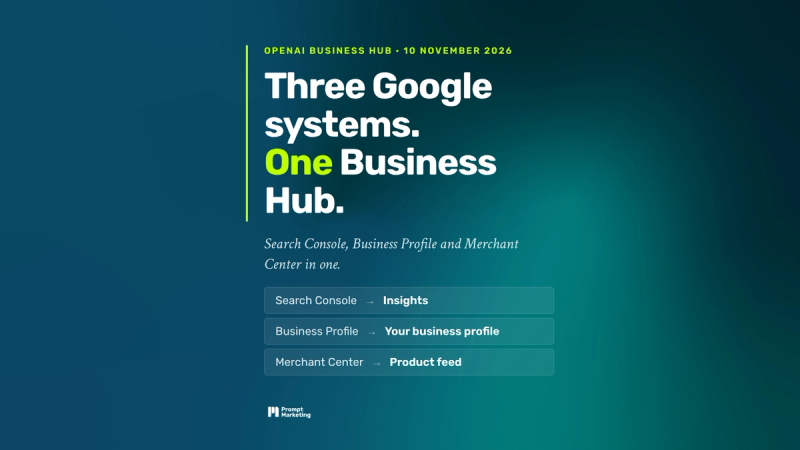
The reporting surprised us: 559 mentions in the last 28 days, against 0 profile views and 1 website click. The dashboard shows growth of 7,886% on the previous period. Ignore that. OpenAI appears to have started counting in late October, so the earlier period is nearly empty. The mentions line runs from 24 October to 20 November and climbs from a handful a day to a peak above 60 around 16 November. The top discovery topic is business vendors and service comparisons, 300 mentions and 69.1% of the total, then local service providers and comparisons at 78. Two caveats before you read the number. A mention is a reference to our website, not our name, so this is closer to a citation count than to a mention count. And we do not know yet whether synthetic tracking sits inside it. Tools such as Promptwatch sample prompts through the real ChatGPT interface. If OpenAI counts those sessions, part of our 559 mentions is our own industry measuring itself. 559 mentions against 1 click suggests that it could be. We are testing this and will share what we find.


On Reddit we spent the week explaining the link-only count. In r/aeo, three threads asked why the Hub shows fewer mentions than a tracker. The answer is that the Hub counts a link to your site and the tracker counts your name, so the Hub is the floor, one of the threads. In r/SEO a beginner asked which tool gives AI citation statistics. The thread grew to 52 comments and named Bing Webmaster Tools, Search Console and the Hub, the three free sources, the thread.
Our view: claim the profile this week if the mail reached you, and let legal read Section 5.2 before a publisher accepts. Put the Hub's mention count next to your tracker's citation count, not its mention count. Then watch the click ratio. Our 559 to 1, Lily Ray's 25 to 4 and the under 1 per 100 we reported last week for two large sites say the same thing: the Hub pays in mentions, and the clicks come from links in answers to specific questions. Then run the synthetic test. Pause your tracker's ChatGPT sampling for a week and watch whether the Hub's mentions line drops. We are doing that now. For Dutch retailers with stores, nothing changed. The store claim is still US only.
Google wires the homepage to AI Mode, hides the hotel's own rate and keeps three citations in view
Robby Stein confirmed the sidebar on Thursday 19 November: "New on the Google desktop homepage globally: we're rolling out a collapsible sidebar to easily find & jump back into your recent AI searches." His reason: "People are coming to Search with more questions that aren't just one and done", and in testing the sidebar "made a big difference for making progress & continuing to explore the web", Search Engine Roundtable on 19 November. Two days earlier Google added temporary threads to AI Mode, globally, on desktop and mobile, in every AI Mode language. A temporary thread is "completely detached from your account", so the answer is not informed by past preferences and the thread is not saved, Google on 17 November. On 15 November Rajan Patel confirmed that AI Mode no longer shows which Gemini model answers, "Intended, but we're thinking through the right way to bring back an indicator", and that Gemini 4 Carbon now runs for Google AI Pro subscribers too, Search Engine Roundtable on 16 November.
Websites got one thing back. Brodie Clark spotted that AI Overviews on desktop now show three citation cards by default, with no fade on the lower two. His note: "last month, Google removed the citations from desktop completely", and this "is the first time in a while that they have made an update that actually makes the citations more visible", Search Engine Roundtable on 17 November. Hotels lost one. Google's hotel results now carry a "Continue on Google" button that takes the booking into AI Mode. Lluc B. Penycate showed the new design: a pop-up for Expedia's "Continue on Google" at 170 dollars covers the other provider, the hotel's own website at 158 dollars. "The cheaper direct rate is the one you can't see", Search Engine Roundtable on 19 November.

The apps keep coming. Stein announced Adobe, Calm and Peloton as connected apps in AI Mode on 16 November, Search Engine Roundtable's recap of 16 November. On 20 November Google added Albertsons, Safeway, Shaw's and Target for groceries in the US, "powered by the Universal Commerce Protocol", plus Experian and H&R Block in Search, with Angi and Thumbtack to follow, Google on 20 November. For Europe the news is Ask Maps, which expands to more than 30 European countries, Google on 16 November. Google also published a help document on letting Google-Agent through: "Google-Agent is the name used by agents hosted on Google infrastructure to navigate the web and perform actions upon user request", with instructions for the CDN, the firewall and the bot-detection service, Search Engine Roundtable on 17 November. The November core update is still running. Glenn Gabe puts the landing on 13 November and expects completion early this week, Search Engine Roundtable on 16 November.
What we see ourselves
On Monday morning 23 November we asked AI Mode three times for the best sofa for a small flat, in Dutch, logged out. Without the words "Black Friday" the answer named two IKEA models and Fest Amsterdam, with Goossens and Pronto Wonen as shops. With "Black Friday sale" added it named the deals at fonQ, JYSK, Giga Meubel and vtwonen and cited Goossens, Mokana, Meubelfrits, Boxspringvoorraad and Furni. The same question minutes later gave three different sofas: a WOOOD corner sofa at fonQ and Wehkamp, a by fonQ model and a Vente-unique sleeper. The sources were Sklum, Woonexpress, Giga Meubel and Beddenbriljant. The fonQ page it linked was published on 10 November. Last week the same question gave four sofas led by JYSK. In four runs in eight days, no two lists matched.

Our view: the sidebar turns a search into a thread you return to. A brand named in turn one starts turn two ahead, so test your category with a two-turn and three-turn script, not a single prompt. Temporary threads strip personalisation, which makes a logged-out test a fair proxy for what a careful user sees. The three visible citations are worth the work of being one of them. Hotels should check their Google rate feed today, because the direct rate now sits behind a pop-up. And if you want agent bookings at all, add Google-Agent to the allow list before December.
Bing puts ads in AI Overviews in every market but China, and one in seven ChatGPT answers now carries an ad
Microsoft confirmed on Wednesday 19 November what Barry Schwartz had seen for three weeks. "Your ads can now show up next to AI-powered answers on Bing when your offers are relevant." Nothing to set up: "Ads in AI Overviews run through the campaigns you already use, including Performance Max and AI Max." They are "now available in all markets except China". Microsoft adds that its data shows "a 21% increase in purchases after a Copilot interaction", Microsoft Advertising, November update and Search Engine Roundtable on 19 November.

ChatGPT's ad load is measurable now. Writesonic checks more than 100,000 ChatGPT answers a day. On 22 November 14.2% of 107,777 answers carried a sponsored ad. The 30-day average is 12.3%, the 30-day high 18.9% on 16 November, and on 24 October the share was 8.9%. Writesonic saw 3,816 brands advertising on 22 November and 42 new advertisers in two weeks. Business and productivity software is the largest category at 22.9% of ads, and 76.1% of the ads it sees are in the US. Google AI Overviews showed an ad in 0.13% of answers on 10 November, the last day with data, Writesonic AI Ads Index, 22 November. Distribution grew too. On 19 November OpenAI made Aleph its exclusive reseller in 44 countries, with local contracts, local invoices and credit. Sixteen are in Europe and Central Asia: Azerbaijan, Bulgaria, Croatia, Cyprus, Czechia, Estonia, Hungary, Kazakhstan, Latvia, Lithuania, Romania, Serbia, Slovakia, Slovenia, Ukraine and Uzbekistan, Aleph press release on 19 November. The Netherlands stays self-serve.

The spend estimates and the first cases arrived in the same week. AdClarity put US ChatGPT ad spend at an estimated 70.7 million dollars in October, up 127% from 31.1 million in April, and 110.6 million dollars across the 24 countries it measured, with the UK at 6.2 million and Germany at 2.6 million. These are panel estimates, and AdClarity says they are not comparable with its earlier figures, AdClarity on 17 November. OpenAI published two customer cases on 19 November. WeightWatchers reports an attributed CPA 15.3% below its blended paid-search benchmark, measured by DV Rockerbox over 18 to 31 August, and about 30% lower cost per signup after it moved from click bidding to conversion bidding. OpenAI's own footnote: "This is an attributed benchmark comparison, not an incrementality study", OpenAI, WeightWatchers case. Portland Leather found that 93% of the visitors from ChatGPT Ads were new to its website, measured in Triple Whale over 30 days in September, "not first-time purchasers", OpenAI, Portland Leather case. Genezio's Ads Manager test accepted a single European postal code as a campaign location after the 12 November update. It ran no delivery test, so nobody knows yet how precisely the ads land, Genezio on 20 November. OpenAI updated its ad policies on 20 November: ads for financial services, legal services and healthcare "are allowed on a limited basis when pre-approved by OpenAI", and a passing reference to a sensitive topic "does not necessarily make a conversation ineligible", OpenAI ad policies.
What we see ourselves
On 18 November we posted our European webshop case in r/adtech, under a thread that collected every public ChatGPT Ads benchmark: 0.44 euro per click, 2.41% click rate, 96% mobile, over 25 days in four countries. The original poster replied on 20 November: "EUR 0.44 is way below the US tests, so I agree category and country probably explain more of the spread than anything else", the thread. On 17 November our colleague Jacqueline saw a ChatGPT ad with an introductory sentence above it, while she researched a workwear brand. The ad was about advertising performance on Amazon. On 23 November we searched Bing from the Netherlands, logged out, for a hotel near Snowdonia. Bing showed three sponsored results and a sponsored hotel card, but no AI Overview, so we could not see the new format from here.
Our view: the Bing placement costs nothing to test, because it runs inside the campaigns you have. Pull a placement report in two weeks and look for the AI Overview line. For ChatGPT, one ad in seven answers means the organic answer is no longer the only thing a buyer reads. A brand that is named organically and runs the ad on the same question owns the screen. The two OpenAI cases measure attributed CPA and new visitors, not incremental sales, so test them against your own blended benchmark. And the Aleph list is a map of where OpenAI expects the next advertisers: Eastern Europe, the Gulf and Latin America.
Also noted
• Removing a batch of blog posts in August cut a client's Google AI impressions from 1,535 a day to 591, a 62% drop, while organic clicks rose from 235 to 268 a day. Blog posts were 36% of the pages with AI impressions and 87% of the impressions. Luca Tagliaferro's lesson: with AI visibility as the only metric he would have kept the posts, Search Engine Land on 19 November.
• Ahrefs tracked about 37,500 first-day citations in AI Overviews, AI Mode, ChatGPT, Gemini and Copilot for 20 days. About three in four lost citations came back, half of them within three days. Gemini gave answers without any citation 64% of the time and Copilot 53%. A citation that lasted one day never returned in 34% to 41% of cases, one that lasted eight to 14 days in 4% or fewer. Count the days cited in the last seven, not the state today, Search Engine Journal on 20 November.
• A local SEO ran 480 high-intent searches by hand in 12 US cities between September and November. AI Overviews appeared on 38% of them in the first round and 99% in the last. In the last round the AI Overview replaced the map pack, and more than a third of the businesses it recommended had no page-one website, Semrush on 17 November.
• Semrush and performance.io read 14,300 US desktop pharma keywords across 48 months. Of the AI Overview citations, 83.8% came from domains in the organic top ten, and the number one domain was cited 68.8% of the time an Overview appeared. Pharma brand sites held 9.2% of the number one rankings and 4.2% of the citations, the largest gap of any domain type. Matched at domain level, no clicks measured, Semrush on 16 November.
• A site that excluded itself from AI Overviews and AI Mode with the Search Console control lost "hundreds of thousands of daily impressions", and the effect on clicks was "barely even noticeable", Brodie Clark wrote on 22 November. He published no click figures, PPC Land on 22 November.
• Google told CMOs on 19 November: "AI didn't make your brand invisible in Search. Your content did", and "Stop the 'Top 10' listicle". The linked article by Brendon Kraham, from 14 October, asks for first-hand content and for plans measured by leads or sales, "not unproven proxy metrics", Search Engine Journal on 20 November. Google's evidence is a self-reported Ipsos survey: shoppers who used AI visited 12 touchpoints, and three in four said AI Overviews or AI Mode made their decision faster. SEOs answered with Pew's click rates, 8% of visits with an AI summary against 15% without, and with a Search Console that reports AI impressions per page but no clicks and no prompts, Search Engine Land on 20 November.
• Google's November Knowledge Graph update removed 10.1% of the person entities in Kalicube's daily tracking overnight, while company entities barely moved. Nearly one in five person entities with a result score of 24 disappeared, most of them duplicates without a subtitle or description, Search Engine Land on 20 November.
• Two vendors shipped an AI traffic metric in one week. Semrush's AI-influenced traffic estimates the visits a brand earns after being named in an AI answer, through any channel, from a model trained on web activity within 24 hours of a mention, Semrush on 18 November. AirOps and Paramark released the AI Search Impression on 20 November as the first metric of their measurement standard, an estimate of how often buyers see a brand in AI answers each week, AirOps. Treat both as benchmarks between brands, not as counts.
• Peec AI's first Primary Sources report, dated 12 November, surveyed 700 marketing leaders in the US, the UK and Germany. 89% raised AI search spend in the past year and 24% can prove a return. The platform data is sharper: in July 98% of ChatGPT conversations ran one search, by September 39% did. Reddit citations fell to 9 for every 100 in a typical second-quarter week, and product pages rose from 13.8% to 20.1% of cited sources, Peec AI via MarTech Cube.
• Google added the branded queries filter, web multimodal data and multi-country and multi-device filters to the Search Analytics API on 16 November, Google Search Central.
• Bloomreach bought AthenaHQ on 16 November. Its Athena Citation Engine scores content on how likely AI engines are to cite it. Terms were not disclosed, CMSWire on 17 November.
• Le Figaro signed with OpenAI on 18 November: summaries and excerpts in ChatGPT with links to the stories, and ChatGPT Enterprise in the newsroom, OpenAI on 18 November. LVMH's media division signed on 16 November, OpenAI on 16 November.
• Anthropic's prospectus rules out ads, and Digiday counts the reasons Wall Street may not let that last: 895.4 billion dollars in compute commitments, a free tier it pays to serve, and OpenAI's ad run rate of 1 billion dollars within 200 days, Digiday on 20 November.
• Google told US schools that Search on school accounts comes with AI Overviews or not at all. Three of the four largest districts restrict student AI, Fortune on 21 November.
• The FBI's alert of 16 November ties SEO poisoning through Gootloader malware to more than 1,000 infected WordPress sites and over 28 million dollars in ransomware payments, Search Engine Roundtable on 17 November.
That is the week. If you want to know what any of this means for your own AI visibility, our door is open.